

Audio By Carbonatix
Portugal is in shock after 15 people lost their lives in the derailment of the 140-year-old Gloria funicular, a major tourist attraction in the capital, Lisbon.
Another 18 people were taken to the hospital, five of them in a serious condition, according to the emergency services.
Foreign nationals were among those killed in the crash, which took place around 18:05, although nationalities could not be confirmed, authorities said.
Lisbon's mayor, Carlos Moedas, paid a visit to the hospital on Wednesday night. Calling it a "tragic moment for the city". Portugal's government, which will host the mayor at a cabinet meeting on Thursday, has declared a day of national mourning.
The country's President Marcelo Rebelo de Sousa expressed his "sympathy and solidarity with the families affected by this tragedy".
Police and other emergency workers spent many hours on the scene, as the various investigations into the incident – by the company that runs the funicular, by the national transport safety authority, and by the criminal police – got underway.
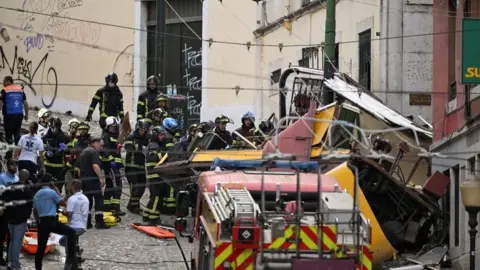
The boss of Lisbon's public transport operator Carris visited the scene of the accident late on Wednesday, with the company issuing a statement to the effect that major four-yearly and interim biennial maintenance had been carried out on the funicular as required, as well as daily, weekly and monthly checks.
But reports from eye-witnesses suggested that the braking system on the cable-hauled funicular failed, sending it hurtling down the steep street and into a building.
Several people had to be freed after being trapped in the wreckage, authorities said.
It is unclear how many people were on board at the time of the cable railway crash, which occurred near the Avenida da Liberdade.
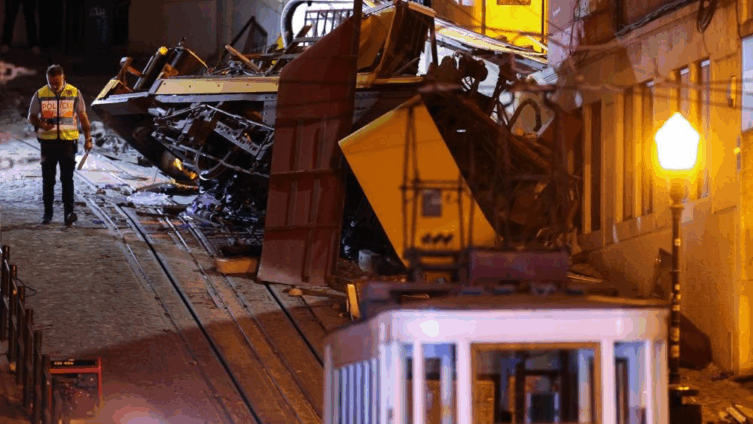
Footage shared widely on social media showed the bright yellow carriage overturned and almost entirely destroyed. People could be seen fleeing the area on foot as what appears to be smoke filled the air.
One witness told Portuguese newspaper Observador the vehicle was "out of control, without brakes".
"We all started running away because we thought [the carriage] was going to hit the one below," said Teresa d'Avó.
"But it fell around the bend and crashed into a building."
Another told Portuguese TV channel SIC that the funicular hit a building as it sped down the steep street "at full speed".
"It hit a building with brutal force and collapsed like a cardboard box; it had no brakes," the woman said.
The Lisbon authorities say it is too early to determine the cause of this incident.
However, Observador reported that a cable came loose along the railway's route, causing it to lose control and collide with a nearby building.
European Commission President Ursula von der Leyen sent her condolences to the families of the victims.
Spain's Prime Minister Pedro Sánchez said he was "appalled by the terrible accident".
A funicular is a type of railway system that allows travel up and down steep slopes.
The two cars on the Gloria funicular are powered by electric motors. They are attached to opposite ends of a haulage cable, meaning that as one travels downhill, its weight lifts the other, allowing them to ascend and descend simultaneously.
The Gloria funicular is one of the most famous sights and tourist attractions in Lisbon. It was opened in 1885 and electrified three decades later.
The iconic yellow vehicles are a crucial part of a city as hilly as Lisbon. They snake their way up many of the cobbled streets.
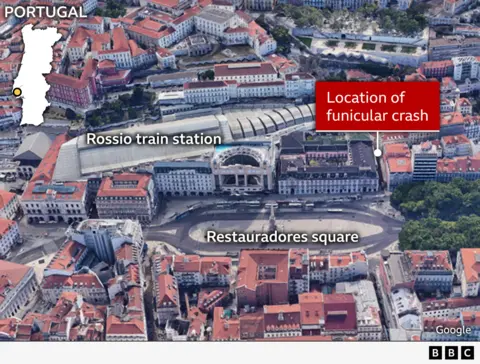
This particular one that crashed travels some 275m (900ft) from Restauradores, a square in the middle of Lisbon, up to the picturesque, cobbled streets of an area called Bairro Alto - or high neighbourhood - taking just three minutes to make the journey.
It, and the other funiculars, are used by Lisbon residents, but they are also extremely popular with tourists – and at the end of the summer, the Portuguese capital is very busy indeed.
Latest Stories
-
Government procures over 2,000 transformers as Ghana’s electricity access hits 89.13% – Energy Minister
1 minute -
UTAG-UG threatens strike on October 19 over unpaid allowance
9 minutes -
Let The Constitution direct Chieftaincy to deliver “All Development Is Local”
1 hour -
John Jinapor outlines renewable energy, nuclear power priorities for 2027
2 hours -
Ghana explores centre of excellence for hearing, communication and cochlear implant care
3 hours -
Schizophrenia-related disorders lead mental health cases recorded in Ghana
3 hours -
Dutch authorities enlist Ghana in hunt for fugitive drug lord Bolle Jos
3 hours -
Ghana housing finance conference adopts communiqué to improve affordable housing access
8 hours -
Special Initiatives Minister urges Wa Technical Institute to enrol more girls as EU-backed solar training lab opens
8 hours -
In the matter of my first year at the Bar
9 hours -
ActionAid Ghana calls for an end to child marriage, greater investment in girls’ rights
9 hours -
Newsfile to tackle World Cup visa scandal, beach demolitions, education strikes, BRICS bid
9 hours -
UK-Ghana Trade & Investment Summit: Trade Resource Centre to help businesses maximise UK-Ghana trade opportunities
9 hours -
Embassy of Denmark celebrates World Maritime Day
9 hours -
Linking LEAP to productive inclusion could cut extreme poverty by 2030 – UNICEF
11 hours