

Audio By Carbonatix
Pension plans provide a cushion to ensure that active workers in their old age have a minimum level of income to sustain their livelihoods and not be engulfed by poverty and become a burden on their families as well as the State.
According to the Ghana Statistical Service, more than 70% of employed persons are neither entitled to social security nor receive any pension on retirement, while 80.1 percent have no subsidized medical care at the workplace.
With approximately 80% of Ghana's labour force employed in the informal sector, a system that seeks to cushion, protect, and prevent all workers from suffering labour market and economic shocks is required.
It is becoming more evident that pensions can help older people and their families avoid the negative effects of shocks in developing countries, considering that traditional social protection systems across the world are gradually breaking down.
In this day and age, when many young adults postpone starting families, an increasing number of pensioners are still paying school fees for their kids, along with the associated cost of raising them.
The traditional social structure of family systems in Ghana is still heavily functional, as older folks with stable sources of income, be it pension or investment income, still provide financial support to struggling family members and even non-relatives.
This redistributive nature is in itself a source of informal social protection. Pensioners are in the most vulnerable stage of their life cycles, with related health challenges that are not adequately cushioned by the National Health Insurance Scheme (NHIS). Hence, Ghana's Domestic Debt Exchange Programme (DDEP) which seeks to restrict access to their lifelong investments, especially for the elderly, undermines social protection.
With the restructuring of pension schemes into three tiers, where tiers 1 and 2 are mandatory for formal sector workers, a number of Ghanaians embraced the third tier, which encourages individuals to sign up for voluntary contributions to augment their old age reserves.
The SSNIT informal sector fund and other private pension schemes have proven to be very relevant in providing a safety net for people as they can make partial withdrawals along their life cycle. For the elderly, lump sums from Tiers 2 and 3 must be invested safely to ensure a life annuity that protects them from the risks of old age.
Government bonds and treasury bills, which were supposed to be safe assets and investment instruments to hold, have become the very pit dug by Ghana's DDEP, threatening lifelong investments and social security guarantees aimed at preventing or alleviating poverty, vulnerability, and social exclusion, as stipulated in the International Labour Organization's social protection floors.
The volatile nature of the Ghanaian economy, particularly in recent years with the financial sector clean-up that has thrown many households into financial difficulty, the emergence of COVID-19, the Russian-Ukrainian war amidst economic mismanagement, identified overspending and corruption from audit reports, and the bloated size of government, appears to have only exacerbated things for Ghanaians across all life cycles and not just old-age social protection.
These events will have long-term consequences for pension schemes, insurance companies, and banks. The goal of getting informal sector workers to subscribe to pension schemes and even NHIS seems threatened.
Formalized financial sector arrangements should make it possible for people to access their funds when they need it most, but the current DDEP undermines that and it looks like a very bitter pill is forced down the throats of these pensioners.
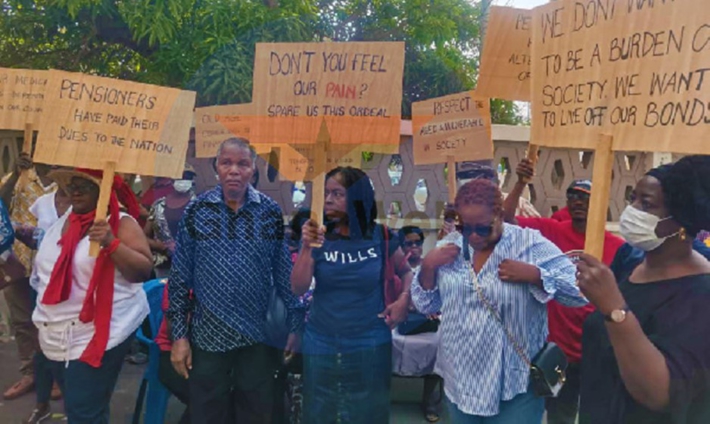
Over the last month, households have granted heartfelt interviews to the media about the impact of the government's decision on their children's education, buying medication for old age illnesses such as hypertension, diabetes, strokes, kidney diseases, and other chronic illnesses, or simply putting food on their tables. The most heartbreaking is seeing senior citizens picket at the Ministry of Finance for three consecutive days to reason with the government to no avail. This is a human right abuse.
Given that Ghana's life expectancy is 66.3 years, which is lower than the global average of 73.4 years according to the World Health Organization, the government's decision to push DDEP down the throats of private bond holders, especially pensioners, is like signing their death warrant.
The ILO, the UN, and labour unions must impress upon the government of Ghana to exclude individual bond holders, particularly senior citizens from the DDEP as a matter of urgency by finding a more suitable arrangement that is fair, equitable, and practical.
Judicious spending, cutting down the size of government and expenditure, and ensuring accountability and transparency in all dealings as efforts are being made to bring the situation under control, financial institutions and insurance companies must begin to take big steps to diversify their investment portfolios and limit the over-reliance on government long term instruments, which have proven to be equally risky in recent times.
Otherwise, we tend to lose all the gains made over the years in banking the unbanked population and the formalization of our economy. Also, households must consider equally diversifying their portfolio by investing in housing, agriculture, and other ventures that keep food on the table.
The writer is a Social Protection and Monitoring & Evaluation Specialist.
Latest Stories
-
Iran war lands ‘triple blow’ to flood-ravaged Sri Lankans
7 minutes -
Gunmen kill at least 11 people at Afghanistan picnic spot
20 minutes -
Woman, 25, in court for stealing baby at Bogoso
21 minutes -
Trump unveils giant gold-accented victory arch design for US capital
25 minutes -
We spoke to the man making viral Lego-style AI videos for Iran. Experts say it’s powerful propaganda
29 minutes -
Hungarians vote in big numbers on whether to end Orbán rule and elect rival
30 minutes -
At least 30 feared dead in crush at Haitian tourist site
30 minutes -
Boxing: Abdul Ahmed wins WBA Africa Cruiserwight title after dispatching Nigeria’s Eradeye
44 minutes -
Nearly 2,000 displaced, schools damaged as windstorm wreaks havoc in Gushegu
1 hour -
Ghana’s Derrick Kohn to work under Marie-Louise Eta as she becomes first woman to coach men’s Bundesliga team
1 hour -
Accra Open Championships conclude with strong performances ahead of African Championships
1 hour -
Ghana to begin camping with 12 athletes after Accra Open Championships – Bawa Fuseni
2 hours -
Anthony Joshua declines showdown with Tyson Fury but admits they ‘probably’ clash next
2 hours -
Tyson Fury dominates Makhmudov, calls out Joshua next
2 hours -
I have supported highway authority financially to fix roads in my constituency – A Plus
3 hours