

Audio By Carbonatix
Hong Kong businessman W. Wong still remembers the day in 1972 when he first heard neighbourhood kids rave about a figure who seemed larger than life: Bruce Lee.
Lee, a consummate martial artist whose films spawned a kung fu craze around the world, was one of the first Asian men to achieve Hollywood superstardom before his death at 32.
His influence can still be felt in Hong Kong, where he spent his childhood and final years, as fans this week hold exhibitions and martial arts workshops to mark the 50th anniversary of Lee’s death.
“Every child needs some kind of role model, and I chose Bruce Lee,” said Wong, 54, who has led the city’s largest fan club devoted to the star for nearly three decades.
“I had hoped my life would resemble the Bruce Lee I saw: handsome, strong, with great martial arts skills and a heroic image.”
At a studio for Wing Chun — a style of martial arts Lee practised before inventing his own Jeet Kune Do method — the martial arts master is revered as something akin to a patron saint.
Studio owner Cheng Chi-ping, 69, told AFP his cohort began their training under the shadow of Lee’s cultural influence but “we could never match his speed, strength or physique”.
Lee’s appeal had not diminished for the next generation, said Mic Leung, 45, who trained at the same studio and, as a teenager, sought out Lee’s movies on old videotapes.
“When we talk about the ‘god of martial arts’, we could only be talking about Bruce Lee. There is no one else,” he said.

Smashing barriers
Born in San Francisco in 1940, Lee was raised in Hong Kong and had an early brush with fame as a child actor, supported by his father, who was a famous Cantonese opera singer.
At 18, he continued his studies in the United States and over the next decade taught martial arts and scored minor parts in Hollywood, before landing the role of Kato in the television series “The Green Hornet”.
But it was not until Lee returned to Hong Kong that he landed his first lead role in the martial arts film “The Big Boss”, which made him a household name in Asia after its 1971 release.
The next year saw two more box office hits — “Fist of Fury” and “The Way of the Dragon” — cementing Lee’s persona as a relentless, lightning-fast fighter.
Lee had completed filming his fourth star vehicle, “Enter the Dragon”, and was halfway through his fifth when he died on July 20, 1973 from swelling of the brain, attributed to an adverse reaction to painkillers.
Film scholar Aaron Han Joon Magnan-Park, who taught Lee’s movies at the University of Hong Kong, said Lee expressed a kind of Chinese identity that transcended national borders.
“I would call Bruce Lee a paragon of Sinophone soft power success with Hong Kong characteristics,” he told AFP.
In Hollywood, Lee represented a rebuke to racist stereotypes, showing that Asian men were more than just servants and villains.
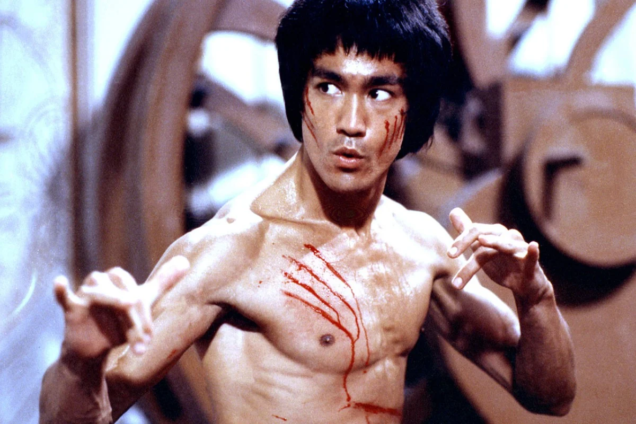
The scenes where he bares his torso and flexes his muscles — what Magnan-Park called the “kung fu striptease” — were essential because they show how ripped bodies can belong to Asian heroes as well.
“He made Asian men sexy, and that is something I don’t think we talk about enough,” he said.
Preserving legacy
Despite Lee’s enduring fame, preserving his legacy in Hong Kong was no easy task, fan club chairman Wong told AFP. Government support was intermittent at best, he said.
Fans in 2004 successfully petitioned to set up a bronze statue of Lee on Hong Kong’s famed waterfront, but a campaign to revitalise his former mansion could not save it from demolition in 2019.
At a government-run museum exhibit commemorating Lee’s life, a woman surnamed Yip told AFP she wanted to share “a symbol of the old Hong Kong” with her two children.
Wong, who had organised a smaller exhibit in Sham Shui Po district, acknowledged a decline of interest among young people but said Lee’s philosophy always has the potential to become relevant again.
He pointed to how protesters in Hong Kong’s 2019 democracy movement cited the martial artist’s mantra — “Be water, my friend” — as a reminder to adopt flexible tactics of resistance.
That discussion has largely tapered off after authorities cracked down on dissent, but Wong remembers the public at the time wondering why young protesters were so taken by Lee.
“As long as everyone still remembers (Lee), once your interest is piqued, you will have a chance to rediscover him,” he said.
Latest Stories
-
Mr President, Ghana was mentioned at the UN; why aren’t we talking about it?
3 hours -
Accra to convene Africa’s regulators and markets on tokenisation at AVAS 2026
3 hours -
The Paradox of Plenty — When every smartphone becomes a newsroom
3 hours -
GTA sensitises taxi drivers in ‘Know Ghana’ tourism campaign
4 hours -
Archbishop Agyinasare calls for responsible speech amid growing social media abuse
4 hours -
‘It will be inexcusable for gov’t not to honour payment of teachers’ arrears by 30th October’ – Haruna Iddrisu
5 hours -
Forbes’ World’s Best Employers 2026: No Ghanaian firm ranked among 900 companies
5 hours -
Electronic processing of teachers’ data: ‘The decision is the Controller’s’ – GES boss
5 hours -
Teachers’ Strike: Haruna Iddrisu questions paper-based processing of promoted teachers’ data
5 hours -
Savannah Region: Kunfusi bridge collapses again, leaving nearly 4,000 residents cut off
5 hours -
Teachers’ strike: GES targets Monday deadline to submit promotion data to Controller
5 hours -
Inflation to average 11.3% in 2027 – Fitch Solutions
6 hours -
‘I didn’t campaign for NDC to come and do this nonsense’ – Kpebu on EOCO’s conduct
6 hours -
Fitch Solutions maintains policy rate forecast of 14% by December 2026
6 hours -
Diaspora Nasara Caucus congratulates Mohammed Ali Suraj, new NPP executives
7 hours