

Audio By Carbonatix
Governments have had to hurriedly formulate laws and take measures to address some of the unprecedented challenges caused by the COVID-19 pandemic. This write-up is meant to raise the issue of the fate of ordinarily resident Ghanaians who have become stranded aborad by Ghana’s border closure.
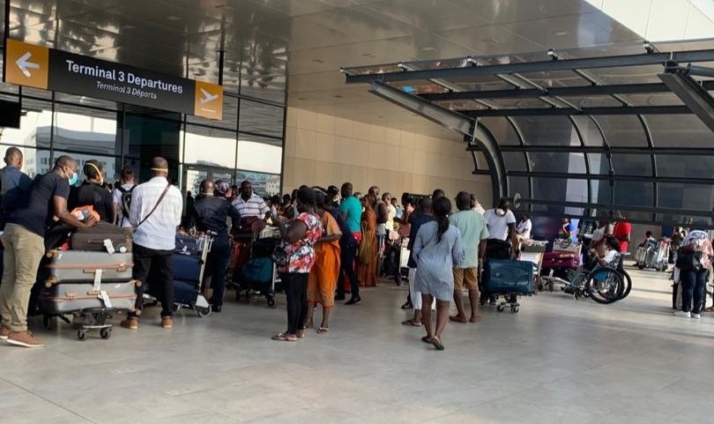
Ghanaian citizens (ordinarily resident in Ghana for all purposes including tax) who were temporarily visiting other nations, were left stranded and without options once Ghana abruptly and without any prior warning closed Kotoka International Airport (KIA) to commercial flights. This measure together with a partial lockdown of two cities and the closure of Ghana’s sea and land borders was widely praised and acknowledged as a necessary measure to help authoritiescontain the COVID-19 pandemic. However, just like the partial lockdown, the blanket border closures are not sustainable, going forward.
From the standpoint of the citizens temporarily visiting other countries with non-immigrant visas at the beginning of March, things escalated very quickly and got out of hand. Most countries including Ghana initially introduced restrictions on persons arriving from highly endemic countries (those with more than 200 cases at the time). However, things quickly degenerated and led to an outright closure of Ghana’s borders. For those traveling by air, it became impossible or difficult to change flights before the closure because European airlines were focused on returning Europeans to their hubs/home countries and due to a spike in flight cancellations/changes.
Opening KIA to International Commercial/CharteredFlights
The key question is whether we can allow commercial or chartered evacuation flights into KIA and still keep a lid on imported cases of COVID-19? The answer is an emphatic yesas demonstrated by countries with airports still open for international commercial or chartered evacuation flights. The measures they have adopted include:▪ Mandatory testing of passengers prior to boarding the aircraft,▪ Insistence that crew and airline staff wear the appropriate Personal Protective Equipment (PPE),▪ Airlines ensure that physical/social distancing is observed throughout the pre-departure process and on onboard the flight,▪ Mandatory testing upon arrival,▪ Mandatory quarantine, and▪ Ensure that airport personnel don the requisite PPEs.
If we can trust our frontline health workers (the heroes/heroines of our time) to take the necessary precautions and measures at health facilities, then surely personnel associated with the aviation industry (which faces an existential threat now) can be trusted to ensure strict adherence to the above. The above measures may be adopted by Ghana to suit our circumstances.
Air travel risk
There is generally an erroneous assumption that merely because the initial cases were all imported, opening KIA to international commercial flights will lead necessarily to the importation of additional cases. That cannot be any further from the truth. The mandatory quarantine instituted, ensured that the passengers on the final few flights before KIA’sclosure ensured that there were no further infections. The imported cases that led to further infections were clearly those who did not undergo mandatory quarantine.
It is clear therefore that mandatory quarantine (in addition to all the measures suggested above) will prevent additional infection of citizens within Ghana by returning stranded citizens. We can consider replicating these measures at our other border posts at Aflao, Paga and Elubo, subject to our ability to manage and control the process effectively. In the absence of a controlled process, desperate citizens may be compelled to exploit our porous borders and enter undetected.
Plight of Stranded Citizens
Interestingly, the plight of stranded citizens and their right to return to their country of abode is yet to be raised as an issue by the Ghanaian media but has been highlighted by the Washington Post. The issues non-immigrant Ghanaian citizens stuck abroad must contend with include:
▪ Risk of breaching laws of other countries by overstaying their temporary visas in their host countries or have to go through a tedious process to extend their stay.
▪ Accommodation challenges for those who made temporary accommodation arrangements.
▪ Those on medication have run out of their stock because they did not expect to be away from home this long and it is impossible to get some of the medications over the counter.
▪ Risk of job loss in Ghana because they did not plan to work from abroad (they have exhausted their leave period).
▪ Exhausted their budget for living expenses.
▪ Being away from family and loved ones.
International law and returning citizens
The right of return (which guarantees a person’s right of voluntary return to or to re-enter their country of origin or of citizenship) is a hallowed principle of international law enshrined in many legally binding international instruments including the 1948 Universal Declaration of Human Rights and the 1966 International Covenant on Civil and Political Rights. The right of return is binding even on non-signatories to these conventions. Even the unprecedented nature of COVID-19 should not lead countries like Ghana, to derogate from this preemptory customary international principle.
Most countries that closed their borders or imposed restrictions on travellers made exceptions for returning citizens, with those from countries severely impacted by COVID-19 being required to undergo mandatory quarantine (in some cases at the cost of those affected). These include Botswana, Ethiopia, Nigeria, Rwanda, Seychelles etc. Citizens have the right to return to their country of abode.
We urge Ghana’s Government to follow the path of those countries that are abiding by the right of return principle in addition to its other commendable efforts.
Policy Response
While appreciating why the President will focus his laudable efforts on citizens within Ghana’s territory, the affected Ghanaians are no less citizens. As a nation with financialconstraints, we appreciate that there is a limit to what the state can do. The affected citizens have indicated that they are willing to contribute or bear the full or part of the cost of flight arrangements, mandatory testing and quarantine. Those who cannot immediately afford the cost may be made to sign a promissory note (like some countries did) or receive a subsidy. Kenya organized repatriation of its citizens from New York. South Africa and Nigeria have planned evacuations for early May 2020. According to the Washington Post, many African “[c]onsulates across the United States have been making lists of the stranded and setting up WhatsApp support groups”. Senegal has sent out US$500 cheques to citizens for accommodation and medical expenses. Thus far, there hasbeen no measure or response from Ghana’s missions abroad. This issue has not been acknowledged in any policy statement or speech including the President’s COVID-19 updates.
Conclusion
A cynical person has pointed out that Ghana’s policy towards citizens offshore is: “you’re on your own!”. We doubt that this is the case. However, Ghana’s silence and seeming inaction in this time of crisis may lead many to that inevitable conclusion soon. The least the nation can do for the affected stranded citizens is to at least open KIA to commercial or chartered evacuation flights, subject to the necessary controls and measures (even if it is at the full or partial cost of returning stranded citizens).
Other options include using EthiopianAirways, which is still operating and is what the Nigerian’s have chartered to evacuate their stranded citizens, to evacuate Ghanaians. Many of the affected Ghanaians are willing to bear the full cost of such interventions.
Latest Stories
-
Henderson scores twice as Chelsea thumb Bournemouth
5 minutes -
Photos: Mentapulse Africa convenes health and labour summit to address talent retention
17 minutes -
Mahama inspects Nkokɔ Nketenkete plant, eyes Bechem as chicken capital
23 minutes -
Ghana not seeking full BRICS membership, applying as Partner Country – Ablakwa
24 minutes -
Woman injures three people in third Poland school knife attack in a week
26 minutes -
Ghana should join BRICS as partner, not member – NPP Bono East Regional Secretary
27 minutes -
Ghana High Commission warns nationals in South Africa over protests in Johannesburg, Durban
27 minutes -
Mahama praises Roads Minister for keeping Big Push contractors on their toes
33 minutes -
World Cup Visa Scandal: ‘My client has not collected money for visas’ – Ampofo Ankrah’s lawyer
44 minutes -
US immigration officials defend ICE agents who shot man in same car as child
54 minutes -
Commentator Katie Zacharia picked as new White House press secretary
57 minutes -
Drone strike by Sudan paramilitary kills 41 near Ethiopian border, rights group says
1 hour -
King warns malicious online actors are evolving tactics
1 hour -
Several injured as Saudi capital airport reportedly hit again
1 hour -
Christa Pike discharged from hospital and returned to prison, her lawyers say
1 hour