

Audio By Carbonatix
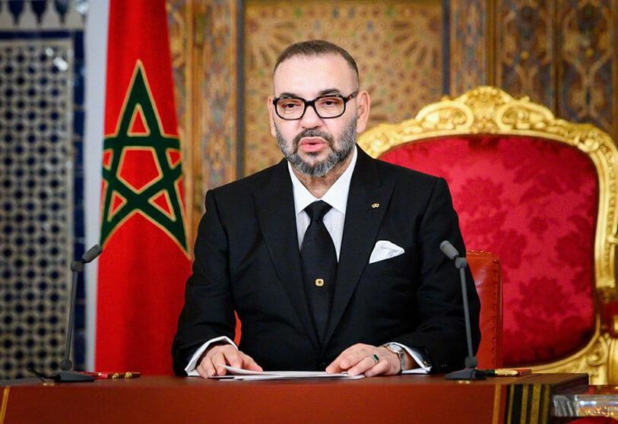
The King of Morocco, Mohammed VI, has stated that the outbreak of the Covid-19 pandemic has shown that migrants do not have a harmful effect on the economy in terms of mobility.
He said, “on the contrary, they have a positive impact in their host country - where they are often "essential workers" - as well as in their country of origin. We should, therefore, take the question of migration for what it is: it is not so much a challenge as a host of opportunities.”
In a statement read on his behalf at the 6th European Union-African Union Summit, held in Brussels by the Minister of Foreign Affairs, African Cooperation and Moroccans Abroad, Nasser Bourita, the Moroccan King further explained that “I firmly believe this to be true, especially since as the African Union's Leader on the issue of migration, I have always sought to dispel misunderstandings.”
He said this was, by the way, the purpose of the African Migration Observatory, whose creation he personally encouraged.
The Observatory’s mission is to provide objective data; to re-establish the truth; to reconcile the interests of Africa and those of Europe when they appear to be contradictory; and to replace the security-first approach with the mobility-development continuum, in keeping with the humanist spirit of the Marrakech Compact.
According to the King, it was only natural that, in keeping with the history and the requirements of a shared destiny, Morocco should simultaneously address Africa, a continent to which it belongs, and Europe, its neighbour and closest partner.
King Mohammed VI stated that education, culture, vocational training, mobility and migration are the priorities of his action, whether it is in Morocco, in Africa or in the framework of their partnership with the European Union.
“The principal reason for this is because these themes essentially concern youth, which is our human capital. It is on them that the Partnership between the two continents should capitalize in order to achieve its full potential. Another reason is that these major sectors have been hard hit by the pandemic, which requires us to take joint action, on a large scale,” he noted.
He called on members of the EU and AU to keep in mind that, “at the height of the pandemic, 94% of the student population in the world suffered school closures. We, therefore, need to ensure the continuity of education, taking into account the new context of digital transformation in this domain. Although global, this requirement is particularly crucial in Africa, a continent where 50% of the population is under 20.
“Moreover, our schools, universities, and vocational training institutions need, just like our respective economies, a robust recovery to make up for the 1.8 trillion hours of lost schooling.
“Furthermore, the pandemic has not spared culture either, be it in economic terms, or from the standpoint of access. In this regard, the shock has been considerable. It is, therefore, necessary today to re-establish cultural cooperation mechanisms in order to reinvigorate the sector, which is a real lever for bringing people together in Africa, in Europe and also between the two continents.”
King Mohammed VI further explained that guaranteeing education, accelerating the training and employability of the youth, promoting culture, putting migration and mobility in order are the challenges of the Partnership between the African Union and the European Union.
The King said “these future-oriented objectives should inspire and inform our approach to the AU-EU Partnership. Neither Africa nor Europe can achieve them on their own. We have a common responsibility, and our interest in this is no less significant.”
He said “Let us hope our discussions today will be a step in that direction. For the real accomplishment of the partnership between the African Union and the European Union is not to bring together 81 countries, but rather to make them pledge resolutely to promote peace, stability and shared prosperity; in other words, to make them commit to the future of all citizens - African as well as European.”
Latest Stories
-
Caveman Watches partners with Mfantsipim School for 150th anniversary
14 minutes -
We’ll pursue GH¢15m defamation suit against Sammy Gyamfi to its logical conclusion – Afenyo-Markin’s lawyers
15 minutes -
Martin Kpebu urges Afenyo-Markin not to return to court over Sammy Gyamfi lawsuit
24 minutes -
GRA submits preliminary report on drug shipment case to Mahama – Commissioner-General
51 minutes -
Sammy Gyamfi using ‘procedural roadblocks’ to dodge defamation case? – Afenyo-Markin’s lawyers
53 minutes -
The illusion of a good deal: Why some everyday money-saving habits may be costing you more
1 hour -
Family seeks autopsy, police investigation into death of student 12 days after Abomosu SHS enrolment
1 hour -
Trade Minister urges employers to leverage industrial opportunities to create jobs
1 hour -
Asantehene plants trees to commence Jimi Watercourse Rehabilitation destroyed by galamsey
2 hours -
15 arrested, 6 trucks impounded over sandwinning activities on Kumasi-Accra Expressway
2 hours -
OFFICIAL: Vinicius will miss El Clásico, suspended four games
2 hours -
Prayer vigil held after four arson attack murders
2 hours -
GRA fully recovers $154k legacy debt owed by foreign entities between 2022 and 2024
2 hours -
Kwesi Pratt Jr warns bus preachers are adding to passengers’ stress with accident prophecies
2 hours -
MTN Ghana to spend $1.1bn in 3 years, build 500 new sites as MoMo hits 44% Growth
2 hours