

Audio By Carbonatix
The Minority in Parliament has called on the government to immediately halt all prosecutions under Sections 207 and 208 of the Criminal Offences Act, including the reported second prosecution of jailed TikToker Camilla Alhassan.
An Accra Circuit Court sentenced the 43‑year‑old TikToker to one year's imprisonment with hard labour for offensive conduct. The court said the sentence was intended to serve as a deterrent to others.
Alhassan, charged with offensive conduct conducive to breaches of the peace, pleaded guilty. The prosecution told the court that the Ghana Police Service intercepted a video circulated on TikTok in which Alhassan made offensive and derogatory statements against President John Mahama.
In the video, she was heard making derogatory remarks, saying: “President Mahama is an old fool who should be killed together with his wife, Lordina Mahama, and that the President had sexual relations with Misbel.”
The prosecution said the statements were likely to provoke a breach of the peace. The Ghana Police Service has indicated that the convict will be put before the High Court on the separate charge of false communication under the Electronic Communications Act, 2008 (Act 775).
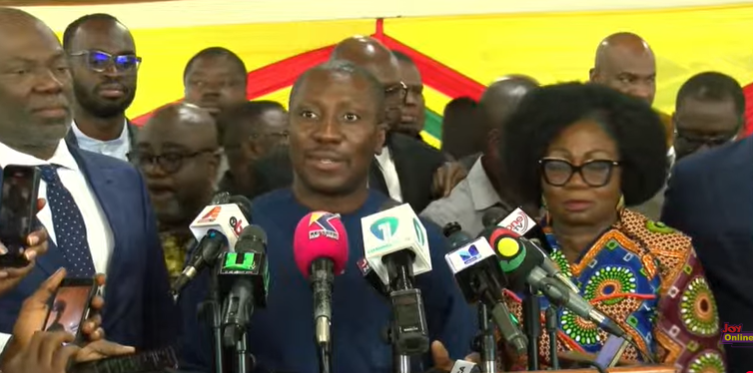
Addressing a press conference in Parliament on Friday, 17 July, Minority Leader Alexander Afenyo-Markin argued that the continued application of the provisions undermines Ghana's democratic credentials and constitutional commitment to freedom of expression.
He urged the government to withdraw all pending prosecutions initiated under the two sections.
"We demand the immediate withdrawal of all pending prosecutions under Sections 207 and 208 of the Criminal and Other Offences Act, including the second prosecution threatened against Camilla Alhassan," Mr Afenyo-Markin said.
The Minority also called for the release of individuals currently serving prison sentences under the provisions, citing the case of Kwame Nkrumah II, who, according to Mr Afenyo-Markin, was imprisoned over a TikTok video.
"We demand the discharge of any person currently serving a sentence, including Kwame Nkrumah II. There's a gentleman, Kwame Nkrumah II, who was jailed about six months ago over a TikTok video," he stated.
Mr Afenyo-Markin further urged Parliament to expedite legislation to repeal Sections 207 and 208, noting that the Minority has already laid a bill before the House seeking to remove the provisions.
"We demand the passage, without delay, of legislation repealing both sections. The Mighty Minority is proposing legislation along the lines of the bill already before the House," he said.
The Minority Leader also called on the government to publicly guarantee that no Ghanaian would face criminal prosecution solely for expressing views that are critical of those in authority.
"We want a public commitment from government that no citizen will face criminal charges for speech that is merely critical, embarrassing or unwelcome to those in power," he said.
According to Mr Afenyo-Markin, Ghana made a significant democratic advance by repealing the criminal libel law in 2001 and should now complete that reform by removing what he described as the remaining legal provisions that could be used to criminalise free speech.
"Ghana chose in 2001 to be the country that led Africa away from criminal insult laws. We are asking this Parliament in 2026 to choose to finish that journey," he stated.
He also appealed directly to President John Dramani Mahama to ensure that law enforcement agencies immediately cease initiating prosecutions under the contested provisions.
"We are asking His Excellency President John Dramani Mahama to ensure that no prosecution is undertaken by the police forthwith," he said.
Who do the laws say?
Sections 207 and 208 of the Criminal Offences Act, 1960 (Act 29) are considered to be archaic public order laws in Ghana, often utilised by authorities to prosecute cases related to free speech and misinformation:
Section 207 (Offensive Conduct): This law criminalises the use of any threatening, abusive, or insulting words, or behaviour. It applies if the action is done intentionally with the intent to provoke a breach of the peace or where a breach of the peace is likely to be caused.
Section 208 (Publication of False News): This law makes it an offence to publish or reproduce any statement, rumour, or report that is likely to cause fear and alarm to the public or disturb the public peace. To be convicted, the person must know, or have reason to believe, that the information is false when publishing it.
Both offences are classified as misdemeanours in Ghana. Because specific punishments are not typically laid out alongside these definitions, offenders can face up to three years of imprisonment, a fine, or both under the broader Criminal Procedure Code.
Latest Stories
-
Power restoration fault suspected in Kumasi Central Market fire
4 hours -
The 7-foot giant of Ngleshie Amanfro: Seven-foot Ghanaian Ephraim Saawa dreams of joining the national basketball team
5 hours -
Government promises support for Kumasi Central Market fire victims
5 hours -
Vibes The Movie: Big Ghun’s Ghanaian film earns five nominations at 2026 REFFA
5 hours -
MamaCare CEO warns unresolved conflicts among health workers could undermine maternal and neonatal care
6 hours -
Health professionals urged to translate medical knowledge into practice to save mothers
6 hours -
Conflicts among care providers linked to maternal, neonatal deaths – Expert
7 hours -
GIS marks 10th TIME conference, champions improved teaching practices
7 hours -
BRICS Or Balance? What Ghana’s bid really means
8 hours -
GPRTU wants full TRAFFITECH-GH implementation to start in 2027
8 hours -
How 10-mile walks for basic education birthed a 50-year legal career for Justice Korbieh
8 hours -
Mahama announces plans to import electric wheelchairs for PWDs
8 hours -
KGL U17 Colts 2026: Western beat Prempeh Elite Academy to set up final final with Greater Accra Region
9 hours -
Late Solanke strike salvages 10-man Spurs draw at Man United
9 hours -
Gender Ministry to monitor welfare of Nana Akua Addo’s children amid domestic violence case
9 hours