

Audio By Carbonatix
South Korea's space agency has released images that show the Moon after part of a SpaceX rocket crashed into its surface on Wednesday.
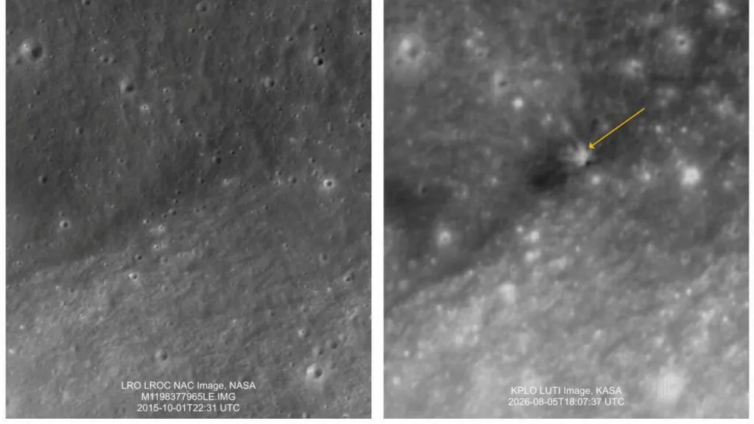
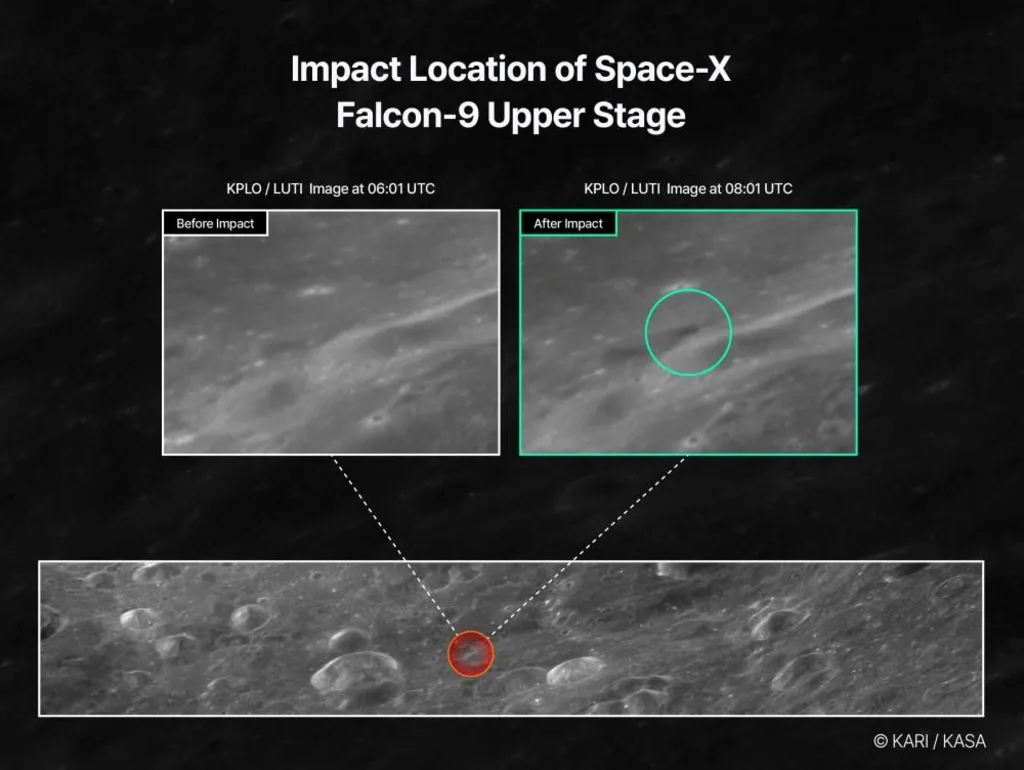
The Korean AeroSpace Administration (KASA) said lunar orbiter Danubri captured images after the impact, which it shared alongside photos of what the Moon's surface looked like before the crash.
Rocket debris struck the Moon at around 06:35 GMT on Wednesday, according to the South Korean space agency.
SpaceX has said the impact was not intentional.
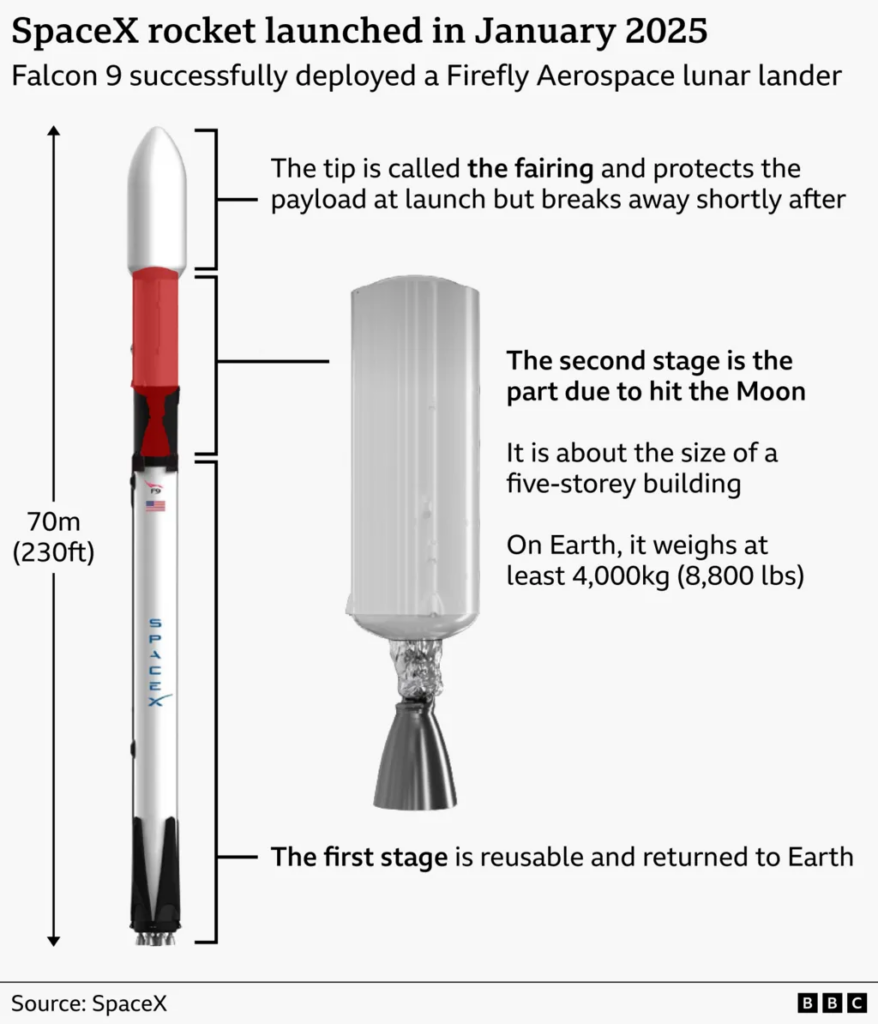
Re-usable Falcon 9 rockets were designed to allow part of the rocket to return to Earth (the upper stage) and other sections to be shed in space. SpaceX has used this type of rocket on several missions.
The empty upper stage of this Falcon 9 rocket, which scientists predicted would hit the Moon at a speed of about 5,400mph (8,700km/h), is about the size of a five-storey building and weighs approximately 4,000kg (630st) on Earth.
The short, dramatic flash created when the rocket part hit the Moon would have been hard to catch by amateur astronomers even with high-end telescopes, but larger observatories - including Seoul's space agency - are analysing the information.
While the impact did not pose any danger to Earth, Matt Bothwell, astronomer at the University of Cambridge, raised concerns about space debris.
"Space is getting more and more crowded," he said, as each year "we launch more stuff into space".
"It could feasibly be within a few decades that it's actually quite hard to get past Earth's orbit because space is so crowded," Bothwell warned.
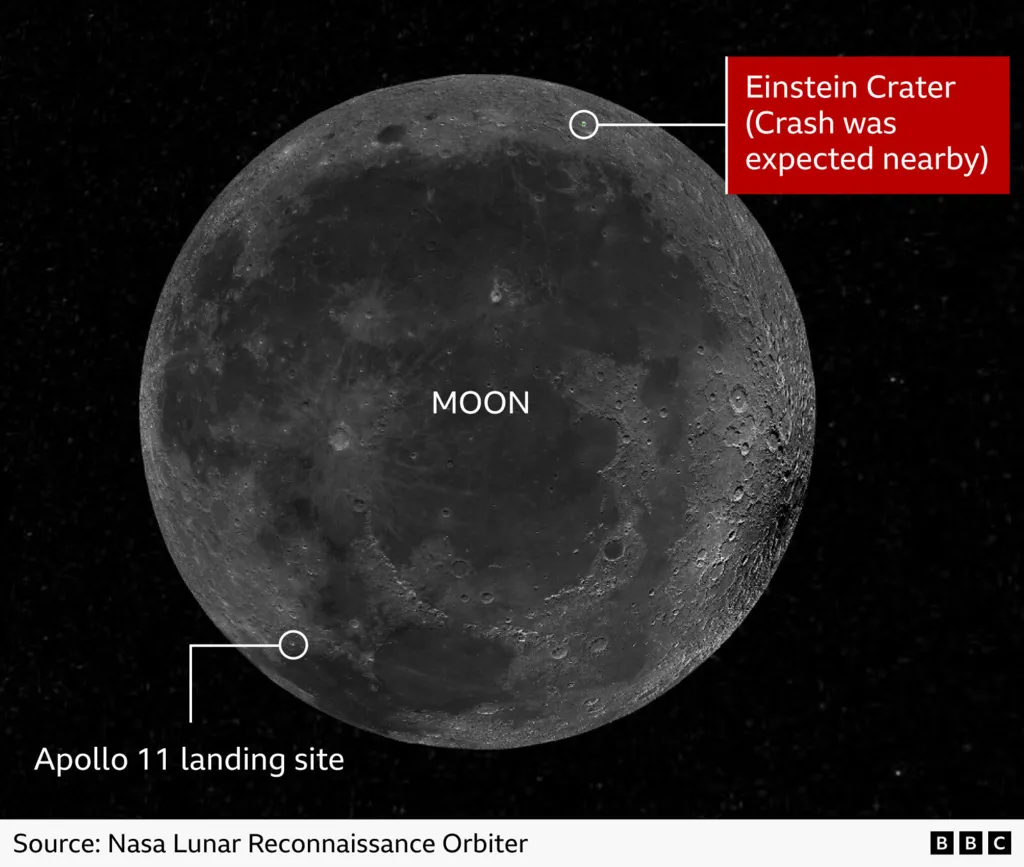
This Falcon 9 was in orbit since January last year, when it blasted off from Florida.
The same booster section from the January 2025 mission is due to set off on its 18th flight on 10 August. SpaceX says the mission hopes to launch 29 Starlink satellites to low-Earth orbit.
The rocket that blasted from Florida last January was carrying two lunar landers into space.
Its job was to fire the upper stage hard enough to send both of the landers out of Earth's orbit and onto a path towards the Moon.
The spent stage was left drifting in a long, looping orbit that swung out towards the Moon and back again.
Over the next 18 months, the gentle gravitational tug of the Earth, Moon and Sun, along with light from the Sun, gave it a faint push.
Astronomers tracking the rocket part eventually worked out that those small nudges had put it on a course towards the Moon, and it was picking up speed every day.
The impact on Wednesday happened in broad daylight for many parts of the world, but the tiny flash it produced would have been far too faint to see, even through a telescope.
Latest Stories
-
Police arrest suspect over jewellery theft during fire outbreak
1 hour -
EOCO returns Hanan’s £6,700, GH¢2,750 and devices after defence challenge
1 hour -
Opplift Youth Entrepreneurs Summit 2026 equips entrepreneurs with skills, mentorship and support
2 hours -
Rival clubs want range of punishments for Man City
2 hours -
Tear gas in Paris and Marseille as school protests grow across France
2 hours -
Kane inspires England to win over Czech Republic in UEFA Nations League
2 hours -
Finland orders halt to work on two Google data centres
2 hours -
Substitute Merino scores twice as Spain win in Croatia
2 hours -
Ronaldo wants Portugal ‘punishment’ but not retiring
3 hours -
White House defends Trump comment to let Iran ‘take out’ LA and San Diego
3 hours -
Asos confirms hackers sent ‘unauthorised’ notification to app users
3 hours -
US televangelist Jim Bakker, disgraced from sex scandal and fraud, dies at 86
3 hours -
Congolese-born golfer to represent Ghana at Turkish Airlines World Cup grand final
3 hours -
Amazon wins global rights to stream Emmys in six-year deal
3 hours -
European Film Festival returns to Ghana after a 5-year break
3 hours