

Audio By Carbonatix
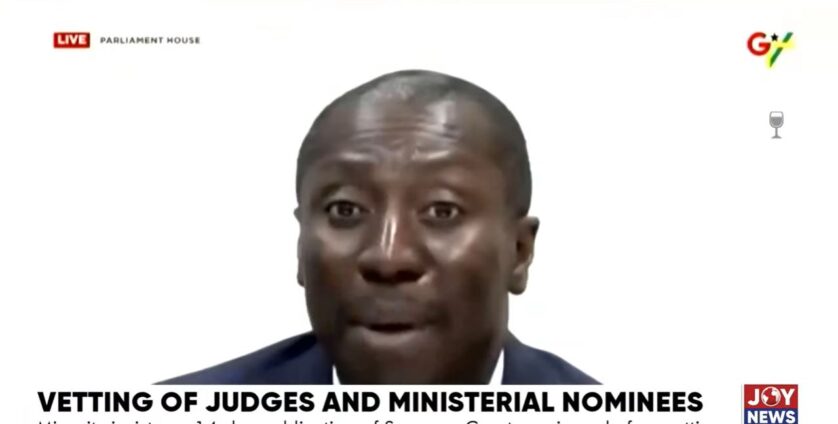
The Minority in Parliament has formally objected to the three-day timetable proposed for the vetting of three nominees for appointment to the Supreme Court.
The objection was raised before the Appointments Committee as Parliament moves to consider President John Dramani Mahama’s nominations. The nominees are Justice Sophia Bernasko-Essah, Justice Amoako Asante and former GBA President Tony Forson.
The Minority Leader, Alexander Afenyo-Markin, said its position should not be interpreted as opposition to either the nominees or the President’s constitutional authority to nominate persons for appointment to the Supreme Court.
Instead, it argued that "the compressed timetable does not allow the committee sufficient time to conduct the level of scrutiny traditionally associated with appointments to the apex court."
Presenting the objection, the Minority Leader said the process could not be “lawfully and safely” completed within the three days remaining in the current sitting of Parliament.
He asked the committee to resolve the objection before proceeding with the vetting and to have the concerns captured in the official record of proceedings.
The Minority advanced nine grounds in support of its objection, with the first being that there is currently "no vacancy on the Supreme Court".
According to the Minority, the apex court presently has its full complement of justices, meaning the three nominees are being considered as additional appointments rather than replacements for justices who have died, retired or been removed.
It therefore questioned the basis for treating the process as an urgent matter requiring a compressed timetable.
“Urgency requires an urgent state of affairs,” the Minority argued, insisting that the Majority should identify what harm would befall the state, the judiciary or litigants if the nominees were subjected to the ordinary vetting process.
The Minority also challenged what it described as the misapplication of Order 217(11) of Parliament’s Standing Orders.
It maintained that, since the adoption of the 1992 Constitution, Supreme Court nominees have traditionally been given adequate notice, including the publication of their nominations in the daily newspapers to allow the public to submit memoranda.
The Minority questioned how nominees announced by the Speaker on Monday could be subjected to vetting from Tuesday through Thursday without the customary period for public scrutiny and preparation by committee members.
The Minority stressed that it was not seeking to frustrate the appointments.
“What we are saying is that your party in opposition,” the Minority said, referring to the governing National Democratic Congress, “and I refer to the verbatim report of 2024 July.”
It subsequently cited comments made by then-MP for Bawku Central, Mahama Ayariga, during a July 30, 2024 Appointments Committee sitting when the NDC was in opposition.
According to the Minority, Ayariga had argued against rushing the vetting of judicial nominees, insisting that the committee needed adequate time to study their backgrounds, judgments, writings and publications.
The Minority said that position demonstrated the importance of applying consistent standards to judicial appointments regardless of which party was in government.
It also referenced comments by then Deputy Minority Leader Alexander Afenyo-Markin during the 2024 proceedings as part of its argument against what it considers an unnecessarily accelerated process.
The Minority is therefore urging the Appointments Committee to reconsider the timetable and allow sufficient time for the nominees’ records to be examined before the vetting proceeds.
Latest Stories
-
Vetting of Supreme Court nominees proceeds despite Minority walkout
6 minutes -
Two teenagers, 13 and 14, among 33 UK nationals missing in Nepal floods
6 minutes -
Don’t let a data mismatch deny young Ghanaians the chance to serve
10 minutes -
‘Flimsy, hollow, baseless’ – Ahiafor dismisses Minority’s objection to judges’ vetting
10 minutes -
Paul Afoko is best placed to unite a divided NPP – Broadcast Journalist, Abdul Moomen
20 minutes -
Paul Afoko: Perhaps the unifier the NPP needs now
25 minutes -
Minority walks out of vetting for 3 Supreme Court justice nominees
29 minutes -
Japanese polka dot artist Yayoi Kusama dies aged 97
32 minutes -
2026-27 Premier League: iLOTBET invites bettors and gamers to register on platform and earn up to GH₵10K
36 minutes -
Minority rejects 3-day timetable for Supreme Court nominees’ vetting
38 minutes -
Man who attacked nun on CCTV in Jerusalem acquitted on grounds of mental health
39 minutes -
Thieves steal Bronze Age artifacts from Spanish museum in four-minute heist
40 minutes -
Photos: Mahama cuts sod for new multi-storey Airport car park, other facilities
42 minutes -
Effective coordination key to fighting galamsey – Zanetor
46 minutes -
Tanzania ruling party expels Vice President after historic resignation
57 minutes