

Audio By Carbonatix
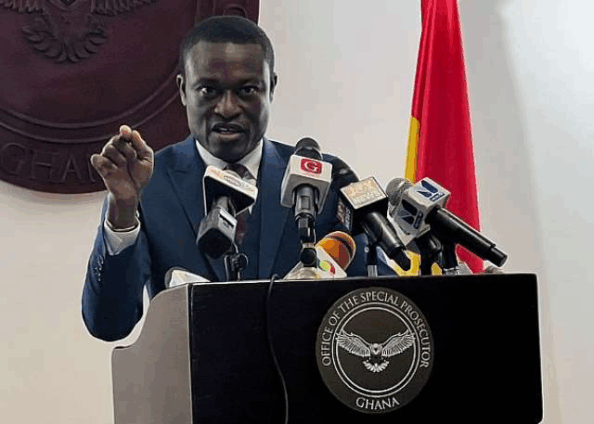
Special Prosecutor Kissi Agyebeng says the Supreme Court’s July 29 decision affirming the constitutionality of the Office of the Special Prosecutor’s prosecutorial powers has settled a major legal battle over the mandate and future of the anti-corruption institution.
Addressing a press conference on Tuesday, August 26, Mr Agyebeng said the Supreme Court, in a unanimous 7-0 decision, upheld the constitutional basis of the OSP’s prosecutorial mandate under the Office of the Special Prosecutor Act, 2017 (Act 959), as well as its governing legislative instruments.
The decision in Noah Ephraem Tetteh Adamtey v Attorney General, he said, expressly overturned decisions by other courts that had questioned the OSP’s powers.
“In this landmark decision, the Supreme Court, by a well-reasoned and emphatic 7-0 verdict, upheld the constitutionality of the prosecutorial function of the OSP and its legal foundation and setup under Act 959, LI 2373, and LI 2374, and the Supreme Court expressly overturned the decision of every other court to the contrary,” he said.
Mr Agyebeng recounted that on April 15, 2026, an Accra High Court struck down parts of Act 959 as unconstitutional, ruling that the OSP lacked an independent prosecutorial mandate.
According to him, the High Court decision invalidated prosecutions conducted by the OSP and nullified convictions and assets secured by the Office.
The court further directed that OSP cases be handed over to the Attorney General.
Mr Agyebeng said the ruling came despite a pending case before the Supreme Court that was directly addressing the constitutionality of the OSP’s prosecutorial powers.
He said the development brought the investigative and prosecutorial work of the OSP across the country to a standstill.
“Other courts, except one, adjourned all proceedings awaiting the Supreme Court's decision. Therefore, prosecutions stalled, investigations were gravely hampered, and corrupt actors became emboldened in their outrageous conduct,” he said.
“The cost to this nation is staggering.”
He said the Supreme Court’s eventual ruling removed the uncertainty surrounding the OSP and reaffirmed its legal authority to investigate and prosecute corruption and corruption-related offences.
Mr Agyebeng used the press conference to highlight what he described as the Office’s performance record.
As of December 31, 2025, he said, the OSP was prosecuting 33 persons, had 79 cases at the full investigation stage and 161 others at the preliminary investigation level.
The Office had also secured seven convictions through court-sanctioned plea bargains.
“The performance ledger transcends convictions and cases under investigation,” he said, arguing that the OSP’s mandate extended beyond investigations and prosecutions to asset recovery and corruption prevention.
According to him, the OSP had secured financial recoveries of GH¢8.5 million and $2 million by December 2025, in addition to substantial movable and immovable assets involved in ongoing proceedings.
Mr Agyebeng said the Office had also prevented significant financial losses through its corruption risk assessments, particularly in relation to Ghana’s natural resources and strategic national assets.
He credited the OSP with safeguarding the Tema Oil Refinery from being “pawned off”, saying the facility was now operating after years of inactivity.
He also cited the OSP’s intervention in the Customs sector, which he said had contributed to reforms in the auction of seized items and a reduction in the abuse of the Customs advance ruling regime.
The Special Prosecutor further said reforms arising from the Office’s scrutiny of the government payroll system had saved the country more than GH¢100 million.
“The OSP has saved the nation more than 20-fold the total amount of money released to it since its establishment and it has thereby fully paid for, and far above, the resources invested in it,” he said.
Mr Agyebeng maintained that the impact of the OSP should not be measured by public applause or political sentiment.
“Criticism is legitimate. Scrutiny is necessary. However, they must be based on facts,” he said.
He argued that the Office’s performance should instead be assessed based on investigations conducted, persons prosecuted, assets recovered, losses prevented, systems corrected and public funds saved.
“So when it is said that the OSP has not performed, the answer is straightforward. Check the statistics and benchmark them against your preferred alternative,” he said.
The Supreme Court’s decision, he added, had now provided a definitive answer to questions about whether the OSP has the constitutional authority to prosecute cases independently.
Latest Stories
-
French Embassy to partner Kobby Kyei Media for bloggers’ training
2 minutes -
Nestlé and NBA announce multi-year international marketing partnership
15 minutes -
Mahama sends condolences to Nigeria over plane crash that killed 25
16 minutes -
Our lifestyles may be killing us but our spatial planning is too
26 minutes -
12 arrested as police seize firearms, suspected drugs in Tamale
27 minutes -
Chamber of Mines challenges Reuters report on proposed mining law
35 minutes -
LA 2028: Black Queens take first leg advantage with 3-0 win over Mauritius
38 minutes -
UG academic calendar could collapse if GAUA strike extends into next week – Awandare
40 minutes -
Black Sherif partners with Telecel Ghana to promote Telecel Cash
43 minutes -
Nestlé Ghana expands Tema factory, raises evaporated milk production capacity
45 minutes -
Telecel Ghana launches CARE Month with customer rewards and community outreach
49 minutes -
Venezuela’s ex-leader Nicolás Maduro charged with conspiracy to commit torture
52 minutes -
Nestlé Ghana expansion shows Ghana’s 24-hour economy in action – Mahama
60 minutes -
Ghana to lead ECOWAS adoption of Accra Convention on cargo documents – Trade Minister
1 hour -
100-bed Atiwa Trauma Hospital to be commissioned in January 2027
1 hour