


Audio By Carbonatix
Banning phones in schools is not linked to pupils getting higher grades or having better mental well-being, the first study of its kind suggests.
Students' sleep, classroom behaviour, exercise or how long they spend on their phones overall also seems to be no different for schools with phone bans and those without, the academics found.
However, they did find that spending longer on smartphones and social media in general was linked with worse results for all of those measures.
The first study in the world to look at school phone rules alongside measures of pupil health and education feeds into a fierce debate that has played out in homes and schools in recent years.
Dr Victoria Goodyear, the study's lead author, told the BBC the findings were not "against" smartphone bans in schools, but "what we're suggesting is that those bans in isolation are not enough to tackle the negative impacts".
She said the "focus" now needed to be on reducing how much time students spent on their phones, adding: "We need to do more than just ban phones in schools."
The University of Birmingham's findings, peer-reviewed and published by the Lancet's journal for European health policy, compared 1,227 students and the rules their 30 different secondary schools had for smartphone use at break and lunchtimes.
The schools were chosen from a sample of 1,341 mainstream state schools in England.
The paper says schools restricting smartphone use did not seem to be seeing their intended improvements in health, well-being and focus in lessons.
However, the research did find a link between more time on phones and social media, and worse mental well-being and mental health, less physical activity, poorer sleep, lower grades and more disruptive classroom behaviour.
The study used the internationally recognised Warwick-Edinburgh Mental Wellbeing Scales to determine participants' well-being. It also looked at students' anxiety and depression levels.
It asked form teachers whether their students were on target, below or above target in English and maths.
Joe Ryrie, director of the campaign group Smartphone Free Childhood, told BBC Radio 4's Today programme the results were "surprising", because teachers in their network had reported benefits of bringing in phone bans at their schools.
He also said the average time children in the study reported spending on their phones - four to six hours - was a "terrifying amount of time to spend scrolling or swiping".
He said tougher regulations were needed to make social media platforms safer and non-addictive to children.
'On their phones all the time'
Charlie got his first smartphone in Year 8 - but a strictly enforced ban meant he was not allowed to bring it with him until he started sixth form.
Anyone caught with a smartphone in the lower school at Twyford School, west London, has it confiscated for the rest of the term, which senior staff say is such an "unpopular" punishment that it works as a strong deterrent.
Charlie says the smartphone ban "forces you to hang out and chat with your friends".
Now in Year 13, he thinks the ban in lower school has "probably" helped him to spend less time scrolling social media - but says lots of his friends are still "on their phones all the time".

Colin Crehan, head at Holy Trinity Catholic School in Small Heath, Birmingham, feels a "moral obligation" to help students learn to use their phones in a "safe and controlled space".
He says phone-related issues, such as devices being a distraction from learning, are "miniscule" because his students value the "freedom" they have been given to use them at break and lunch.
"It's such a pivotal part of their lives outside of school. For [teachers to] then go into the realms of restricting that within the school, we're ultimately going to set ourselves up for a battle which we're not going to win," he adds.
However, students at other schools where phones are banned have told BBC News they have seen benefits like less bullying and better social skills - factors not included in the University of Birmingham study. Its authors said more research was needed in this area to draw any links.
Ysgol Aberconwy, in Conwy, changed rules recently so that students' phones are locked inside magnetic pouches unless a teacher unlocks them for use during class.
The school cites research suggesting rising loneliness at school, and the suggestion that time on social media is linked to lower life satisfaction for some children.
Georgie, 15, says before the rule change, the atmosphere at school "was quite aggressive".
"There was a lot of fights, and people would just pull out their phone and start filming it. A lot of people would get quite upset," she said.
Now, Georgie feels arguments do not escalate so much or as often.
"People have got closer because they're talking face-to-face," she said.
It is a change Georgie's sister Charlotte, 12, found "reassuring" to hear about, as she started Year 7.
Headteacher Ian Gerrard says while bullying hasn't been "completely eradicated", the pouches have created "a safe space within a school" where students "don't need to worry about those things".
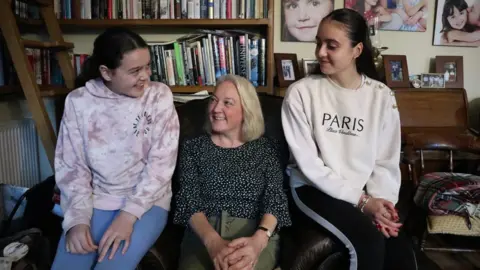
Despite the lack of clear-cut evidence, Georgie's mother Sarah says she "absolutely" supports Aberconwy's policy.
She says she has found it tough not to be able to message her children during exam time.
"It would be nice to be able to sometimes communicate with them to be able to say, 'has everything gone all right?'," she said.
Other schools have found parents wanting contact with children to be a sticking point when introducing new rules around phones.
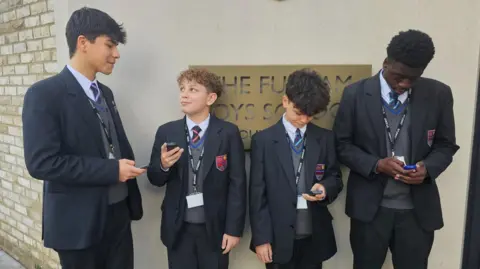
Within a few weeks of The Fulham Boys School in west London bringing in a "brick"-phones-only policy in September, students were "over it", head teacher David Smith says - but "teething problems" came from parents worried about their children travelling across the capital without apps to help them.
One student recently got on a bus going in the wrong direction and ended up at the other end of the line to his home neighbourhood - without a smartphone on him to check a map or call home.
In the UK, 96% of 12 to 15-year-olds have their own phone, according to the latest research by the online safety regulator, Ofcom.
Last year, the Department for Education in England said most schools were imposing restrictions on smartphone use, as it released non-binding guidance encouraging head teachers to do so.
Scotland and Northern Ireland followed suit, though Wales's inclusion of "digital skills" on the curriculum means Welsh schools tend to take a more open approach.

The study may intensify the debate around whether under-16s should be stopped from having smartphones altogether.
Some schools say it is down to parents to act.
The Conservative Party is among those pressing the government to tighten up restrictions within schools.
Labour has previously said the answer could lie with a social media ban for under-16s, like in Australia.
Technology Secretary Peter Kyle said he would be watching the situation in Australia "very closely".
He said his team would also be looking at the University of Birmingham study "in great detail", amid a lack of other established scientific evidence around the impact of smartphones.
Responding to the study, a government official said teachers already had "clear guidance" to manage phone use in a way that worked for their schools.
The Online Safety Act, which will soon come into effect, would protect young people from harmful content and ensure they had an age-appropriate experience online.
"More robust evidence is needed to reach clear conclusions on the impact of smartphones on children, which is why we have launched our own research, led by the University of Cambridge, into the impact of social media on children's overall wellbeing," the official added.
Latest Stories
-
GJA accepts Mahama’s request to organise national forum on hate speech
2 minutes -
Democratizing the judiciary: Why Judges in Ghana should engage “We the People” through social media platforms.
4 minutes -
Bond market: Turnover increases by 47% to GH¢4.07bn
16 minutes -
DVLA prepares electronic queue system to reduce congestion
23 minutes -
Hearts of Oak coach Kapor raises alarm over poor pitches in Ghana football
33 minutes -
Dorimon Traditional Council endorses policy to formalise female chieftaincy
37 minutes -
DVLA expands from 33 to 63 offices after opening 30 new service centres across Ghana
38 minutes -
State Housing Company offers 195 homes with a 5% discount; prices start at GH¢950,000
41 minutes -
Learn Deutsch opens German language examination centre in Accra
41 minutes -
Decline in external buffers complicates foreign exchange outlook – IC Insights
42 minutes -
Ghanaian filmmakers urged to tell local stories and take them to the world
47 minutes -
Educated but unable to communicate? The missing link in Ghana’s University education
50 minutes -
Informant demanded $20 million from NACOC for information on major drug consignment – Muntaka
56 minutes -
Gov’t introduces mental health and drug tests for security recruits amid suicide concerns – Interior Minister
56 minutes -
DVLA generates GH¢27.14m from dealer plates between January and September 2026
60 minutes