

Audio By Carbonatix
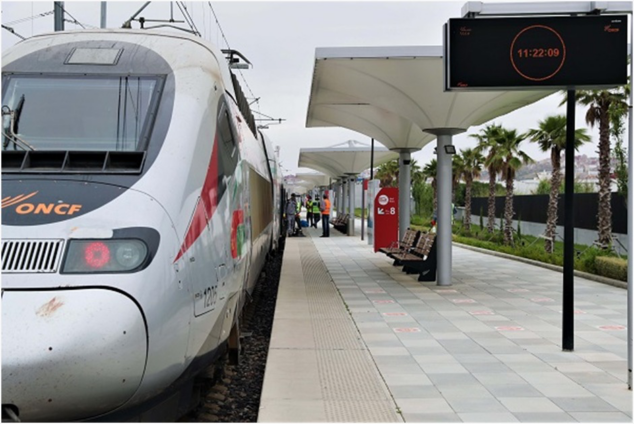
The Kenitra-Marrakech High-Speed Rail Line (HSL), launched by Morocco's King Mohammed VI on Thursday, marks a major leap forward in the country's national development agenda, according to Transport and Logistics Minister Abdessamad Kayouh.
In a statement, he explained that this landmark project will dramatically cut travel times between key cities, saving up to 70% compared to current journeys, and strengthen connections between major hubs like Rabat, Casablanca, and Marrakech.
It will also serve several of the Kingdom’s main airports, enhancing mobility for citizens and visitors alike.
A New Place Among Global Rail Giants
Mohamed Rabie Khlie, Director General of the National Railways Office (ONCF), emphasised that the Kenitra-Marrakech line will position Morocco among the countries with the longest high-speed networks in the world, spanning an impressive 630 kilometres.
He noted that this project is part of a broader national strategy, championed by the King, that has propelled Morocco’s railway sector into a new era of investment, performance, and innovation over the past two decades.
Khlie highlighted the success of the Al Boraq high-speed train—Africa’s first—which launched in 2018 and quickly became a preferred travel option.
Passenger numbers soared from 3 million in 2019 to 5.5 million in 2024. Overall, ONCF transported 53 million passengers across all services last year.
Al Boraq: A Symbol of Green Innovation
Al Boraq’s success showcases the power of sustainable mobility. Powered by clean energy, it links Casablanca and Tangier, two of Morocco’s economic giants, in record time.
It’s more than just fast transport; it’s a catalyst for economic integration and environmental stewardship.
Building on this momentum, the new Kenitra-Marrakech High-Speed Line will offer an even greater leap forward, reinforcing Morocco’s rail network as the most efficient and sustainable mode for medium and long-distance travel.
Ready for the 2030 FIFA World Cup
Khalid Khairane, Director of High-Speed Line Projects at ONCF, assured that construction work is on track to be completed in time for the 2030 FIFA World Cup, which Morocco will co-host with Spain and Portugal.
All studies were finalised in 2022, contracts were awarded in 2024, and land acquisition is nearly complete.
Next-Generation Trains on the Way
Luciano Borges, Director of ONCF’s Equipment Division, announced the acquisition of 18 new high-speed trains from French manufacturer ALSTOM.
Each train, capable of reaching 320 km/h and carrying 641 passengers, will feature cutting-edge technology with a strong emphasis on environmental sustainability, boasting over 97% recyclability.
The expansion will more than double ONCF’s high-speed fleet from twelve to thirty trains.
Borges also highlighted plans to leverage Morocco’s own industrial capacities for train equipment production, boosting local industry and reducing environmental impact through shorter supply chains.
Latest Stories
-
‘Beating Ghana did not surprise me’ – Gambia boss
25 minutes -
OpenAI agents get rebrand – as ‘dots’ – while safety worries delay new model
31 minutes -
US ban on Canadian alcohol and dairy takes effect as trade war drags on
44 minutes -
Baffour Awuah’s EOCO case reopens Equity Savings & Loans file as SIC recovery battle emerges
45 minutes -
Ghana ranked 5th source of cocaine seized at Antwerp, Belgium in 2025
45 minutes -
‘We knew there was disruption’ – Gambia boss claims Ghana players clashed at half-time
46 minutes -
Bagbin adjourns Parliament indefinitely
1 hour -
African Most Beautiful USA Queen to host Community Zumba Dance session in Accra
1 hour -
Cocaine probe: Speaker got it wrong by blocking parliamentary inquiry – Minority Leader
2 hours -
FoSCel foundation calls for end to stigma and stereotyping against people living with sickle cell disease
2 hours -
Auditor-General to track audit recommendations as GH¢280.5m in surcharges remains unpaid
2 hours -
Walewale MP withdraws ‘rude’ comment on Bagbin’s Parliament recall, apologises
2 hours -
FoSCel founder urges curriculum reform to strengthen sickle cell education in Ghana
2 hours -
United States launches America.Gov for public services 5 years after Dr. Bawumia launched Ghana’s version Ghana.Gov
2 hours -
Cocaine probe: Majority used super majority with Speaker’s support to weaken Parliament – Afenyo-Markin
2 hours