

Audio By Carbonatix
The Member of Parliament for Abuakwa South, Dr Kingsley Agyemang, has called on African governments to establish dedicated, legally protected disaster risk management funds to help countries prepare for and respond to increasingly severe floods.
The insurance and risk management expert said African countries must move away from treating floods as emergencies that require action only after they occur and instead invest consistently in prevention, preparedness, and resilience.
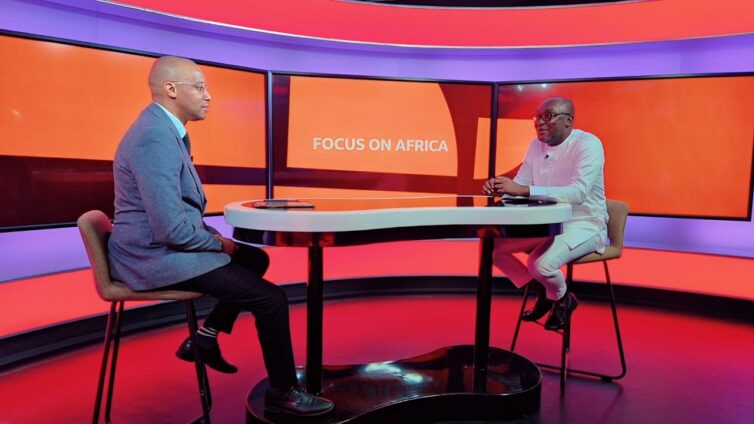
Speaking in an interview with the BBC’s Focus on Africa, Dr Agyemang said many African countries already had early warning systems but lacked the financing and coordination required to act on warnings before disasters struck.
“Most often on the continent, there are effective early warning systems for many of these flood disasters. But the truth of the matter is that governments are unable to respond effectively to those early warning signs because of the financing regime,” he said.
Dr Agyemang, who has more than 20 years’ experience as a risk management consultant, proposed an integrated financing model that would draw resources from multiple domestic sources.
He suggested combining annual government budget allocations with revenues from mineral resources, corporate taxes, levies, and support from development partners.
“That will make us build funds over the years and be more proactive towards resilience,” he said.
The MP, who is also Vice-Chairman of Parliament’s Human Rights Committee, wants the proposed funds to be established by law and ring-fenced to prevent governments from diverting the money to other priorities.
He argued that protecting lives and property should be regarded as a fundamental responsibility of every government.
“The basic responsibility of every government is to protect life and property,” he said.
“A government cannot say it has a priority more important than its basic responsibility of protecting life and property.”
Dr Agyemang's proposal follows devastating floods that hit parts of West Africa on June 29, including Ghana and Côte d’Ivoire.
In Ghana, at least 12 people were confirmed dead, while thousands of households were affected after torrential rains caused flooding in several parts of the country.
The disaster has renewed concerns about Ghana's and the wider region's preparedness for increasingly extreme weather events.
The Intergovernmental Panel on Climate Change (IPCC) has warned that climate change is expected to increase the frequency and severity of flooding in parts of Africa.
The IPCC estimates that across large African river basins, a flood with a historical one-in-100-year probability could occur roughly once every 40 years at 1.5°C to 2°C of global warming, and about once every 21 years at 4°C of warming.
For Dr Agyemang, who also lectures at the Ghana Institute of Management and Public Administration (GIMPA), the projections make a shift from what he describes as a “reactionary” approach increasingly urgent.
“Why should African governments always be waiting for donations to support victims anytime disaster strikes on the continent?” he asked.
“That is reactionary. That is why we have to be intentional and in-depth about a more domestically sustainable funding regime to tackle disasters on the continent.”
Dr Agyemang said financing was only one part of the problem.
He identified weak institutional coordination, political interference in urban planning, and low insurance penetration as additional barriers to effective flood management.
He said African countries could draw lessons from other jurisdictions that have developed systems to spread the financial risks associated with disasters.
He cited the United Kingdom’s flood reinsurance arrangements and the United States’ National Flood Insurance Programme as examples of risk-pooling mechanisms that could inform approaches in Africa.
“These are tried and tested disaster risk management systems that have survived over the decades that Africa is refusing to learn from,” he said.
He also called for flood prevention to be incorporated into economic planning rather than treated as an emergency expenditure.
“We have to begin to perceive risk prevention or flood prevention as an investment and economic activity rather than contingency,” he said.
Dr Agyemang, who is also a public health expert and lecturer at the Kwame Nkrumah University of Science and Technology (KNUST), warned that the consequences of flooding extend beyond deaths, damaged homes, and destroyed infrastructure.
He said repeated flooding could create conditions for the spread of waterborne diseases and increase pressure on already stretched health systems.
“Malaria is still rising, waterborne vectors such as cholera cases are rising, typhoid, diarrhoea are all public health impacts of floods,” he said.
He argued that regular contributions to a national disaster risk management fund could enable governments to accumulate reserves for drainage projects, flood-control measures, emergency response, and other preventive interventions.
Dr Agyemang stressed that legislation would be necessary to protect the proposed funds from being diverted.
“If it is not backed by legislation, member states or governments can take the funds and use them for any other thing,” he said.
He said his reviews had not identified an African country currently operating a disaster risk management fund of the kind he is proposing, backed by legislation and functioning as a dedicated financial mechanism.
“I stand to be corrected, but nothing like that has come up in all the reviews I have done across the continent so far,” he said.
The Abuakwa South MP said sustained advocacy would be required to persuade governments across the continent to adopt more proactive disaster risk management systems.
He argued that African countries already possessed much of the knowledge and technology needed to improve resilience, but needed stronger political commitment and sustainable financing.
“We cannot neglect the safety of our people. We have to stop the reactionary attitude towards disasters,” he said.
Dr Agyemang said the increasing frequency and severity of flooding meant governments could no longer continue responding to disasters only after they occurred.
“Disaster has come to live with us and we have to find a sustainable way of managing it,” he added.
His proposal is aimed at encouraging a continent-wide shift towards prevention, risk pooling and long-term investment as African countries grapple with the growing threat posed by extreme weather.
Latest Stories
-
Ghana, Côte d’Ivoire mark major border milestone with 37 new pillars
13 minutes -
Almost everything in Ghana is expensive – CUTS Director on airfare debate
23 minutes -
NAFCO builds GH¢100m food buffer as Ghana moves to strengthen food security
39 minutes -
Oil heads higher as US-Iran peace talks in stalemate
58 minutes -
GAF sets Sept. 28–30 for Documentation, Body Selection Exercise
1 hour -
I resigned five months ago – BoG Governor Asiama explains GoldBod Board exit
1 hour -
Trump says men arrested at UK air base used by US were looking to do ‘big damage’
2 hours -
Trump confirms meeting with Anthropic’s Amodei, repeats dismissal of AI fears
2 hours -
China pushes back against US on Iran and Cuba in UN speech
2 hours -
OpenAI, Anthropic CEOs called to appear at Australian AI probe
2 hours -
No land is worth a human life – Sissala West MP mourns 2 dead in Buo-Tiwii clashes
4 hours -
GCAA explains why some prospective airlines fail to complete certification
5 hours -
WHO says Congo Ebola outbreak spreads to two new health zones
5 hours -
Nigeria come from benhind to win in AFCON 2027 qualifier
5 hours -
South African white genocide does not exist, new ambassador to US tells BBC
5 hours