

Audio By Carbonatix
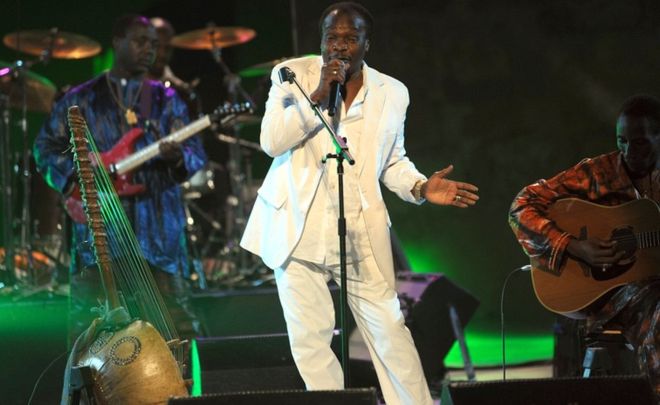
The singer Mory Kanté, who helped bring African music to world audiences with hits like Yéké Yéké, has died in Guinea.
Kanté died in hospital on Friday in the capital, Conakry, aged 70, his son Balla Kanté told the AFP news agency.
His death was the result of untreated health problems, he said.
"He suffered from chronic illnesses and often travelled to France for treatment but that was no longer possible with the coronavirus," he added.
"We saw his condition deteriorate rapidly, but I was still surprised because he'd been through much worse times before."
Born in a famous family of "griots" - West African musicians and storytellers - he had been nicknamed "the electronic griot", and was known as a distinguished player of kora - a West African harp.
His song Yéké Yéké became a huge hit in the late 1980s and was widely remixed.
Tributes were paid by fellow musicians on Friday, including Senegalese musician Youssou N'Dour who said he felt a huge void on learning of Kanté's death and called the late singer "a baobab of African culture".
Je viens d'apprendre avec consternation le rappel à Dieu de mon frère aîné et référence Maître Mory Kanté. Je ressens un énorme vide aujourd'hui avec le départ de ce baobab de la Culture Africaine. Repose en paix. De ton Frère affligé Youssou Ndour pic.twitter.com/L62RWiEbTh
— YOUSSOU NDOUR (@YoussouNdourSN) May 22, 2020
The president of Guinea, Alpha Condé, said on Twitter that African culture was in mourning. He thanked Kanté, saying his career had been "exceptional".
#Mory_Kanté La culture africaine est en deuil. Mes condoléances les plus attristées...
— Alpha CONDÉ (@alphacondepresi) May 22, 2020
Merci l'artiste. Un parcours exceptionnel. Exemplaire. Une fierté. pic.twitter.com/Acoxjyfwnb
Kanté is the latest prominent African musician to pass away, after the recent deaths of Manu Dibango, Tony Allen and Idir.
Avant-garde musician - and humanitarian
By Ata Ahli Ahebla, BBC African music presenter
Mory Kanté started music at the age of just seven, when he was sent to Mali to learn to play the kora harp.
In the 1970s, he joined Mali's legendary group the Rail Band of Bamako and performed alongside Salif Keita and became the lead singer after Keita left.
His international success came in 1988 when he released his album Akwaba Beach, which includes Yéké Yéké. Millions of copies of Yéké Yéké were sold and Akwaba Beach became the best-selling African album of that time.
He belonged to a generation of avant-garde African musicians who dared to create new sounds.
Born and raised in the West African Mandigo traditional culture and Muslim religion, he came up with an unique sound by mixing his kora with electronic music.
As a goodwill ambassador for international organisations like Unicef, the FAO, UNHCR, he was involved in various humanitarian causes in Africa and Eastern Europe.
Latest Stories
-
All set for 7th Ghana Credit Excellence Awards 2026 on October 10
5 minutes -
The job interview question you don’t have to answer
1 hour -
Trump unveils ‘Super Intelligence Force’ to oversee AI policy
2 hours -
Zirkzee gives Netherlands win as van Dijk joins 100 club
2 hours -
Portugal boss says door open for Ronaldo return
2 hours -
Younger men now rushing older women – Damilola Adegbite claims
4 hours -
[Video] Legendary Nigerian actor Olu Jacobs buried in Lagos
4 hours -
Intelligent content no longer works in Nigeria – Tekno
4 hours -
Tiwa Savage accepts Teni’s fight challenge
4 hours -
Actress Chioma Chukwuka announces death of father in emotion-laden post
4 hours -
[Video]‘I have asked God to take me when it is time’ – Pete Edochie on health struggles
4 hours -
Manager remanded over $1m auto fraud
5 hours -
Mr President, Ghana was mentioned at the UN; why aren’t we talking about it?
5 hours -
US Marine arrested over murder of woman in Okinawa, Japan
5 hours -
Accra to convene Africa’s regulators and markets on tokenisation at AVAS 2026
5 hours