

Audio By Carbonatix
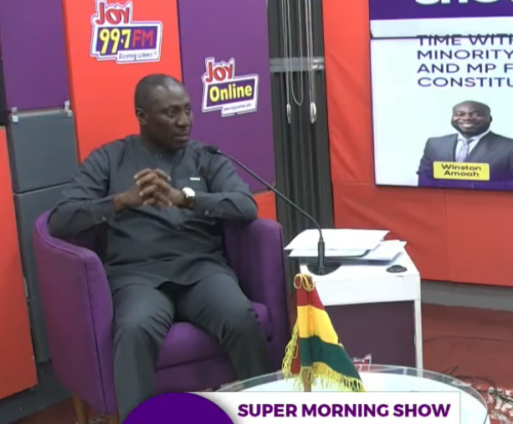
Minority Leader and Member of Parliament for Effutu, Alexander Afenyo-Markin, has questioned the Mahama administration's flagship 24-hour economy policy, claiming the government has failed to clearly define how it will be implemented or create the conditions needed for businesses to operate around the clock.
Speaking in an interview on Joy FM's Super Morning Show on Friday, July 17, Afenyo-Markin said the National Democratic Congress (NDC) had campaigned extensively on the 24-hour economy but had yet to present a clear policy framework.
According to him, the government has instead introduced measures that make it more difficult for businesses to expand.
"They said one job, three shifts, 24-hour economy, Women's Bank and many other things. They made all these promises, but where are they?" he asked.
The Minority Leader said that a genuine 24-hour economy cannot succeed when businesses are faced with rising operational costs.
He cited the recent increase in electricity tariffs as an example of policies that discourage investment.
"If you say 24-hour economy and then increase electricity tariffs by almost 30 per cent, there is no incentive for the private sector," he said.
The Minority leader also criticised the government's decision to discontinue the One District, One Factory (1D1F) initiative, describing it as a programme that had encouraged investment and industrial growth.
He questioned what alternative policy had been introduced to support businesses.
"You cancel 1D1F, which was creating opportunities and opening Ghana up for investment. In its place, there is no alternative policy for the private sector," he said.
He challenged the government to explain how it intends to stimulate private sector growth.
"What is the government's flagship policy for the private sector? What investments are they making? What incentives are they introducing? What reforms are they carrying out?" he asked.
He accused the government of failing to fulfil its promise to ease the tax burden on businesses.
According to him, changes to the Value Added Tax (VAT) regime, including the removal of the flat-rate system, have increased the cost of doing business, particularly for operators in the informal sector.
"They promised lower taxes, but VAT has gone up. The flat-rate system, which was introduced to help the informal sector, is no more," he stated.
He said that although government officials point to improving macroeconomic indicators, many Ghanaians have yet to experience any meaningful improvement in their livelihoods.
"If they say they are running the economy and the macro numbers are okay, talk to the ordinary Ghanaian. He will tell you that it is not reflected in his life because the incentive for the private sector to grow is not there," he said.
Latest Stories
-
Ghana housing finance conference adopts communiqué to improve affordable housing access
2 hours -
Special Initiatives Minister urges Wa Technical Institute to enrol more girls as EU-backed solar training lab opens
2 hours -
In the matter of my first year at the Bar
3 hours -
ActionAid Ghana calls for an end to child marriage, greater investment in girls’ rights
3 hours -
Newsfile to tackle World Cup visa scandal, beach demolitions, education strikes, BRICS bid
3 hours -
UK-Ghana Trade & Investment Summit: Trade Resource Centre to help businesses maximise UK-Ghana trade opportunities
3 hours -
Embassy of Denmark celebrates World Maritime Day
3 hours -
Linking LEAP to productive inclusion could cut extreme poverty by 2030 – UNICEF
5 hours -
Trade Ministry backs use of creative arts to rehabilitate prison inmates
5 hours -
Negotiations with government to continue despite strike suspension – GNAT
5 hours -
‘Ghana cannot afford to waste public resources; every cedi has a job’ – Ato Forson
5 hours -
Ghana expects economic boost as World Assemblies of God Congress brings 10,000 delegates to Accra
5 hours -
Joy in Nayilifong as Farouk Aliu Mahama donates 100kVA transformer to improve power supply
5 hours -
Chief Justice urges employers to tackle mental health stigma in workplaces
6 hours -
Analysis: Ghana’s yellow fever numbers reveal a gap between vaccination and protection
7 hours