


Audio By Carbonatix
After nearly a dozen years moving through the United States visa system, Sai Kyaw's brother and sister and their families were at the finish line: a final interview before they could leave Myanmar to join him in Massachusetts and work at his restaurant.
Then a dramatic turn in US immigration policy halted their plans. The interview was postponed, and it is not clear when, or whether, it will be rescheduled.
"It's terrible," Kyaw said. "There's nothing we can really do except pray. They've been waiting 12 years. If they have to wait another 12 years, they will."
His is just one of many stories of confusion, sorrow and outrage spreading across some immigrant communities after the announcement of a Trump administration policy that is expected to all but shut down family-based immigration from Myanmar, also known as Burma, as well as Nigeria, Kyrgyzstan and Eritrea.
The policy also restricts visas from Sudan and Tanzania.
"There's a panic wave going through the community," said Grace Mobosi-Enwensi, president of the Minnesota Institute for Nigerian Development, a nonprofit group.
In signing a proclamation last month that takes effect on Friday, President Donald Trump said those countries failed to meet minimum security standards. It was his latest crackdown on his signature issue of immigration.
Calls about the restrictions have flooded legal advocacy groups and lawyers' offices. A Boston-area Burmese church is trying to intervene to help congregants. The United African Organization has held legal clinics in Chicago to walk people through their options.
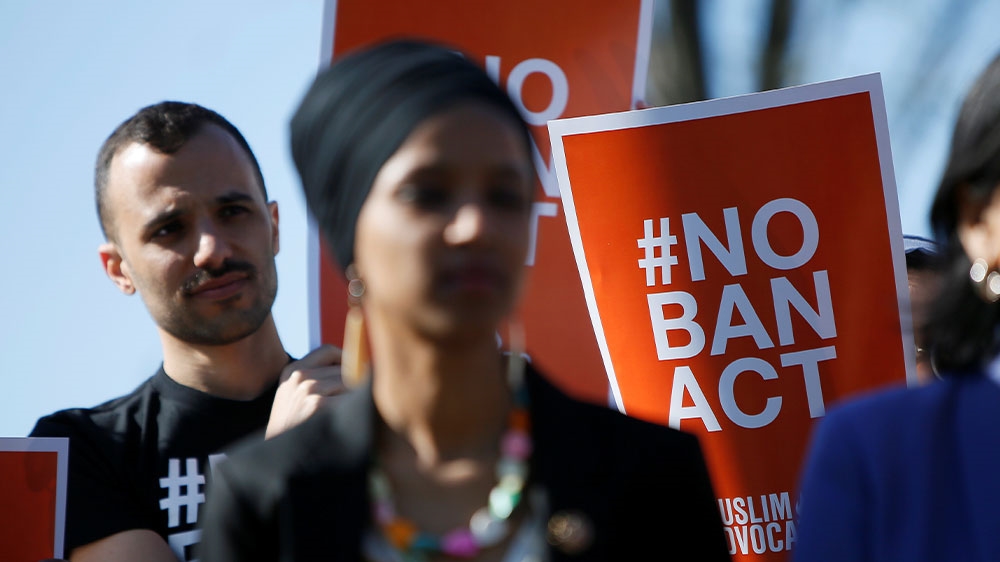
The rules are certain to face legal challenges, but in the meantime, activists have organised around #MuslimBan and #AfricaBan on social media and ramped up lobbying efforts to press Congress to pass the No Ban Act, which would limit the president's ability to restrict entry to the US.
Roughly 10,000 people received immigration-based visas from Nigeria, Eritrea, Kyrgyzstan and Myanmar in the 2018 fiscal year, according to federal data analysed by the nonpartisan Migration Policy Institute. More than half were from Nigeria, the most populous African nation.
The ripple of emotion has been felt strongest among America's roughly 380,000 Nigerian immigrants and their children. They are one of the most educated immigrant groups. More than 60 percent of people with Nigerian ancestry who are at least 25 have a bachelor's degree or higher, which is more than twice the general US population rate of 29 percent, according to 2017 census data.
Tope Aladele, who is seeking a visa for his wife in Nigeria, has faint hope that she will be able to come to the US.
"I thought this year I could at least celebrate Christmas with her," said Aladele, a US citizen who works as a nursing assistant in the Chicago area. "I'm just hoping and praying."
Citizenship and Immigration Services officials declined to comment on the concerns of affected families, deferring to the Department of Homeland Security. Agency officials did not respond to emails seeking comment.
Unlike previous travel bans, the new rules are narrower. They stop immigrant visas from Nigeria, Eritrea, Myanmar and Kyrgystan, covering people who want to live in the US permanently and are sponsored by family members or employers. They also eliminate participation in a visa lottery programme in which a computer randomly selects up to 55,000 people for visas from underrepresented countries. Sudan and Tanzania will also be barred from the lottery.
The ban does not affect immigrants travelling to the US for a temporary stay, including tourists and students, or immigrants already in the US. There are also exceptions, including dual citizenship holders.
In Chicago, the United African Organization hosted dozens of people at legal clinics. Many had questions about their spouses and children. One was Osemeh Otoboh, 46, a Nigerian citizen with a green card who has applied for two of his teenage children from a previous marriage to come to the US.
Though their visas were recently approved, the suburban Chicago man married to a US citizen was worried. His children live in Lagos, and he wants them to pursue an education in the US.
"I don't even know how to explain it to them," Otoboh said of the restrictions.
Experts have questioned the administration's national security reasoning since there are no restrictions on tourist or student visas, which can take less time and vetting to acquire. Officials in at least one country, Nigeria, have said they are working to address security concerns, such as information sharing.
Activists said the restrictions amount to another travel ban like the one that was widely decried as targeting Muslims. The Supreme Court upheld that ban as lawful in 2018. It restricted travel from several Muslim-majority countries including Iran, Somalia and Syria.
Sudan and Kyrgyzstan are also majority-Muslim countries. Nigeria, the world's seventh-most populous nation, has a large Muslim population too.
"It's a continuation of this administration's racist and xenophobic immigration framework that they use," said Mustafa Jumale, a policy manager for the Black Alliance for Just Immigration.
 People protest outside of the US Supreme Court after President Trump's travel ban was upheld by the Supreme Court in Washington, DC
Latest Stories
-
Mr President, Ghana was mentioned at the UN; why aren’t we talking about it?
55 minutes -
Accra to convene Africa’s regulators and markets on tokenisation at AVAS 2026
58 minutes -
The Paradox of Plenty — When every smartphone becomes a newsroom
2 hours -
GTA sensitises taxi drivers in ‘Know Ghana’ tourism campaign
3 hours -
Archbishop Agyinasare calls for responsible speech amid growing social media abuse
3 hours -
‘It will be inexcusable for gov’t not to honour payment of teachers’ arrears by 30th October’ – Haruna Iddrisu
3 hours -
Forbes’ World’s Best Employers 2026: No Ghanaian firm ranked among 900 companies
3 hours -
Electronic processing of teachers’ data: ‘The decision is the Controller’s’ – GES boss
3 hours -
Teachers’ Strike: Haruna Iddrisu questions paper-based processing of promoted teachers’ data
3 hours -
Savannah Region: Kunfusi bridge collapses again, leaving nearly 4,000 residents cut off
3 hours -
Teachers’ strike: GES targets Monday deadline to submit promotion data to Controller
3 hours -
Inflation to average 11.3% in 2027 – Fitch Solutions
4 hours -
‘I didn’t campaign for NDC to come and do this nonsense’ – Kpebu on EOCO’s conduct
4 hours -
Fitch Solutions maintains policy rate forecast of 14% by December 2026
4 hours -
Diaspora Nasara Caucus congratulates Mohammed Ali Suraj, new NPP executives
6 hours