

Audio By Carbonatix
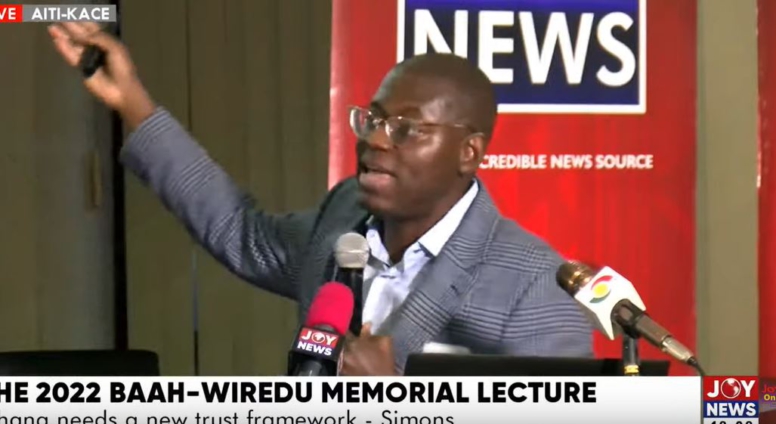
Vice President of Imani Africa, Bright Simons has criticized President Akufo-Addo and his administration for persistently blaming the conflict in Ukraine for Ghana's distressed economy.
Ghana is frantically working to initiate talks with domestic bondholders on a restructuring of its local currency debt as part of plan to secure a $3 billion loan from the IMF.
The administration and party communicators have consistently blamed the poor economic status of the country partly on the Russia-Ukraine situation.
President Akufo-Addo in his address at this year's United Nations General Assembly made attempts to show how "every bomb in Ukraine" is hitting the pockets of economies on the African continent.
But speaking at the 2022 Baah-Wiredu Lecture, Bright Simons argued that there's no justification for the government to blame the sorry state of the Ghanaian economy on the conflict in Ukraine because the country's economy is not as exposed to the Russian economy as other countries.
"When we start to do the comparative analysis you cannot use some other factor that has had a uniform effect. I tried my best to give you factors that could have shown that Ghana has been affected more, and as you saw I struggled with the data. I went to jobs, I went to growth, I went to how many people were killed and none of it bears out that we were affected worse. So if you are the worse performing in terms of currency, you cannot complain and say it is because of some factor that has affected everybody uniformly. It is as simple as that," Bright Simons said.
According to him, wastage by MMDAs, and luxurious expenditure on government machinery are partly to blame for the current state of the Ghanaian economy.
Meanwhile, the Managing Director of IMF, Kristalina Georgieva has said the hardship the country is facing is not due to bad policies.
According to her, the Covid-19 pandemic and the Russia-Ukraine war have affected the country negatively.
Speaking with JoyNews’ Benjamin Akapko on the sidelines of the Africa Adaptation Summit, in Rotterdam, Netherlands, she said most countries are also facing similar problems.
“First the pandemic, then Russia’s war in Ukraine. We need to realize that it is not because of bad policies in the country but because of this combination of shocks, and, therefore, we have to support Ghana”, she said.
Latest Stories
-
Bahass Foundation launches vocational skills training to support mental health recovery in Wa
17 minutes -
NPP orders parliamentary aspirants and their supporters to suspend campaign activities
50 minutes -
Techiman unites against child marriage: Joy Impact Makers Awardee leads charge on International Day of the Girl Child
1 hour -
Ghana Psychological Association calls for greater involvement of people with lived experience in mental health care
2 hours -
Ablakwa says Ghana could evacuate more citizens from South Africa if the situation worsens
3 hours -
Violence against girls must be tackled through individual responsibility – Gender advocate
3 hours -
Ghana’s BRICS bid must be guided by national interest – International Affairs Analyst
3 hours -
Journalists look back on a decade of breast cancer reporting in Ghana
4 hours -
President Mahama ends Resetting Ghana tour of Ahafo Region
5 hours -
African negotiators seek delivery of climate commitments at COP31
5 hours -
BoG develops AI rules for financial sector
5 hours -
‘Big Push’: Government assures contractors of prompt payments
6 hours -
Court fines miner for breaking into gold buying shop
6 hours -
Tarkwa court jails labourer for three years over GH¢123,000 theft
7 hours -
GAEC must retain nuclear scientists for Ghana’s nuclear ambitions – Minister
7 hours