

Audio By Carbonatix
"I want to give people inspiration to protect the environment; plant trees, and make it a pleasure to maintain them."
Those are the words of Catholic priest at Damongo Archdiocese in the Savannah region, Father Dr. Clement Aapengnuo, who seeks to supply finest noni fruit trees to Ghanaians.
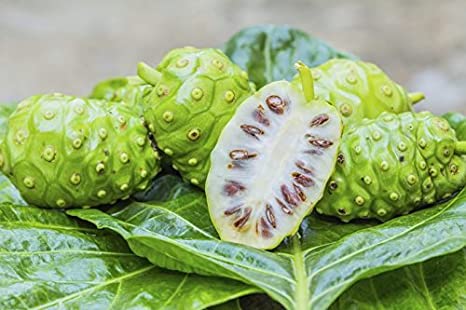
Noni tree - native to Southeast Asia and Australasia, is a source of phytonutrients, known to boost the immune system as well as repair cellular damage.
They have anti-inflammatory, anti-viral, and anti-bacterial compounds.
Fr. Aapengnuo says the tree is a potential income generator that can give cultivators in rural areas, at least, 300 cedis in a month.
"If you have three of the trees and every month you fill ten bottles at 10 cedis that's 300 cedis. That is basic salary for some people," he says.
In just a few years of planting the tree, he says it is only appropriate to share what is good with Ghanaians.
The Noni tree, known scientifically as Morinda citrifolia grows in shady forests, as well as on open rocky or sandy shores of rivers.
It matures in about 18 months, and begins to bear between 4 and 8 kg of fruits every month.
"The amazing thing about this tree, it fruits all year round even in the dry season. So pluck and pluck the fruits."
The oval-shaped of 10-18 centimeters in size, is also known as cheese fruit or even vomit fruit, due to its pungent smell when ripening.
"Just on the same branch, you would have some flowering while others are fruiting. So there is a constant supply."
The tree is tolerant of saline soils, drought conditions, and secondary soils.
It can grow up to 9m tall, with large, simple, dark green, shiny and deeply veined leaves.
Besides its ability to beautify the environment and provide oxygen, a variety of products from the fruit can be found on the consumer market.
"Now we have got an outlet. When you do you package it nicely and put it in a small bottle."
They come in the form of beverage, powder and other cosmetics as well as oil.
But in Damongo people know it in bevergare.
"I was surprised to see that a lot of people in Damongo know the noni and buy it" adding that, it has economic values.
Morinda citrifolia is attractive to weaver ants, which make nests from its leaves.
These ants protect the plant from some parasitic insects.
The smell of the fruit attracts fruit bats, which aid in seed dispersal.
A type of fly, Drosophila sechellia, feeds exclusively on the fruits.
Fr Aapengnuo says his work as a catholic priest puts him in a better position to protect the environment and change lives.
He wants to grow more seedlings and distribute to interested Ghanaians to also rape the benefit.
Beyond that, the sustainable environmental activist wants to see a world of great opportunity in safety for all.
Latest Stories
-
Former JoyNews journalist Ayisha Ibrahim called to the Bar
5 minutes -
Counting performances of the Black Stars – at the doom stage?
11 minutes -
When The Gospel boarded a trotro
14 minutes -
Gender Ministry, IOM build stakeholders’ capacity to combat human trafficking in tourism and sports
15 minutes -
Health Ministry declares Yellow Fever outbreak in Upper West Region
22 minutes -
CRS, LDS hand over 6 renovated NAS facilities to strengthen emergency response
23 minutes -
Labour Minister banks on dialogue to end teachers’ strike, rules out alternative measures
30 minutes -
Transport operators slam gov’t; vow to defy suspension of preaching and hawking restrictions
30 minutes -
Domestic abuse is about power and control, not ordinary relationship conflict – ARK Foundation
32 minutes -
Keep your windows open or risk lung cancer – GAEC warns over deadly radon gas
38 minutes -
‘I was beaten, threatened with death, and was told to stay’ – Abuse survivor recounts ordeal in marriage
1 hour -
Ato Forson has performed wonders with common fund releases – Northern Regional Minister
2 hours -
Zelensky accuses US of inaction as Russian strikes kill over 70 in two days
2 hours -
Bipartisan majority of Americans blame Trump policies for rising costs, Reuters/Ipsos poll finds
2 hours -
New Trump rules will make it harder for farmers to access US funds for energy projects
2 hours