

Audio By Carbonatix
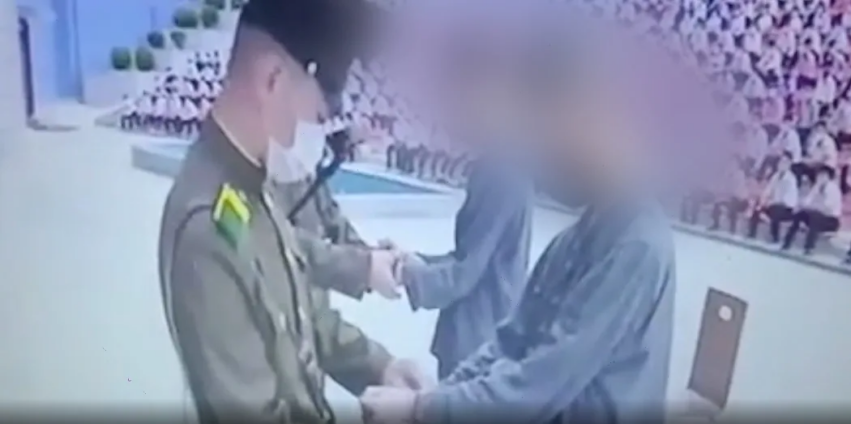
Rare footage obtained by BBC Korean shows North Korea publicly sentencing two teenage boys to 12 years of hard labour for watching K-dramas.
The footage, which appears to have been filmed in 2022, shows two 16-year-old boys handcuffed in front of hundreds of students at an outdoor stadium.
It also shows uniformed officers reprimanding the boys for not "deeply reflecting on their mistakes".
South Korean entertainment, including TV, is banned in the North.
Despite that, some are prepared to risk severe punishment to access K-dramas, which have a huge global audience.
Footage such as this is rare because North Korea forbids photos, videos and other evidence of life in the country from being leaked to the outside world.
This video was provided to the BBC by the South and North Development (Sand), a research institute that works with defectors from the North.
It suggests authorities are coming down harder on such incidents. The clip has reportedly been distributed in North Korea for ideology education and to warn citizens not to watch "decadent recordings".
The video includes a narrator who is repeating state propaganda. "The rotten puppet regime's culture has spread even to teenagers," says the voice, in an apparent reference to South Korea. "They are just 16 years old, but they ruined their own future," it adds.
The boys were also named by officers and had their addresses revealed.
In the past, minors who broke the law in this way would be sent to youth labour camps rather than put behind bars, and the punishment was usually less than five years.
In 2020, however, Pyongyang enacted a law to make watching or distributing South Korean entertainment punishable by death.
A defector previously told the BBC that he was forced to watch a 22-year-old man shot to death. He said the man was accused of listening to South Korean music and had shared films from the South with his friend.
Sand CEO Choi Kyong-hui said Pyongyang sees the spread of K-dramas and K-pop as a danger to its ideology.
"Admiration for South Korean society can soon lead to a weakening of the system...This goes against the monolithic ideology that makes North Koreans revere the Kim family," she said.
North Koreans started getting a taste of South Korean entertainment in the 2000s, during the years of the South's "sunshine policy" which saw it offering unconditional economic and humanitarian aid to the North.
Seoul ended the policy in 2010, saying it found the aid did not reach the ordinary North Koreans it was intended for, and that it had not resulted in any "positive changes" to Pyongyang's behaviour.
However, South Korean entertainment continued to reach North Korea through China.
"If you get caught watching an American drama, you can get away with a bribe, but if you watch a Korean drama, you get shot," a North Korean defector told BBC Korean on Thursday.
"For North Korean people, Korean dramas are a 'drug' that helps them forget their difficult reality," the defector said.
"In North Korea, we learn that South Korea lives much worse than us, but when you watch South Korean dramas, it's a completely different world. It seems like the North Korean authorities are wary of that," said another North Korean defector in her 20s.
Latest Stories
-
Gov’t to suspend GH¢1 D-Levy on diesel for October and November
18 minutes -
Fire destroys belongings in Akweteyman apartment
48 minutes -
Baffour Awuah to turn himself in to EOCO today – JoyNews sources
54 minutes -
Government identifies payment discrepancy holding up teachers’ strike resolution
1 hour -
BoG signals no FX intermediation for October as GoldBod plans $1bn support for banks
1 hour -
When share ownership becomes personal: The African mindset of the Dangote IPO
1 hour -
Why MFWA Legal Fund matters to Ghana’s democracy
1 hour -
Fuel prices to rise from October 1; diesel could hit GH¢19.60 – COMAC
1 hour -
Parliament must investigate how 3.9 tonnes of cocaine left Ghana undetected – Samuel Jinapor
1 hour -
Government pledges to pay striking teachers as payment dispute is resolved
2 hours -
Government cannot investigate drug exports under its own watch – Abu Jinapor
2 hours -
Government extends GH¢2 diesel subsidy for two more months
2 hours -
GTEC flags over 100 tertiary institutions as unrecognised
2 hours -
Agric Committee chair commends NAFCO for turnaround from GH¢20m debt to GH¢96m profit
2 hours -
NPP: Judicial office requires judges to surrender some personal freedoms
2 hours