

Audio By Carbonatix
Oil prices have fallen and shares risen after the US and Iran said they had agreed a framework deal to end the war, which US President Donald Trump said would see the reopening of the key Strait of Hormuz shipping route.
Brent crude, the global oil benchmark,dropped more than 5% to $82.84 (£61.70) a barrel, while stock markets rose, particularly in Asia.
Pakistan, which has been mediating an end to the US-Iran war, said an official signing ceremony would be held on Friday, 19 June in Switzerland.
Iran's deputy foreign minister Kazem Gharibabadi confirmed in a phone call on state TV that a deal with the US had been finalised, while Trump posted on social media "let the oil flow!".
But Vandana Hari from energy markets analysis firm Vanda Insights said a lack of detail on what has been agreed was "likely to inject unease and uncertainty into the market".
This could mean a week of uncertainty and volatility for the oil market, she added.
The Strait of Hormuz has been effectively closed since shortly after the US and Israel launched airstrikes on Iran on 28 February.
After the conflict began, Tehran threatened to attack vessels using the crucial waterway, through which around 20% of the world's oil and liquefied natural gas (LNG) normally passes.
Global energy markets have been on a wild ride in recent months, with prices often rising or falling sharply in response to developments in the US-Israel war with Iran.
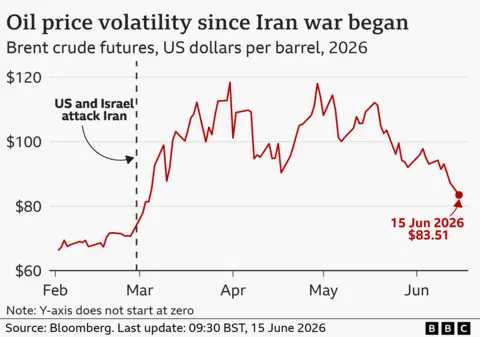
Brent crude, which was trading at around $70 a barrel before the conflict started, peaked at about $120 during the war.
Asian stock markets surged on Monday as investors welcomed the framework deal. Japan's Nikkei 225 share index closed 5% higher, while the Kospi in South Korea ended up 5.2%.
The region was hit particularly hard by higher energy prices as it is heavily reliant on the Middle East for its oil and LNG supplies.
In Europe, Germany's Dax rose 1.3% while France's Cac 40 added 1.2%.
In London, the FTSE 100 index edged up 0.1%. The increase was smaller than elsewhere as shares in energy giants BP and Shell – two of the biggest companies in the FTSE 100 – fell on news of the lower oil price.
Matt Britzman, senior equity analyst at Hargreaves Lansdown, said global equity markets were "firmly on the front foot".
He added the framework deal had "given investors a clear reason to dial back some of the geopolitical risk premium that has hung over markets".
However, energy market experts have warned the movement of oil through the strait is unlikely to immediately return to pre-war levels.
Andrew Lipow from consulting company Lipow Oil Associates said mines would first need to cleared from the waterway, which could take from a few weeks to up to six months.
He also said there is a large backlog of tankers waiting to use the waterway and that restarting oil production and getting the loading of ships back to normal levels could take weeks.
Admiral Mark Montgomery, a retired US Navy rear admiral and senior fellow at the Foundation for the Defence of Democracies, told the BBC's Today programme that getting back to normal would not be "an overnight thing".
"I would say that's going to take a month or 45 days to kind of fully get till you're at a normal pumping balance, and vessels moving in and out smoothly," he said.
Latest Stories
-
‘There is no competition’ – Justin Kodua confident of NPP General Secretary re-election
54 minutes -
J100 Accra Doubles Champions : Kolesolva/ Ndukwa, Agarwal/Patel seal title victories
56 minutes -
Sydney Wright crowned J100 Accra Champion
1 hour -
J100 Accra Boys’ Singles: Verma denies Beckles back-to-back titles to claim crown
1 hour -
Two friends fined GH¢12,000 for stealing
1 hour -
Son jailed for threatening to stab mother
1 hour -
Drive constitutional reform – GJA urges journalists
2 hours -
NPP Delagates Congress: Confusion delays voting at Ashanti Region TESCON centre
3 hours -
Fire ravages shops, houses near Koforidua Central Police Station
3 hours -
NPP Delegates conference: The wisdom of the masses will prevail – Napo
3 hours -
Flydubai co-pilot attacked captain with axe, UAE official says
3 hours -
NPP Bosome Freho Constituency Chairman reportedly arrested over ballot paper incident
4 hours -
Medical plane with 6 on board missing off Massachusetts coast
4 hours -
Bolt driver jailed 25 years for robbing beautician
4 hours -
Happy 76th Birthday to the Daily Graphic!
4 hours