


Audio By Carbonatix
Children's eyesight is steadily getting worse with one in three now short-sighted or unable to see things in the distance clearly, a global analysis suggests.
The researchers say Covid lockdowns had a negative impact on eyesight as children spent more time on screens and less time outdoors.
Short-sightedness, or myopia, is a growing global health concern which is set to affect millions more children by 2050, the study warns.
The highest rates are in Asia - 85% of children in Japan and 73% in South Korea are short-sighted with more than 40% affected in China and Russia.
Paraguay and Uganda, at about 1%, had some of the lowest levels of myopia, with the UK, Ireland and the US all about 15%.
The study, published in the British Journal of Ophthalmology, looked at research involving more than five million children and teenagers from 50 countries across all six continents.
Their number-crunching revealed that short-sightedness tripled between 1990 and 2023 - rising to 36%.
And the increase was "particularly notable" after the Covid pandemic, the researchers say.
Myopia usually starts during primary school years and tends to worsen until the eye has stopped growing, at about 20 years of age.
There are factors that make it much more likely - living in East Asia is one of those.
It is also down to genetics - the traits children inherit from their parents - but there are other factors too, such as the particularly young age (two years old) that children start their education in places like Singapore and Hong Kong.
This means they are spending more time focusing on books and screens with their eyes during their early years, which strains the eye muscles and can lead to myopia, research suggests.
In Africa, where schooling starts at the age of six to eight years old, myopia is seven times less common than in Asia.
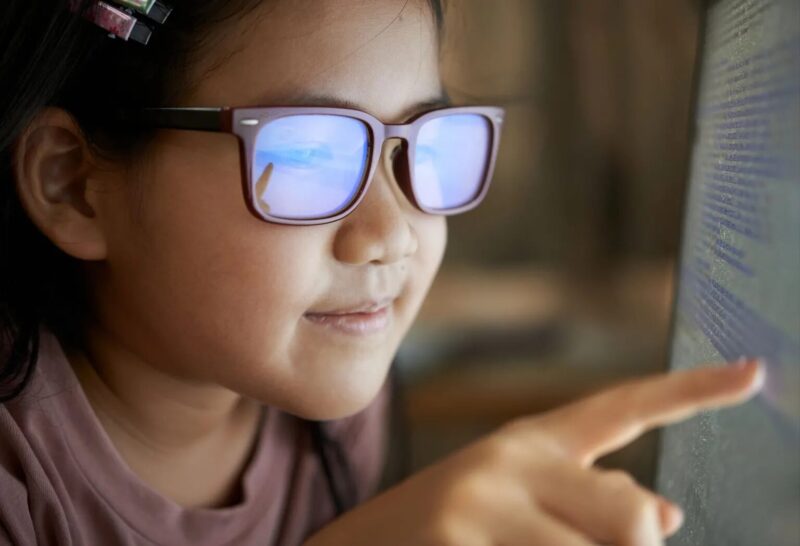
During Covid lockdowns worldwide, when millions had to stay indoors for lengthy periods, children and teenagers' eyesight took a hit.
"Emerging evidence suggests a potential association between the pandemic and accelerated vision deterioration among young adults," the researchers write.
By 2050, the condition could affect more than half of teens worldwide, the research predicts.
Girls and young women are likely to have higher rates than boys and young men because they tend to spend less time doing outdoor activities at school and at home as they grow up, the study suggests.
Girls' growth and development, including puberty, starts earlier which means they tend to experience short-sightedness at an earlier age too.
Although Asia is expected to have the highest levels compared with all other continents by 2050, with nearly 69% short-sighted, developing countries may also reach 40%, the researchers say.
How do I protect my child's eyesight?
Children should spend at least two hours outside every day, particularly between the age of seven and nine, to reduce their chances of being short-sighted, say UK eye experts.
It is not clear if it is the presence of natural sunlight, the exercise taken outdoors or the fact that children's eyes are focusing on objects that are further away that makes the difference.
"There is something about being outside that is a real benefit to children," says Daniel Hardiman-McCartney, clinical adviser from the UK College of Optometrists.
He also recommends that parents take their children for an eye test when they are seven to 10 years old, even if their vision was checked at a younger age.
Parent should also take note - myopia runs in families. If you are short-sighted then your children are three times more likely than others to be short-sighted too.
Myopia cannot be cured but it can be corrected with glasses or contact lenses.
Special lenses can slow down the development of myopia in young children by encouraging the eye to grow differently, but they are expensive.
In Asia, where these special lenses are very popular, glass classrooms which mimic learning outdoors are also being used.
The concern is that high rates of myopia could lead to large numbers of unusual eye conditions in older age.
What are the signs of short-sightedness?
- Difficulty reading words from a distance, such as reading the whiteboard at school
- Sitting close to the TV or computer, or holding a mobile phone or tablet close to the face
- Getting headaches
- Rubbing the eyes a lot
Latest Stories
-
NDC threatens sanctions over oversized campaign posters, gives aspirants 5 days to comply
5 minutes -
Star Oil paid GH¢2.7bn in taxes, levies in nine months of 2026
19 minutes -
Samson’s Take: The rule of law is cheaper before the bulldozer
20 minutes -
GRA blames system failure for delay in issuing receipt over passenger’s customs duty
41 minutes -
Livestream: Newsfile discusses World Cup visa scandal, beach demolitions, education strikes, BRICS bid
45 minutes -
NC-PTAs welcomes end of teachers’ strike, urges parents to prepare children for Monday
55 minutes -
Government procures over 2,000 transformers as Ghana’s electricity access hits 89.13% – Energy Minister
1 hour -
UTAG-UG threatens strike on October 19 over unpaid allowance
1 hour -
Let The Constitution direct Chieftaincy to deliver “All Development Is Local”
3 hours -
John Jinapor outlines renewable energy, nuclear power priorities for 2027
3 hours -
Ghana explores centre of excellence for hearing, communication and cochlear implant care
4 hours -
Schizophrenia-related disorders lead mental health cases recorded in Ghana
4 hours -
Dutch authorities enlist Ghana in hunt for fugitive drug lord Bolle Jos
5 hours -
Ghana housing finance conference adopts communiqué to improve affordable housing access
9 hours -
Special Initiatives Minister urges Wa Technical Institute to enrol more girls as EU-backed solar training lab opens
10 hours