
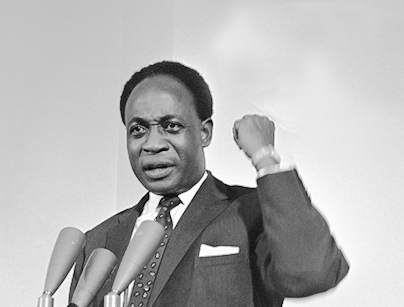

Audio By Carbonatix
As Ghana commemorates Founder’s Day on September 21 in honor of Osagyefo Dr. Kwame Nkrumah, and prepares to observe World Maritime Day on September 25, it is fitting to reflect on the immense legacy of Ghana’s first President in shaping the nation’s maritime infrastructure and its associated economic development.
Nkrumah understood, far earlier than many of his contemporaries, that maritime infrastructure was not merely about ships and harbors, but about the holistic integration of ports, industry, and transport systems as catalysts for national development. His vision for Ghana’s maritime future laid the foundation for much of what sustains the sector today.
Central to Nkrumah’s maritime ambition was the construction of Tema Port in the 1950s. At that time, global port development was in its second generation, characterized by mechanized handling of bulk cargo, stronger links with inland transport, and increasing integration with industrial activity. Though containerization in Ghana would only begin in the 1980s, the decision to build Tema Port positioned Ghana as a modern maritime hub in West Africa.
In keeping with international practice where port development stimulates city growth, Nkrumah complemented Tema Port with the creation of Tema Township, envisaging a symbiotic relationship between the port and the surrounding urban space. Although the port’s contribution to the township’s development has diminished in contemporary times, the initial model remains a testament to his foresight.
Nkrumah ensured that the port was not an isolated facility, but part of a broader industrial ecosystem. He strategically established industries such as the Tema Oil Refinery, Volta Aluminium Company (VALCO), and Tema Steel Works to provide both inputs and outputs for port-related trade, while also supporting maritime-linked industries such as shipbuilding.
Equally critical was the creation of maritime-supporting infrastructure:
- Tema Dry Dock: Essential for ship maintenance and repair, reducing dependence on foreign facilities and ensuring that Ghanaian and foreign vessels could be serviced locally, thereby retaining revenue within the country.
- Tema and Takoradi Boat Yards: Vital for constructing and repairing smaller vessels, enhancing coastal trade, artisanal fishing, and inland waterway transport. Boat yards not only bolstered the fishing and transport sectors but also cultivated local technical skills in ship repair and boatbuilding.
Recognizing the strategic importance of fisheries to food security and maritime trade, Nkrumah established the Ghana Fishing Corporation, which operated 19 fishing trawlers. This strengthened Ghana’s presence in industrial fishing, encouraged the growth of ancillary industries such as fish processing, and provided employment for Ghanaian seafarers.
To absorb the seafarers being trained by the Ghana Nautical College—established in the 1950s—Nkrumah created the Black Star Line, Ghana’s national shipping line, with 19 general cargo vessels. This provided opportunities for practical sea service, reduced dependency on foreign shipping lines, and elevated Ghana’s status as a maritime nation. The Nautical College has since evolved into the Regional Maritime University (RMU), serving West and Central Africa, a living testament to Nkrumah’s regional vision.
A port is only as strong as its connections to its hinterland. Nkrumah’s infrastructure development included the Tema–Accra Railway line and other railway projects to facilitate efficient cargo movement between ports and inland destinations. Complementing this was the Tema Motorway, which remains Ghana’s most vital land transport corridor for cargo moving to and from Tema Port. These projects illustrate Nkrumah’s comprehensive understanding of the maritime transport chain.
Osagyefo Dr. Kwame Nkrumah was not merely Ghana’s political founder; he was the architect of Ghana’s maritime and industrial infrastructure. His integrated approach—linking ports, industry, shipping, fishing, education, and transport—demonstrates an advanced appreciation of maritime economics and logistics. Today, even as Ghana navigates new challenges in the global maritime domain, Nkrumah’s legacy continues to inspire.
As we mark World Maritime Day, we must acknowledge that Ghana’s maritime future rests on the shoulders of the visionary who built its foundation. Indeed, Kwame Nkrumah remains the doyen of Ghana’s maritime infrastructure—a leader who saw in the sea not just a boundary, but a boundless horizon of opportunity.
Writer: Evans Ago Tetteh, Ph.D.
Regional Maritime University.
Regent, Kpone-Sebrepor.
Latest Stories
-
‘I am disappointed’ – Yaw Ampofo Ankrah breaks silence after NSA suspension
12 minutes -
Douglas Boateng receives IMM Institute Supply Chain Lifetime Achievement Award
26 minutes -
Pentecost University to host international sustainability conference
58 minutes -
Ampofo Ankrah did not collect World Cup visa money – Lawyer
1 hour -
Baffour Awuah to spend night in EOCO custody – Atta Akyea
1 hour -
Torgbiga Wenya III opposes proposed elevation of 36 Anlo chiefs to Paramount status
1 hour -
The strengthening El Niño and what it could mean for Ghana
1 hour -
Baffour Awuah formally charged with money laundering, loss of public funds – Lawyer
1 hour -
Drone flight over EOCO building could attract 30-year jail term – Security consultant
1 hour -
Flying drone over EOCO premises is strictly prohibited – Security consultant
1 hour -
SIC file was surrendered to client, EOCO has no reason to search Manhyia South MP’s firm – Atta Akyea
2 hours -
EOCO search of Baffour Awuah’s law firm raises confidentiality concerns – Atta Akyea
2 hours -
“I will never ignore an invitation from EOCO if I had received one” — Manhyia MP
2 hours -
Baffour Awuah ready to cooperate fully with EOCO investigation – Bosome Freho MP
2 hours -
How a Ghanaian technology is helping fish farmers detect hidden threats before fish die
2 hours