

Audio By Carbonatix
The Director of Communications at Ghana Water Limited (GWL), Stanley Martey, has attributed the flooding in parts of Weija to human activities along river channels rather than the controlled spillage of the Weija Dam.
He explained that many residents have built structures on buffer zones and directly within river pathways, blocking the natural flow of water.
“People keep putting up structures that impede the flow of the river, and that is what is happening in the area,” he said on Adom FM’s Dwaso Nsem on June 11.
He stressed that when rivers are blocked, water will inevitably find alternative paths, often leading to flooding in surrounding communities.
“If you block a river, it will find a place to pass,” he stated.
Mr. Martey noted that there are clear policies prohibiting construction along riverbanks, but these rules have been ignored in several communities.
“On every side of the river, people are not supposed to build, but they have built to the extent that structures are now in the river itself and even filling it up,” he said.
He explained that when heavy rains occur, the blocked waterways cause water to overflow into residential areas.
“When the rains come, and the river cannot flow freely, it diverts and floods safer places,” he added.
Mr. Martey therefore rejected claims that Ghana Water Limited is responsible for the flooding due to the spillage.
“So we cannot be blamed for opening the dam,” he stressed.
He further warned that failure to release excess water from the dam could lead to a far worse disaster.
“If we do not open the dam and the excess water has nowhere to go, the dam could break—and that would be more disastrous than what we are seeing now,” he explained.
He cautioned that a collapse of the dam would cut off the water supply to large parts of Accra.
“If the dam breaks, we will not be able to abstract water for treatment. It would take three to four years to reconstruct it, meaning about 60 percent of people in Accra could go without water for years,” he warned.
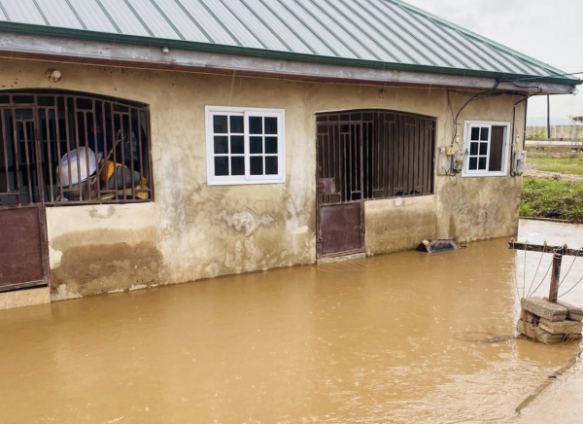
The controlled spillage has contributed to rising floodwaters in downstream communities, submerging homes and shops, and forcing residents to move belongings to safer locations.
Latest Stories
-
Mfantsipim @150: Ace Anan Ankomah leads project to preserve school’s musical heritage
38 seconds -
Gov’t launches rCOMSDEP in Ahanta West, Mpohor Fiase to promote responsible community mining
2 minutes -
AI is forcing professionals to rethink how they deliver value – Hubtel CEO
5 minutes -
Daily Insight for CEOs: Strengthening the CEO’s Leadership Legacy
6 minutes -
Jimmy Aglah’s ‘When the River Testified’ approved by NaCCA as Supplementary Reader
15 minutes -
Hubtel willing to contribute to Ghana’s proposed AI fund – CEO
19 minutes -
Nkrumah family pays tribute to Gamal, says he died after prolonged illness
29 minutes -
Police arrest eight suspects in anti-narcotics operation at Okaishie Drug Lane
40 minutes -
Former Krowor chairman pledges grassroots empowerment in NDC regional chairmanship bid
42 minutes -
GES recommends reposting of Obuasi SHTS headmaster after August 2026 campus riot
45 minutes -
Rocky Dawuni celebrates King Ayisoba for taking traditional music global
57 minutes -
Ghana targets $5bn in annual economic gains from AI – Sam George
58 minutes -
From childhood dreams to future careers: Ecobank’s Big Pitch seeks to promote early savings and investment
1 hour -
Public office demands make party work difficult for NDC appointees – Mahdi Gibril
1 hour -
AI could deepen rural-urban inequality without better connectivity – Sam George
1 hour