

Audio By Carbonatix
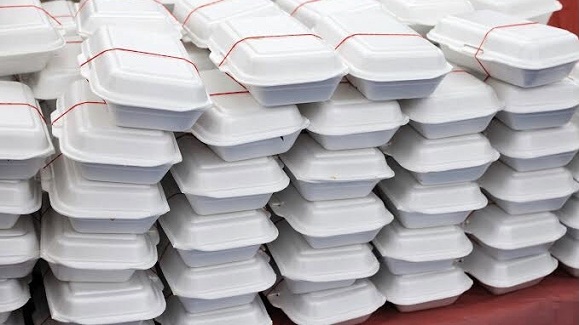
The Ghana Plastic Manufacturers’ Association (GPMA) has strongly opposed the Environmental Protection Authority’s planned ban on Styrofoam products, warning that the January 2027 deadline could trigger a financial crisis, widespread job losses, and undermine the government’s industrialisation agenda.
In a press statement issued on June 21, the GPMA appealed to President John Dramani Mahama to intervene and extend the implementation date to January 1, 2030, arguing that the current seven-month transition period is grossly insufficient and amounts to an “indirect closure” of their businesses.
The association, which represents over 171 production factories nationwide, said manufacturers have invested an estimated GH¢1.493 billion in plant and machinery dedicated to Styrofoam food packaging production, with much of that investment tied to bank loans.
In a firm rebuttal to suggestions that equipment could be converted for alternative uses, the GPMA stated categorically that Styrofoam manufacturing machines are designed solely for polystyrene products and cannot be retooled to produce biodegradable alternatives.
“Absolutely no Styrofoam manufacturing machine can be retooled to manufacture any of the proposed alternatives using plant-based materials,” the association declared in its statement.
The GPMA noted that return on investment for such machinery typically takes between five and ten years, with some companies having acquired new equipment as recently as two years ago. In one instance, a company that set up completely new operations two years ago would only recover its investment by 2030.
The plastic industry, the GPMA stressed, is a significant contributor to Ghana’s economy. It directly employs over 41,395 people and supports an estimated 1.89 million jobs in the plastic waste recycling sector, as well as 1.43 million jobs in the sachet water, bottled water, food and beverage industries.
“Total employment generation by the plastic industry is about 3.71 million, and about 92% of industries in Ghana depend on the plastic industry for all their plastic packaging needs,” the association stated.
The industry also exports over 57% of its products across the ECOWAS region and beyond, including Angola, Namibia, the Democratic Republic of Congo, and Algeria, making it one of Ghana’s top five commodity exports.
The GPMA warned that an outright ban would increase dependence on imported alternatives, put pressure on foreign exchange, and lead to factory closures. It also cautioned that relocating machinery abroad could trigger capital flight and fuel inflation.
The association revealed that financial institutions have grown increasingly concerned since the EPA’s May 25 announcement, with banks worried about how to recover loans if machinery becomes obsolete.
“Since EPA’s press release, the banks have taken serious concern as to what will happen to our machinery and how to recover their loans if the machines become scrap,” the GPMA said.
The Environmental Protection Authority announced the nationwide ban on the production, importation, distribution, sale, and use of polystyrene foam products on May 25, 2026, following a policy announcement by President Mahama during the 2025 World Environment Day celebrations.
The ban covers all forms of expanded polystyrene foam products, including food packaging containers, disposable cups and plates, foam mattresses, and ceiling insulation materials, though medical and scientific products are exempt.
The GPMA said it was formally notified on June 4, 2026, leaving manufacturers just seven months to cease operations—a timeline the association described as premature.
While the GPMA says it does not oppose the ban in principle, it is urging a more measured approach. The association has proposed an 18-month transition period as a minimum, once all necessary conditions are in place, and has expressed support for a ban on the importation of finished Styrofoam products from January 2027.
Alternatively, should the government insist on the January 2027 deadline, the GPMA has requested a bailout or reimbursement of the GH¢1.493 billion capital investment cost of plant and machinery.
“These investments were made under the existing regulatory framework, and therefore, a sudden transition presents serious financial challenges,” the association stated.
The GPMA also argued that plastic pollution is primarily a waste management challenge rather than a production issue, pointing to countries like Germany, South Korea, and the Netherlands, which achieved better environmental outcomes through Extended Producer Responsibility systems and investments in recycling infrastructure rather than outright bans.
The association has appealed to President Mahama to intervene, warning that a ban implemented without adequate safeguards could defeat government efforts to support local manufacturing and improve import substitution.
Latest Stories
-
Absa Bank Ghana names Stephen Ato Frimpong as Board Chair
5 minutes -
Pickford ‘almost caused crash’ with careless driving
7 minutes -
Author and former politician Jeffrey Archer dies aged 86
18 minutes -
No education reform can succeed without teachers – Education Ministry
26 minutes -
Gauff condemns racist abuse after China Open win
43 minutes -
Medvedev disqualified for hitting spectator with ball
52 minutes -
Oliseh scores twice in late comeback win for France
1 hour -
Pentagon stops using Anthropic AI tools after blacklisting company, BBC told
1 hour -
From despair to dance: Family of nurse Salomey Baffoe rejoices after GH¢100k bail granted
2 hours -
Kejetia Phase III pricing talks loom as government moves to restart stalled works
2 hours -
Nchiraa Yam festival: Two killed, 14 injured as police restore calm
2 hours -
I draw inspiration for my songs from Reggae music – Lyrical Joe
2 hours -
AI must not replace human judgment in public spending – BoG Governor
2 hours -
Ghana should withdraw from 2027 AFCON – Kojo Addae Mensah
3 hours -
Team Ghana departs Accra for Angola ahead of Karting Africa Trophy
3 hours