

Audio By Carbonatix
The government’s Big Push infrastructure programme represents one of the most ambitious road development efforts Ghana has undertaken in decades.
Across the country, major corridors are being rehabilitated, expanded, and newly constructed to improve mobility, trade, and national integration.
Projects such as the Accra–Kumasi Expressway, the Eastern Corridor Road, the Tamale Outer Ring Road, the Sunyani Outer Ring Road, the Kumasi By-pass Road, the Ho–Denu Road, the Winneba–Cape Coast dualisation, and the Techiman–Nkonsia–Wenchi Road demonstrate a serious commitment to infrastructure-led development.
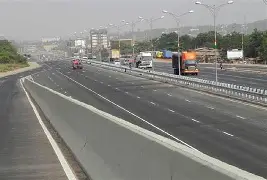
As these projects advance, one concern deserves urgent attention. Ghana must ensure that communities do not eventually creep onto these highways.
This is one of the biggest infrastructure mistakes many developing countries make. Roads are constructed as high-speed national corridors, only for uncontrolled settlements, roadside trading, fuel stations, churches, container shops, schools, and residential developments to gradually grow directly along the carriageway.
Within a few years, the highway ceases to function as a true highway. It becomes a crowded town road. And once that happens, the problems begin.
Traffic congestion becomes inevitable because vehicles entering and exiting homes, shops, markets, and communities constantly interrupt traffic flow. What was designed for fast intercity movement becomes slow, chaotic, and heavily congested. A journey that should take two hours gradually becomes four or five.
Even more serious is the danger to human life. When settlements creep onto highways, pedestrians begin crossing high-speed roads daily. Children cross to school. Traders cross to markets. Residents cross to churches, mosques, workplaces, and bus stops.
In some cases, entire communities become divided by the road itself, with families effectively living on one side and carrying out daily life activities on the other side.
This creates the perfect conditions for road accidents. Many of the fatal highway accidents across Africa are not caused only by speeding or poor driving. They are caused by poor spatial planning around highways.
A motorway is never meant to function simultaneously as a pedestrian walkway, market centre, transport terminal, and residential access road.
Across much of the world, major highways are protected corridors. Communities are deliberately prevented from building directly onto them. Access is controlled through exits, interchanges, service roads, and bypass systems.
The principle is simple: highways are for movement, while towns are accessed through planned entry points. Ghana must adopt the same long-term mindset.
If strict development controls are not enforced around these Big Push corridors, today’s modern highways could become tomorrow’s congestion nightmares. The country would then spend billions again trying to solve problems that could have been prevented from the beginning.
This is why land use regulation is just as important as road construction itself.
District Assemblies, physical planning authorities, the Ministry of Roads and Highways, and traditional authorities must work together to preserve road corridors before encroachment becomes irreversible.
Setback enforcement cannot be relaxed for short-term political convenience. Unauthorised roadside developments must not be tolerated simply because they emerge gradually over time.
The danger with settlement creep is that it often happens slowly and almost unnoticed. One fuel station appears. Then a few container shops. Then a transport stop. Then residential buildings. Before long, a national highway is functioning like a busy urban street.
And once communities become fully established along a highway, removing or redesigning them becomes politically difficult, socially disruptive, and financially expensive.
The Big Push programme should therefore not be evaluated only by the number of kilometres constructed. Its true success will also depend on whether Ghana preserves these corridors properly for future generations.
Infrastructure is not only about building roads. It is about protecting the purpose of those roads. If we fail to control community creep around these highways, we risk creating more traffic congestion, more pedestrian deaths, more roadside disorder, and more costly reconstruction exercises in the future.
The decisions made today about corridor protection and settlement control will determine whether these roads remain efficient national arteries decades from now or become yet another cycle of congestion and avoidable tragedy.
Latest Stories
-
GTA sensitises taxi drivers in ‘Know Ghana’ tourism campaign
2 minutes -
Archbishop Agyinasare calls for responsible speech amid growing social media abuse
6 minutes -
‘It will be inexcusable for gov’t not to honour payment of teachers’ arrears by 30th October’ – Haruna Iddrisu
15 minutes -
Forbes’ World’s Best Employers 2026: No Ghanaian firm ranked among 900 companies
17 minutes -
Electronic processing of teachers’ data: ‘The decision is the Controller’s’ – GES boss
21 minutes -
Teachers’ Strike: Haruna Iddrisu questions paper-based processing of promoted teachers’ data
34 minutes -
Teachers’ strike: GES targets Monday deadline to submit promotion data to Controller
42 minutes -
Inflation to average 11.3% in 2027 – Fitch Solutions
1 hour -
I didn’t campaign for NDC to come and do this nonsense – Kpebu on EOCO
1 hour -
Fitch Solutions maintains policy rate forecast of 14% by December 2026
1 hour -
Diaspora Nasara Caucus congratulates Mohammed Ali Suraj, new NPP executives
3 hours -
Dr Antwi-Boasiako’s cybersecurity book showcased at UN crime prevention congress
3 hours -
We will empower the grassroots and protect every vote – NPP’s 1st Vice Chair Kojo Bamba
3 hours -
I do not see myself as better than anyone – NPP’s 1st Vice Chair Kojo Bamba
4 hours -
Police blur the line between invitations and arrests – Reindorf Twumasi Ankrah
4 hours