

Audio By Carbonatix
Ghana’s efforts to tackle youth unemployment and poverty will remain incomplete without sustained investment in Technical and Vocational Education and Training (TVET), with a deliberate focus on strengthening small and medium-sized enterprises (SMEs) as drivers of job creation.
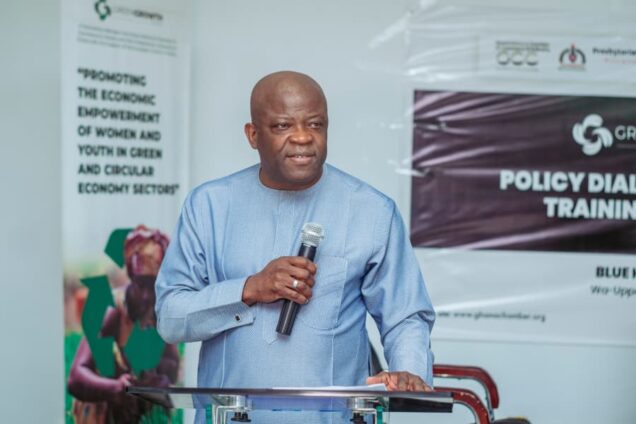
This was the message delivered by development expert Chris Addy-Nayo during a recent policy dialogue on vocational training, youth development and economic transformation in Tamale.
Mr Addy-Nayo stressed the urgent need to reposition TVET as a strategic catalyst for SME growth rather than treating it as a secondary alternative to academic education.
“In today’s economy, skills are the new currency,” he stated, emphasising the need to equip young people with practical and market-relevant skills that directly support enterprise development in sectors such as green businesses, digital services, construction and sustainable agriculture.
He explained that aligning TVET curricula with the needs of SMEs would ensure graduates are not only employable but also capable of establishing and expanding their own businesses.
According to him, a well-structured TVET system has the potential to transform thousands of young people into entrepreneurs, strengthen local industries and reduce dependence on limited formal sector employment opportunities.
Mr Addy-Nayo noted that SMEs thrive when supported by a skilled workforce, innovation and business-oriented training, areas in which TVET can play a transformative role.
He added that strengthening TVET is critical not only for economic growth but also for building resilient local economies and reducing rural-urban migration.
The development expert further highlighted the potential of TVET to empower women and rural youth by equipping them with practical skills, financial literacy and access to value chains needed to establish and grow SMEs.
According to him, this approach is essential for promoting inclusive growth and reducing inequality across regions.
However, he cautioned that the full benefits of TVET can only be realised through strong political commitment, increased funding and deeper collaboration among government, industry players, financial institutions and training centres.
He also called for the establishment of incubation hubs, strengthened apprenticeship systems and improved access to start-up financing to bridge the gap between skills training and enterprise development.
As Ghana seeks to build a resilient and inclusive economy, Mr Addy-Nayo said policymakers must move beyond rhetoric and invest decisively in a TVET system that directly supports SME development.
“TVET is not just about skills training; it is about building businesses, creating jobs, restoring dignity, and securing the future of our young people,” he concluded.
Latest Stories
-
Police blur the line between invitations and arrests – Reindorf Twumasi Ankrah
20 minutes -
Turning invitations into arrests is making citizens reluctant to assist police – Twumasi Ankrah
53 minutes -
The Traffitech-GH SMS spot-fine system: The good, the sad, and the funny – Bright Simons writes
1 hour -
Hawa Koomson pledges experienced and mature leadership of NPP women’s wing
2 hours -
Young woman found dead at Kasoa Peace Town
3 hours -
Playback: The Law examined lawful arrest in Ghana
3 hours -
Mahama urges African governments to treat healthcare as an investment, not budget cost
4 hours -
Bawumia congratulates John Boadu and new NPP executives, pledges support ahead of 2028
4 hours -
Aksa Energy delegation pays courtesy call on GRA Commissioner-General
4 hours -
‘No talent should be left out’ – Bawumia pledges inclusive NPP campaign for 2028
4 hours -
Prof. Mike Oquaye recounts how he blocked the Special Prosecutor’s attempt to arrest Bawku Central MP
4 hours -
Make health sovereignty a priority for Africa – Mahama
4 hours -
Dorimon Naa, Wa West DCE lead massive clean-up exercise; threaten sanctions against recalcitrant residents
5 hours -
Photos from Adom FM Y2K Jam
5 hours -
Praye Tiatia steals the show at Adom FM Y2K Jam [Watch]
5 hours