

Audio By Carbonatix
Rwanda’s health minister said Sunday that an outbreak of the Marburg virus is not spreading in the country, citing the absence of new infections or deaths in the past six days.
“We don’t have community transmission,” Health Minister Sabin Nsanzimana told reporters in Kigali, the Rwandan capital. All positive cases have come from the list of known contacts of people with the virus, he said.
Identifying and isolating people exposed to contamination is key to stopping outbreaks of viral hemorrhagic fevers like Marburg. Rwanda has documented 1,146 contacts.
Nsanzimana spoke alongside Tedros Adhanom Ghebereyesus, the World Health Organization director-general, who praised Rwanda’s efforts to stem the outbreak of the Ebola-like disease.
“I can see that the outbreak is being managed under strong leadership,” Tedros said. “But we are dealing with one of the world’s most dangerous viruses, and continued vigilance is essential.”
Rwanda declared the outbreak on Sept. 27 and has so far reported 15 deaths. Health authorities have confirmed 44 recoveries and only three active cases remain, according to official figures.
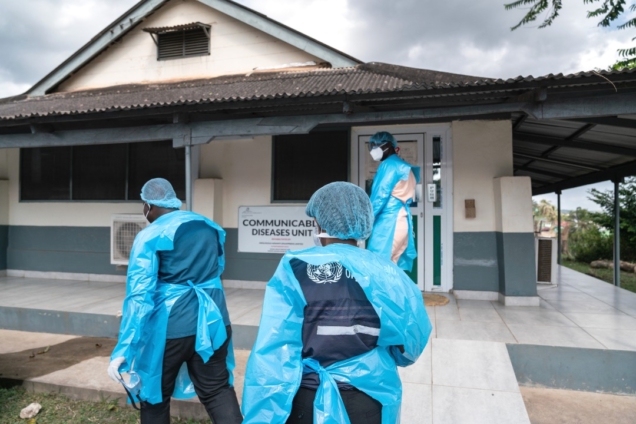
Most of the affected people have been health workers who got the virus while treating patients, Nsanzimana said.
Nsanzimana said that an investigation showed the index case was almost certainly a 27-year-old man who had been exposed to the virus from contact with a specific cave-dwelling bat species. The man had sought treatment at Kigali’s King Faisal Hospital, exposing many health workers there.
Like Ebola, the Marburg virus is believed to originate in fruit bats and spreads between people through close contact with the bodily fluids of infected individuals or with surfaces, such as contaminated bed sheets.
Without treatment, Marburg can be fatal in up to 88% of people who fall ill. Symptoms include fever, muscle pains, diarrhea, vomiting and, in some cases, death through extreme blood loss.
Rwandans have been urged to avoid physical contact to help curb the spread. Schools and hospital visits have been suspended and the numbers of people who can attend funerals for Marburg victims have also been restricted. Home vigils are banned if a death is linked to Marburg.
The U.S. Embassy in Kigali has urged its staff to work remotely and avoid visiting offices.
There is no authorized vaccine or treatment for Marburg.
Marburg outbreaks and individual cases have in the past been recorded in Tanzania, Equatorial Guinea, Angola, Congo, Kenya, South Africa, Uganda and Ghana.
The virus was first identified in 1967 after it caused simultaneous outbreaks of disease in laboratories in the German city of Marburg and in Belgrade, Yugoslavia. Seven people died after being exposed to the virus while conducting research on monkeys.
Latest Stories
-
Iran war lands ‘triple blow’ to flood-ravaged Sri Lankans
7 minutes -
Gunmen kill at least 11 people at Afghanistan picnic spot
20 minutes -
Woman, 25, in court for stealing baby at Bogoso
21 minutes -
Trump unveils giant gold-accented victory arch design for US capital
25 minutes -
We spoke to the man making viral Lego-style AI videos for Iran. Experts say it’s powerful propaganda
29 minutes -
Hungarians vote in big numbers on whether to end Orbán rule and elect rival
30 minutes -
At least 30 feared dead in crush at Haitian tourist site
30 minutes -
Boxing: Abdul Ahmed wins WBA Africa Cruiserwight title after dispatching Nigeria’s Eradeye
44 minutes -
Nearly 2,000 displaced, schools damaged as windstorm wreaks havoc in Gushegu
1 hour -
Ghana’s Derrick Kohn to work under Marie-Louise Eta as she becomes first woman to coach men’s Bundesliga team
1 hour -
Accra Open Championships conclude with strong performances ahead of African Championships
1 hour -
Ghana to begin camping with 12 athletes after Accra Open Championships – Bawa Fuseni
2 hours -
Anthony Joshua declines showdown with Tyson Fury but admits they ‘probably’ clash next
2 hours -
Tyson Fury dominates Makhmudov, calls out Joshua next
2 hours -
I have supported highway authority financially to fix roads in my constituency – A Plus
3 hours