


Audio By Carbonatix
A judge has denied bail to Sean "Diddy" Combs after a jury convicted the hip-hop mogul of transportation to engage in prostitution, but acquitted him of the most serious charges: racketeering and sex trafficking.
Lawyers for the recording artist had argued he posed no flight risk, pointing out his jet is being chartered in Hawaii.
But Judge Arun Subramanian cited Combs' history of violence as he ruled the rapper must remain behind bars until sentencing later this year when he faces up to 20 years in prison.
In the nearly two-month federal trial in New York City, prosecutors accused Combs of using his celebrity status and business empire to run a criminal enterprise to sex traffic women.
A panel of 12 jurors deliberated for 13 hours before acquitting Combs of three of the five most serious charges.
He will continue to be held at the same federal jail in Brooklyn where he has been detained since last September.
The sentencing was tentatively scheduled for 3 October.
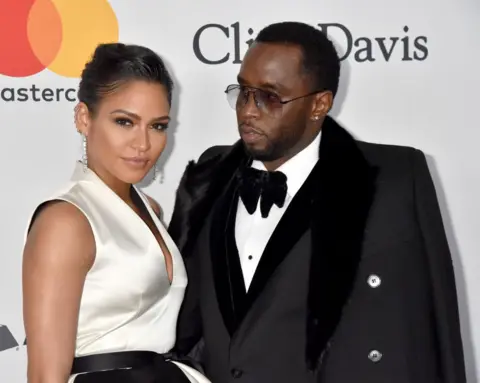
Combs' attorney, Marc Agnifilo, made an impassioned argument for the judge to release his client.
The defence lawyer said Combs had attended a programme for perpetrators of domestic violence to try to reform his conduct, even before he was arrested, and that he had not been violent since 2018.
"I just think we should trust him," Agnifilo said.
But Combs' ex-girlfriend, musician Casandra Ventura, had warned the court in a letter that the hip-hop mogul would pose a danger if released.
The rapper had acknowledged domestic violence, but denied any non-consensual sexual encounters or a larger racketeering scheme.
Judge Subramanian said bail was being denied because "the defence conceded violence in his personal relationship".
The mood in court was emotional after jurors announced they had acquitted Combs of the most serious charges of racketeering and sex trafficking.
Sex trafficking and racketeering both carry a maximum sentence of life in prison.
As Combs learned the verdict, he got on his knees, put his face into his chair and appeared to be praying. He was shaking.
The verdict comes a day after jurors told the court they had reached a decision on the sex-trafficking and transportation to engage in prostitution charges against Combs, but were unable to decide on the racketeering count.
The jurors said they had had "unpersuadable" opinions on both sides about the charge, which was the most complicated of any of the counts Combs faced.
Racketeering conspiracy, or directing an illegal enterprise under the Racketeer Influenced and Corrupt Organizations Act (Rico), is the formal name for the charge.
To convict Combs on this charge, prosecutors had to prove he used his loyal network of associates to run a criminal enterprise to commit crimes including sex trafficking, kidnapping, drugging and obstruction of justice.
Defence lawyers argued the case could not be considered to be racketeering if members of Combs' staff were not knowingly complicit.
Prosecutors called more than 30 witnesses over the course of the seven-week trial, includingMs Ventura, rapper Kid Cudi, several ex-employees and hotel security workers.
They allegedCombs had relied on employees to coerce his partners into so-called "freak-offs", in which his girlfriends would have sex with a male escort while he watched and filmed.
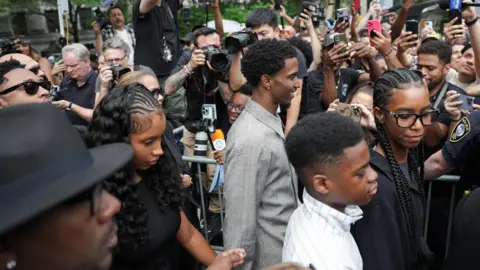
The government relied on testimony from Ms Ventura, who took the witness stand while eight months pregnant, telling the court that Combs had pressured her into sex acts and threatened to release tapes of the freak-offs if she disobeyed.
Ms Ventura warned on Wednesday that Combs would pose a danger if granted bail.
In a letter filed to the court, her attorney Douglas Wigdor wrote: "Ms Ventura believes that Mr Combs is likely to pose a danger to the victims who testified in this case, including herself, as well as to the community."
At the centre of their case was a video of the rapper beating and dragging Ms Ventura in a Los Angeles hotel hallway in 2016 - surveillance footage that security employees testified Combs tried to pay them to delete.
Combs' attorneys conceded their client was violent towards women, but argued that his behaviour was motivated by drugs and jealousy, not evidence of a larger sex trafficking and racketeering scheme.
Combs is also facing dozens of civil lawsuits alleging sexual assault and violence.
The Harlem-born rapper founded Bad Boy Records in 1993, a label that represented some of the biggest names in hip hop - including Notorious B.I.G. and Usher.
He went on to establish a clothing line called Sean John and a variety of other businesses including fragrances, alcohol and even a media company.
Latest Stories
-
Mr President, Ghana was mentioned at the UN; why aren’t we talking about it?
3 hours -
Accra to convene Africa’s regulators and markets on tokenisation at AVAS 2026
3 hours -
The Paradox of Plenty — When every smartphone becomes a newsroom
3 hours -
GTA sensitises taxi drivers in ‘Know Ghana’ tourism campaign
4 hours -
Archbishop Agyinasare calls for responsible speech amid growing social media abuse
4 hours -
‘It will be inexcusable for gov’t not to honour payment of teachers’ arrears by 30th October’ – Haruna Iddrisu
5 hours -
Forbes’ World’s Best Employers 2026: No Ghanaian firm ranked among 900 companies
5 hours -
Electronic processing of teachers’ data: ‘The decision is the Controller’s’ – GES boss
5 hours -
Teachers’ Strike: Haruna Iddrisu questions paper-based processing of promoted teachers’ data
5 hours -
Savannah Region: Kunfusi bridge collapses again, leaving nearly 4,000 residents cut off
5 hours -
Teachers’ strike: GES targets Monday deadline to submit promotion data to Controller
5 hours -
Inflation to average 11.3% in 2027 – Fitch Solutions
6 hours -
‘I didn’t campaign for NDC to come and do this nonsense’ – Kpebu on EOCO’s conduct
6 hours -
Fitch Solutions maintains policy rate forecast of 14% by December 2026
6 hours -
Diaspora Nasara Caucus congratulates Mohammed Ali Suraj, new NPP executives
7 hours