

Audio By Carbonatix
March 8 is International Women’s Day. We celebrate the day because the pursuit of equality is just, fair and necessary. We celebrate the day because the shattering of the false assumptions of patriarchy and the progress women and girls have made in male-dominated societies mark an inflection point for civilization.
But even as we celebrate, the theme for this year’s observance, #Accelerateaction, reminds us of the obstacles, reverses and the work that remains to be done. Indeed, as I will argue, the work of and for equality is always in progress. Like all areas of human life that deal with rights, responsibilities and expanding freedom, the progress attained at each point can slip away, unless citizens continue to fight daily and relentlessly for hard-won victories, and even more progress.
That is why we must devote the day for reflection and stock taking. Everyone- men, women, boys and girls - can make that effort worthwhile by committing to amplify efforts for attaining gender equality.
I am aware that because of the progress we have made, some assume that the world is an equal place. They see women going to school, voting, working, and leading. The statistics show otherwise. The World Economic Forum for example estimates that it will take some 134 years to reach full parity, roughly five generations beyond the 2030 Sustainable Development Goal (SDG) target.
Aside from the statistics from the World Economic Forum and research bodies, most countries, communities and organisations still have men dominating in leadership positions, science, technology and business. Recent developments have shown that we cannot afford to take even the progress made since the Beijing Conference of 1995 for granted. We see a pattern of regression on women’s empowerment and gender equality. Some question the value of gender parity. The pushback against women’s rights is what made Antonio Guterres, the Secretary-General of the United Nations, call for a pushback against the pushback.
In some parts of the world, groups advocating for certain religious and political ideologies have targeted women and girls, especially female human rights defenders, with violence and, at times, death. Some political leaders in democratic states exploit latent misogyny to ride to power and curtail the rights of women. Female representation in parliaments and cabinets continues to ebb and flow. And the consensus around affirmative action has never faced such an attack as we see today.
If there was any doubt about the seriousness of the pushback, recent developments, demonising support for diversity and discrimination-conscious or discrimination-sensitive policy-making should make us all sit up.
As a four–term Ghanaian parliamentarian who has also served for eight years as Foreign Minister, including being a proud member of the network of female Foreign Ministers, I am familiar with sexism in politics and other barriers women face navigating leadership and politics. I am also very familiar with the cost of discrimination and inequality across all classes and groups. I do not reveal an original truth by saying that we all lose when we relegate women, and girls to an inferior status.
I call on leaders, including female leaders, to ensure that younger generations are empowered to lead conversations on #Me too, achieving gender equality, ending violence against women; eliminating unpaid labour, bridging the financial gap, including women in peace processes and climate change policy deliberations. Political leaders must have the courage to stand by their convictions on the primacy of human rights.
The Commonwealth of Nations, which I will lead as the 7th Secretary-General from April 1st, 2025, has a population of 2.7 billion people, out of which about 1.5 billion are young people. Our family of nations hosts a large number of women and girls. I am committed to working with Governments, civil society and boys in the Commonwealth to fight for the equality of men and women and to uphold the rights and voices of girls and women. Parents play an outsize role in the education of children, especially in imparting stereotypes. We must re-engage families and communities in conversations on women’s empowerment and gender equality. And we must avoid knee-jerk social goals that contradict evidence, especially as we fight to protect young people from gender based violence, disease and poor health and human well-being outcomes.
I will advocate with others for the access of young girls to digital education and artificial intelligence to bridge the gender data gap, which is exacerbated by inherent biases. As we do that, we must promote independent, non-male-centred data that serves the needs of all members of society.
We cannot let the reverses of today, accentuated by the cynicism of those who yearn for a world gone by, disempower us. I fear that unless we reclaim the fighting spirit of those who brought women the vote; the Universal Declaration on Human Rights; the victories of the Civil Rights Movement in the United States that inspired others elsewhere; political independence, and the heady promise of Beijing, we shall drown in pitiful pessimism.
It is a long and hard road
We must not set down the load
North, south, east or west.
There’s no place yet to lounge or rest.
I take my stand. I say no to an unequal world.
******
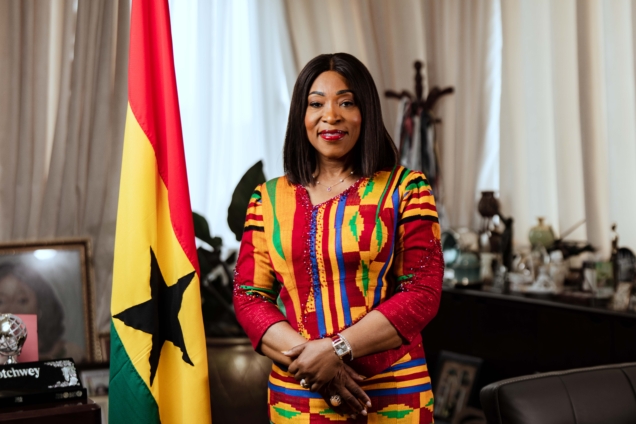
Shirley A. Botchwey is the Secretary-General-Elect of The Commonwealth. She takes office on April 1, 2025, as Commonwealth Secretary-General from the Baroness Patricia Scotland.
Latest Stories
-
Israel-bound flight diverted after fight between pilots
1 minute -
EchoWave earns praise for sound quality at 10th Women in Worship
11 minutes -
Crackdown on South Africa’s unsafe streets ordered by president to keep women safe
22 minutes -
Banks are responding to improved monetary policy conditions – John Awuah
41 minutes -
Judges’ conference forces further adjournment of Salomey Baffoe case to Oct. 5
53 minutes -
GRA assures Tullow of collaboration to settle $393m tax liability without disrupting its petroleum operations
1 hour -
South Korea demands apology from Pyongyang for landmine blasts that injured three
1 hour -
Carlos Queiroz not the sort of coach Black Stars need – Nii Lante Vanderpuye
2 hours -
AFCON 2027Q: ‘Our Black Stars team is gone’ – Former Sports Minister
2 hours -
Prof. Prempeh calls for public review of draft constitutional reform bills
2 hours -
AFCON 2027Q: ‘I have never seen a poor performance from Black Stars like against Gambia’ – Nii Lante Vanderpuye
3 hours -
Bawumia backs insurance sector reforms after engagement with IBAG
3 hours -
Nigeria set to launch National Digital Address System 9 years after Ghana showed the way
3 hours -
Policy rate decision takes time to reflect in lower lending rates – BoG
3 hours -
Polytanks Ghana supports GNFS with water storage tanks
3 hours