


Audio By Carbonatix
South Africa's High Court has ruled that a decision to drop 783 corruption charges against President Jacob Zuma should be reviewed.
The charges were dropped just weeks before the 2009 election which led to Mr Zuma becoming president.
Judge Aubrey Ledwaba said the decision by the chief state prosecutor at the time, Mokotedi Mpshe, was "irrational".
The case, brought by the opposition Democratic Alliance, opens the way for prosecutors to reinstate the charges.
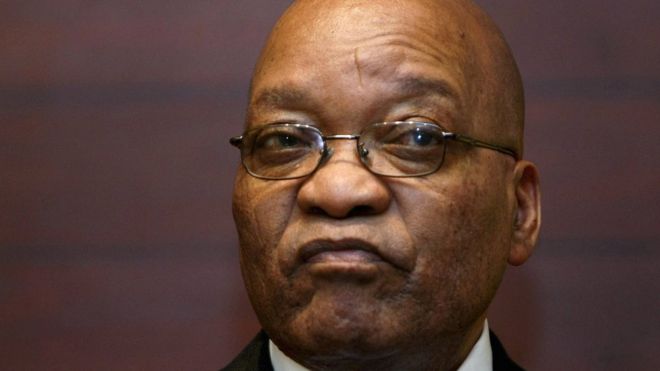
Mr Zuma always denied the allegations which are linked to a government arms deal in 1999 worth billions of dollars.
Last week, a judge-led commission of inquiry found no evidence of corruption or fraud by any government officials at the time.
"Today is a great victory for the rule of law and ultimately we believe that Jacob Zuma must face prosecution and this judgement certainly affirms the view that we've always held," Democratic Alliance leader Mmusi Maimane said after the ruling.
"I congratulate my colleagues who've worked exceptionally hard on this case; it's been a long battle."
It was dubbed the "spy tapes" case after the National Prosecuting Authority (NPA) dropped the charges in 2009.
The authority said new phone-tap evidence suggested political interference in the investigation.
South Africa's governing African National Congress (ANC) said the High Court's ruling did not infer any culpability in any crime or offence by the president.
"The ANC has consistently supported the legal maxim that justice delayed is justice denied. This matter has dragged on for close to a decade and the ANC is pleased therefore that it now appears closer to resolution, seven years since the NPA decision," it said in a statement.
What are the spy tapes?
- In 2009, NPA chief prosecutor Mokotedi Mpshe received phone-tap evidence from Mr Zuma's lawyers
- He said the recordings suggested political interference in the investigation
- The recordings were of conversations that Leonard McCarthy, a former head of an elite unit fighting organised crime, had with several people about the timing of the case against Mr Zuma
- In 2014, the opposition DA won a court battle to access the sealed recordings and make them public
- After listening to the recordings, the DA legal team believed there was nothing that warranted the charges being dropped
- A High Court ruling in April 2016 says the 2009 decision was irrational and Mr Zuma should face charges.
Judge Ledwaba said Mr Mpshe had "found himself under pressure" when he decided to discontinue the prosecution and "consequently made an irrational decision".
"Considering the situation in which he found himself, Mr Mpshe ignored the importance of the oath of office which commanded him to act independently and without fear and favour.
"It is thus our view that the envisaged prosecution against Mr Zuma was not tainted by the allegations against Mr McCarthy.
"Mr Zuma should face the charges as outlined in the indictment."
This is the latest legal setback for the South African president.
Last month, South Africa's highest court found that he had breached the constitution by failing to repay public money used to upgrade his private home.
It backed an earlier ruling by an anti-corruption body that said $23m (£15m) of public money had been improperly spent on Mr Zuma's rural home in Nkandla in KwaZulu-Natal province.
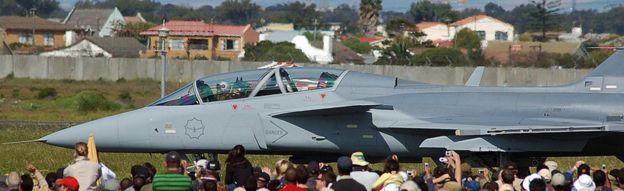
- 1999: largest-ever post-apartheid arms deal announced with contracts totalling 30bn rand ($5bn; £2.5bn) to modernise national defence force
- Deal involved companies from Germany, Italy, Sweden, the UK, France and South Africa
- Allegations of bribery over deal dogged governments of President Jacob Zuma and predecessor Thabo Mbeki
- Mr Zuma's former financial adviser Schabir Shaik convicted in 2005 for corruption over deal. Found guilty of trying to solicit bribe from Thint, local subsidiary of French arms firm Thales, on behalf of Mr Zuma - then deputy president. Released on parole on health grounds after serving just over two years
- Another official, Tony Yengeni, chairman of parliament's defence committee at time of deal and ANC chief whip, convicted of fraud in 2003. Also freed on parole after serving five months of four-year sentence
- April 2016: commission of inquiry into deal found no further evidence of corruption or fraud
Latest Stories
-
Politicisation could undermine parliamentary probe into cocaine seizures – Dr Osae-Kwapong
6 minutes -
EOCO chases MP: Can Section 41 cure lacuna in EOCO Act? – Inusah Fuseini asks
9 minutes -
GNFS, GWL inspect fire hydrants in Ministries enclave; 23 found faulty
15 minutes -
Gov’t directs release of 50,000 bags of grain to ECOWAS
17 minutes -
Ghana, Germany deepen cooperation on railways, labour mobility
22 minutes -
Huge crowds greet Pope in Paris for open-air Mass
33 minutes -
‘I never said I’ll declare a state of emergency’ – President Mahama on galamsey
1 hour -
Bobby Banson condemns EOCO’s attempted arrest of Nana Agyei Baffour Awuah
2 hours -
When Kumasi begins to look like somebody is in charge
2 hours -
Parliamentary probe into cocaine seizure would be a waste of time – Inusah Fuseini
2 hours -
Cocaine seizure: Focus on Ghana’s reputation, not partisan blame – Osae-Kwapong
2 hours -
Two Invitations, Three Interrogations: Did Baffour Awuah tell the whole story?
2 hours -
Drug cartels may be seeing Ghana as easy route – Lenin Anane Agyei
3 hours -
Ghana risks gaining notoriety as drug-trafficking hub – Bobby Banson
3 hours -
Government dismissed my drug trafficking warning, then tried to arrest me – Ntim Fordjour
3 hours