

Audio By Carbonatix
After delays and a flap with the FAA, the Mars rocket prototype ran a vertical 10K on Tuesday.
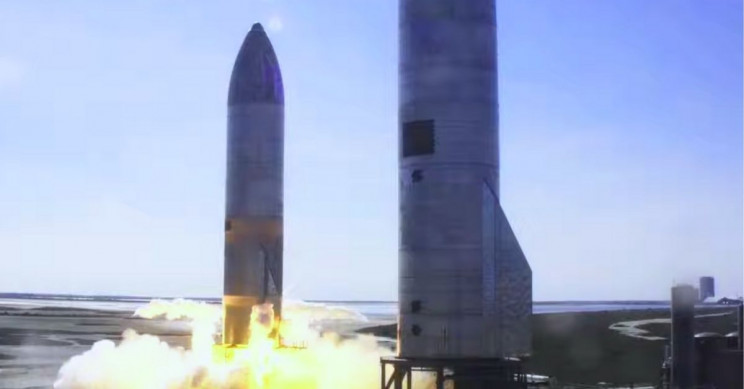
The second flight of a prototype of Elon Musk's next-generation Starship rocket, meant for eventual trips to Mars, was picture-perfect right up until the landing, which like the test of an earlier prototype, ended in a fiery explosion on Tuesday.
After several delays and a dust-up with the Federal Aviation Administration over its launch license, SpaceX launched the vehicle dubbed SN9 from its Boca Chica, Texas, facility at around 12:30 p.m. PT.
The three-engine rocket flew to an altitude of 6.2 miles (10 kilometers), shutting off its three engines in sequence as it climbed higher. It then began a long fall back to Earth, as its predecessor SN8 did during a test flight in December.
As it came in for a landing, SN9 executed a landing burn to orient itself vertically for touchdown, then appeared to land hard and not quite vertical, exploding on impact just as SN8 did.
The FAA announced after the flight that the agency will open and oversee an investigation into SN9's "landing mishap."
"Although this was an uncrewed test flight, the investigation will identify the root cause of today's mishap and possible opportunities to further enhance safety as the program develops," an FAA spokesperson said in a statement.
SpaceX still considers the test a success and will continue to gather data for future test flights that will eventually take the prototypes to orbit.
"We've just gotta work on that landing," SpaceX's John Insprucker said during the livestream of the flight.
It became clear early Tuesday morning this might finally be the day for SN9's maiden (and only) flight, when the FAA said in an emailed statement it had approved the launch license for SN9, while also revealing the December launch of SN8 was done without the full sanctioning of the agency.
The revelation helps explain the weeks of delays before the launch of SN9. Last week, SpaceX and Musk engaged in a staring contest with the FAA, and the FAA didn't blink.
On Thursday, SpaceX went through the process of loading fuel into SN9 in preparation for a launch at its Texas Gulf Coast facility. But the FAA didn't give its approval for the flight to take place.
Musk aired his frustration with the government agency on Twitter:
Unlike its aircraft division, which is fine, the FAA space division has a fundamentally broken regulatory structure.
— Elon Musk (@elonmusk) January 28, 2021
Their rules are meant for a handful of expendable launches per year from a few government facilities. Under those rules, humanity will never get to Mars.
"Unlike its aircraft division, which is fine, the FAA space division has a fundamentally broken regulatory structure. Their rules are meant for a handful of expendable launches per year from a few government facilities. Under those rules, humanity will never get to Mars."
In response to a request for comment, an FAA spokesperson said: "We will continue working with SpaceX to resolve outstanding safety issues before we approve the next test flight."
Latest Stories
-
Ziope undertakes initiative to build a technologically inclined community, commissions self-help ICT lab
13 minutes -
ECG announces power outage in parts of Tema, Central Region due to network fault, maintenance
40 minutes -
When the Gospel Becomes a Weapon: The church, blackmail and the abuse of faith
1 hour -
JoyNews’ Jacqueline Ansomah Yeboah selected for UK Media Excellence for Emerging Technology Fellowship
1 hour -
Mental Health Alliance urges government to operationalise Mental Health Fund
2 hours -
Ghana–Holy See agreement heads to Parliament after Cabinet approval
2 hours -
Luv FM Corporate Games 2026: Kumasi Central Prisons, Amanfiman Bank win big amid fun
2 hours -
WAFU B U17: Ghana top Group A after win over Togo
2 hours -
Ho Central Mosque reopens amid unresolved leadership dispute that led to closure
4 hours -
Minority caucus questions GH¢16.4m in Ablakwa’s SA evacuation spending, demands independent audit
4 hours -
Gender Ministry meets Nana Akua Addo’s husband over domestic violence after hospital discharge
5 hours -
UG Vice-Chancellor urges swift operationalisation of National Research Fund
5 hours -
Pope Leo to have surgery after lump found in lung
5 hours -
Joseph Cudjoe writes: Ghana must break free from the dangerous mindset that natural resources are the foundation for wealth
5 hours -
Children among 109 dead after boat capsizes off Djibouti, UN says
6 hours