

Audio By Carbonatix
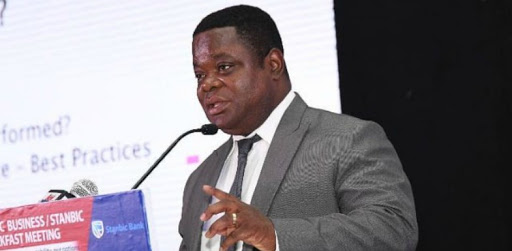
The Director of the Institute of Statistical, Social and Economic Research (ISSER), Professor Peter Quartey, says government’s provision of a stimulus package does not directly translate into job security.
Speaking on Joy News’ Upfront, he explained that how the package is distributed will, however, determine the security of jobs in the country.
According to him, sectors of the economy that have high demand are those that deserve to be awarded the stimulus package against those with lower demands.
Government is set to roll out a GH¢600 million soft loan scheme for Small and Medium Scale businesses in the country, President Akufo-Addo announced on April 5, 2020.
The loan scheme is expected to have a one-year moratorium and two-year repayment period.
The President had earlier also announced a GH¢1 billion stimulus package for households and businesses under the Coronavirus Alleviation Programme to address the disruption in economic activities, the hardship of Ghanaians, and to rescue and revitalize the country's industries.
Prof Quartey said targeted distribution of the loan facility to beneficiary companies will ensure that they do not go bad.
“No, it [Job security] is not a guarantee and you need to look at where you put the money. In other words, the stimulus package has to go to sectors that will be producing because there are some that no matter what you do, there won’t even be demand for their services," Prof said.
According to him, the tourism and hospitality sectors for example are currently not in high demand, and would not be producing at their full capacities for sometime even after the pandemic, thus awarding them a stimulus package could result in bad loans.
“So you ought to look at all of these and see which of the sectors if you put in money it will stimulate production; it would ensure that labour is guaranteed of employment," he said.
He suggested bailouts for non-producing sectors.
According to him, bailouts would be efficient in sustaining jobs for some three or six months to allow businesses recuperate.
Bailouts, unlike loans are not meant to be paid back, he said, thus will be best suitable for non-producing businesses struggling to increase demand.
"In that case if they don’t engage in production at least they are guaranteeing labour that for the next three or six months, you’re guaranteed your job and then when we get back into production, we’ll continue to hire you," he said.
Government is confident that the stimulus package will mitigate the impact of the coronavirus pandemic on the Ghanaian economy.
Latest Stories
-
Evangelism or Collection in God’s Name? The plight of Ghana’s captive passengers
4 minutes -
‘I don’t expect preferential treatment for me, my party or gov’t’ – Mahama to new EC deputies
20 minutes -
Mahama tasks new EC Deputy Chairpersons to protect electoral integrity
21 minutes -
Police arrest officer after shooting injures 2 at Ritz Junction
22 minutes -
‘Delete, retract, apologise’ – Agyinasare urges Ghanaians to take responsibility for misinformation
23 minutes -
Saudi minister vows ‘serious response’ to Houthi attacks on airports
45 minutes -
When dialogue fails and strikes speak: Is industrial action the only language government understands?
51 minutes -
Ghana launches Social Protection Act regulations and Affirmative Action Gender Equity Regulations
52 minutes -
Mahama swears in Emelia Afi Agbenyo, Joseph Kwaku Asamoah as EC Deputy Commissioners
1 hour -
Wetland communities in Northern Ghana face a hotter, flood-prone future as climate risks intensif
1 hour -
Sam George tasks KNUST to develop Twi AI model as Ghana plans local-language artificial intelligence
1 hour -
Poor roads choking eco-tourism potential – Avatime Paramount Chief cries out
1 hour -
DVLA records GH¢25 million surplus in 2025 as contributions to state funds reach GH¢98.1 million
1 hour -
Over 10 suspected scam centre kingpins arrested and remanded – CSA
1 hour -
Ministers, CEOs, policymakers to grace 7th Africa Public Sector Conference in Accra
1 hour