

Audio By Carbonatix
The Institute of Statistical, Social and Economic Research (ISSER) has cautioned that Ghana risks undermining its long-term development goals if infrastructure spending continues to fall short of target due to tight expenditure controls.
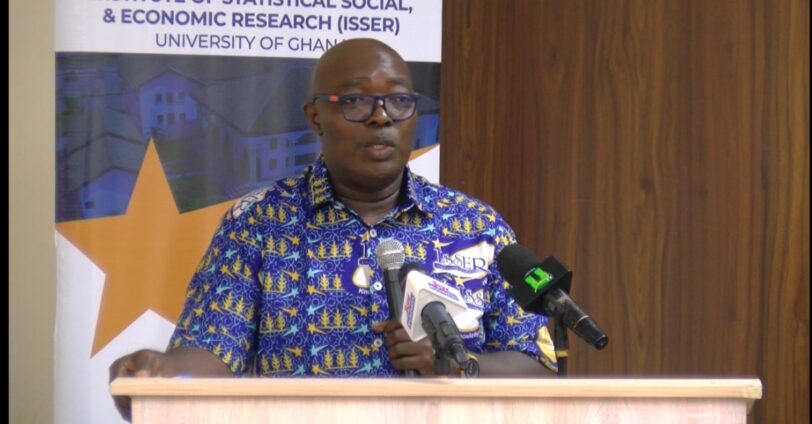
Presenting ISSER’s review of the 2026 Mid-Year Budget Statement and Economic Policy in Accra, Professor Robert Darko Osei, Director of ISSER, acknowledged that the economy was making significant progress in achieving macroeconomic stability.
However, he warned that policymakers must avoid sacrificing growth-enhancing investments in pursuit of fiscal consolidation targets.
According to ISSER’s assessment, the government’s fiscal strategy aimed to create fiscal space for increased capital expenditure.
Despite this objective, actual spending in the first half of 2026 fell short of expectations.
The review found that capital expenditure was nearly 40 per cent below its programmed level, making it the weakest-performing component of government expenditure during the period.
ISSER attributed the shortfall largely to tight expenditure controls and delays in implementing projects under the government’s “Big Push” infrastructure programme.
As a result, planned infrastructure investments have yet to generate the anticipated economic impact, with many projects remaining at preparatory stages and contributing little to growth.
The slowdown in infrastructure spending was also reflected in the construction sector, which recorded growth of just 1.3 per cent in the first quarter of 2026. This was despite expectations that major public infrastructure works would stimulate activity.
Prof. Osei stressed that capital expenditure remained a crucial driver of infrastructure development, industrialisation, productivity growth and job creation.
“Capital expenditures are critical for growth, sustainability and the achievement of development targets,” he said.
He warned that prolonged expenditure restraint could weaken the investments needed to transform the economy and expand its productive capacity, even as Ghana makes progress in its fiscal consolidation programme.
According to him, the situation reflects a policy trade-off between economic stabilisation and growth, and called for a carefully balanced approach.
“Public investment plays a vital role in creating the conditions that attract private capital, promote economic diversification and strengthen productive sectors,” Prof. Osei added.
He further urged government to improve the efficiency and sequencing of public investment projects to ensure that limited resources deliver the greatest developmental impact.
ISSER therefore called on policymakers to ensure that fiscal consolidation efforts did not come at the expense of Ghana’s long-term development and economic transformation agenda.
Latest Stories
-
‘There is no competition’ – Justin Kodua confident of NPP General Secretary re-election
51 minutes -
J100 Accra Doubles Champions : Kolesolva/ Ndukwa, Agarwal/Patel seal title victories
53 minutes -
Sydney Wright crowned J100 Accra Champion
57 minutes -
J100 Accra Boys’ Singles: Verma denies Beckles back-to-back titles to claim crown
60 minutes -
Two friends fined GH¢12,000 for stealing
1 hour -
Son jailed for threatening to stab mother
1 hour -
Drive constitutional reform – GJA urges journalists
2 hours -
NPP Delagates Congress: Confusion delays voting at Ashanti Region TESCON centre
3 hours -
Fire ravages shops, houses near Koforidua Central Police Station
3 hours -
NPP Delegates conference: The wisdom of the masses will prevail – Napo
3 hours -
Flydubai co-pilot attacked captain with axe, UAE official says
3 hours -
NPP Bosome Freho Constituency Chairman reportedly arrested over ballot paper incident
4 hours -
Medical plane with 6 on board missing off Massachusetts coast
4 hours -
Bolt driver jailed 25 years for robbing beautician
4 hours -
Happy 76th Birthday to the Daily Graphic!
4 hours