


Audio By Carbonatix
A highly effective vaccine that guards against the deadly Ebola virus could be available by 2018, says the World Health Organization.
Trials conducted in Guinea, one of the West African countries most affected by an outbreak of Ebola that ended this year, show it offers 100% protection.
The vaccine is now being fast-tracked for regulatory approval.
Manufacturer Merck has made 300,000 doses of the rVSV-ZEBOV vaccine available for use should Ebola strike.
GAVI, the global vaccine alliance, provided $5m for the stockpile.
Results, published in The Lancet medical journal, show of nearly 6,000 people receiving the vaccine, all were free of the virus 10 days later.
In a group of the same size not vaccinated, 23 later developed Ebola.
Only one person who was vaccinated had a serious side effect that the researchers think was caused by the jab. This was a very high temperature and the patient recovered fully.
It is not known how well the vaccine might work in children since this was not tested in the trial.
Analysis - Tulip Mazumdar, Global Health Correspondent
Ebola has been around for 40 years now. But it wasn't until the height of the 2014 outbreak in West Africa that the world decided to invest some serious money into finding treatments and cures.
I watched as families of those who had become infected were isolated in their homes. Often entire neighbourhoods were quarantined behind orange fencing. That was their best chance of not becoming infected and infecting others.
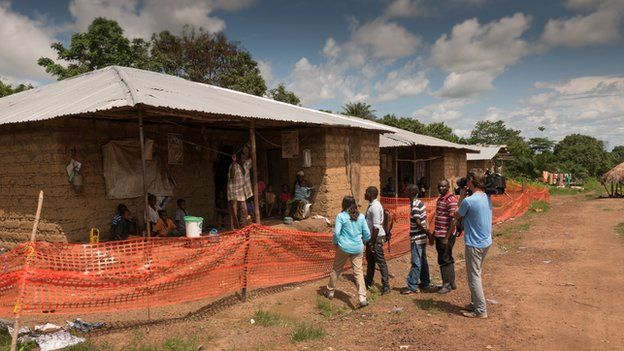
Visiting a house under quarantine in Port Loko, Sierra Leone
But as hundreds of people continued to die, and cases started being exported to Europe and the US - the world decided to act.
Now, two years later, we have a vaccine. It usually takes around 10 years.
There were some mild side effects reported in this trial, and the vaccine is only known to protect against one of the strains of Ebola, but it is the most deadly Zaire strain.
Today's news is a very welcome and much needed breakthrough. However, as the WHO points out, more lives would be saved if countries invested in vaccines before outbreaks, rather during them.
The director of British-based medical research institute the Wellcome Trust described the findings as "remarkable".
"Had a vaccine been available earlier in the Ebola epidemic, thousands of lives might have been saved," Jeremy Farrar said.
"We have to get ahead of the curve and make promising diagnostics, drugs and vaccines for diseases we know could be a threat in the future."
The trial was led by the World Health Organization (WHO), working with Guinea's health ministry and international groups.
The WHO's Marie-Paule Kieny said the results could help combat future outbreaks.
"While these compelling results come too late for those who lost their lives during West Africa's Ebola epidemic, they show that when the next Ebola outbreak hits, we will not be defenceless," said Dr Kieny, the lead author of the study.
Other drug companies are developing different Ebola vaccines that could be used in the future too.
The Ebola virus was first identified in 1976 but the recent outbreak in West Africa, which killed more than 11,000 people, highlighted the need for a vaccine.
The outbreak began in Guinea in 2013 and spread to Liberia and Sierra Leone.
Latest Stories
-
Four family members burnt to death in fire at Apemanim Number Two
7 minutes -
Comfort Jehu-Appiah
18 minutes -
Afoko can help rebuild NPP and bring back disgruntled members – Political Scientist
24 minutes -
Too early to say if Iran involved in Dubai-Tel Aviv flight attack, Israeli PM says
34 minutes -
Ghana’s trade surplus shrinks by 70% to US$1.3bn in quarter 2, 2026 – GSS
37 minutes -
KMA orders traders and garage operators to vacate Abrepo ahead of Suame Interchange works
38 minutes -
Ankrah’s removal should not end accountability over World Cup visa controversy – Ekow Assafuah
39 minutes -
You have 24 hours to vacate – AMA Mayor warns squatters after Avenor fire outbreak
41 minutes -
Western Region teacher unions reaffirm strike over unpaid allowances and promotion concerns
44 minutes -
Prof. Emmanuel Sarpong replaces Yaw Ampofo Ankrah as National Sports Authority boss
49 minutes -
Agric Committee in Parliament calls on Finance Minister to fund timely completion of Farmers Service Centres
50 minutes -
GABET raises concerns over teacher training and resources for new SHS curriculum
52 minutes -
Daily Insight for CEOs series
1 hour -
Government moves to make public institutions buy from Ghanaian farmers
1 hour -
Diesel price to remain below GH¢20 per litre in October after government intervention – NPA
1 hour