

Audio By Carbonatix
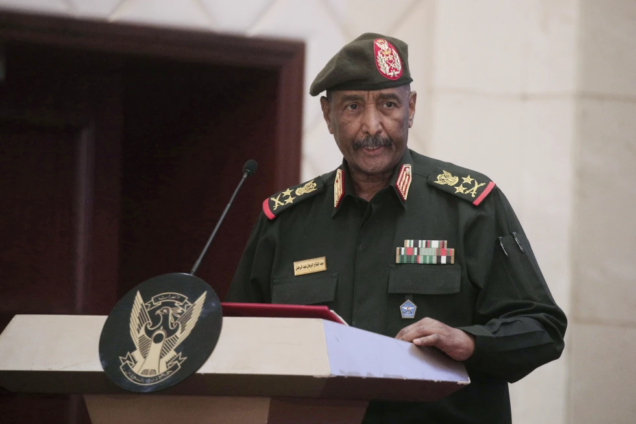
Sudan's military leader, Gen. Abdel-Fattah Burhan, survived a drone attack Wednesday on an army graduation ceremony he was attending in the country’s east, the military said.
The attack that killed five people was the latest twist in the conflict Sudan has been going through since a popular uprising removed its veteran leader Omar al-Bashir in 2019.
The attack by two drones took place in the town of Gebeit after the ceremony was concluded, the military added. Burhan was not hurt, according to Lt. Col. Hassan Ibrahim, from the military spokesman’s office.
Videos posted by Al Araby TV showed multiple people running along a dusty road at the time of the drone attack, while other footage showed people at the graduation ceremony apparently looking to the sky as the drone strike hit.
Another video posted on Facebook by the Sudanese Armed Forces showed a crowd of people gathering around Burhan following the drone strike, cheering for him as he smiled.
“A spontaneous popular gathering of the people of the Jebait region with the President of the Sovereign Council and Commander-in-Chief following the graduation of a new batch of officers,” the post read.

Sudan has been torn by war for more than a year between the military and a powerful paramilitary group, the Rapid Support Forces or RSF. With fighting in the capital, Khartoum, the military leadership largely operates out of eastern Sudan near the Red Sea Coast.
The RSF has not commented on the assassination attempt yet, which comes nearly a week after its leader said that he planned to attend cease-fire talks in Switzerland next month arranged by the United States and Saudi Arabia.
Gen. Mohammed Hamdan Dagalo, head of the Rapid Support Forces fighting Sudan’s army, emphasized at the time that the talks would become “a major step” toward peace and stability in Sudan and create a new state based on “justice, equality and federal rule.”
The Sudanese Foreign Ministry on Tuesday responded to the U.S. invitation to the talks in Geneva, saying the military-controlled Sudanese government is prepared to take part but said that any negotiation before implementing the Jeddah Declaration “wouldn’t be acceptable to the Sudanese people.”
The Jeddah Declaration of Commitment to Protect Civilians passed last year meant to end the conflict, but neither side committed to its objectives.
Representatives from the Sudanese Army and the RSF, led by Mohamed Hamadan Dagalo, engaged in revived talks brokered by the U.S. and Saudi Arabia in Jeddah, focusing on the delivery of humanitarian aid, achieving ceasefires and paving the way toward a permanent cessation of aggression, among other objectives.
In its Tuesday statement, the Sudanese Foreign Ministry accused the RSF of being the only party that attacks cities, villages and civilians. The military-controlled Sudanese government demanded sanctions be imposed on “rebels to stop their continuous aggression, end their siege on cities, and open roads.”
“Those taking part in the initiative are the same as the parties who participated in the Jeddah talks, and the topics are identical to what was agreed upon,” the statement read.
The ministry added that the military-led government must be consulted about the planned agenda for any negotiations and parties taking part, with the provisions in the Jeddah Declaration being the basis of future talks.
Cameron Hudson, the former chief of staff to the special envoy to Sudan, said the military government’s response is “far more positive and open” than he had anticipated because it opened the door to preliminary talks with the U.S.
The Rapid Support Forces were formed from Janjaweed fighters created under former Sudanese President Omar al-Bashir, who ruled the country for three decades before being overthrown during a popular uprising in 2019. He is wanted by the International Criminal Court on charges of genocide and other crimes during the conflict in Darfur in the 2000s.
The conflict has created the world’s largest displacement crisis with more than 10 million people forced to flee their homes since April 2023, according to the U.N. migration agency. They include more than 2.2 million who crossed into neighboring countries, it said.
Latest Stories
-
Hurricane Polo makes landfall on Mexico’s Pacific coast
2 minutes -
US ban on Canadian alcohol and dairy comes into effect as trade war drags on
3 minutes -
GES orders SHS heads to refund unauthorised fees collected from parents
11 minutes -
AFCON 2027Q: ‘We don’t need to cry over spilled milk’ – Damba on Ghana injury concerns
15 minutes -
NDC communicator blames documentation, payroll validation for teachers’ promotion arrears delay
16 minutes -
2026 JoyNews Impact Maker Award winner brings clean water to Yoko Tsume after years of cattle dugout dependence
23 minutes -
Sarkodie commends Mahama for rejecting US health compact
23 minutes -
‘The worst hate speech comes from NDC; enough of lip service, optics politics’ – Afenyo-Markin to Mahama
24 minutes -
Tree Crops Development Authority tightens regulation of tree crop trade, targets $10bn sector
24 minutes -
Ghana’s fiscal deficit to widen to 3.9% a year through 2029 – S&P
24 minutes -
‘It’s not a matter of evidence; it was a metaphor’ – Afenyo-Markin defends ‘drug lab’ comment
37 minutes -
Borrowing costs cut by more than half – Finance Minister
40 minutes -
KNUST students urged to look beyond Ghana for AI and robotics opportunities
43 minutes -
Odeibea Foundation extends energy equity initiative with solar streetlights in Akpato and Worwonyo
44 minutes -
Customs increases surveillance at ports, warns importers against concealing restricted items
46 minutes