


Audio By Carbonatix
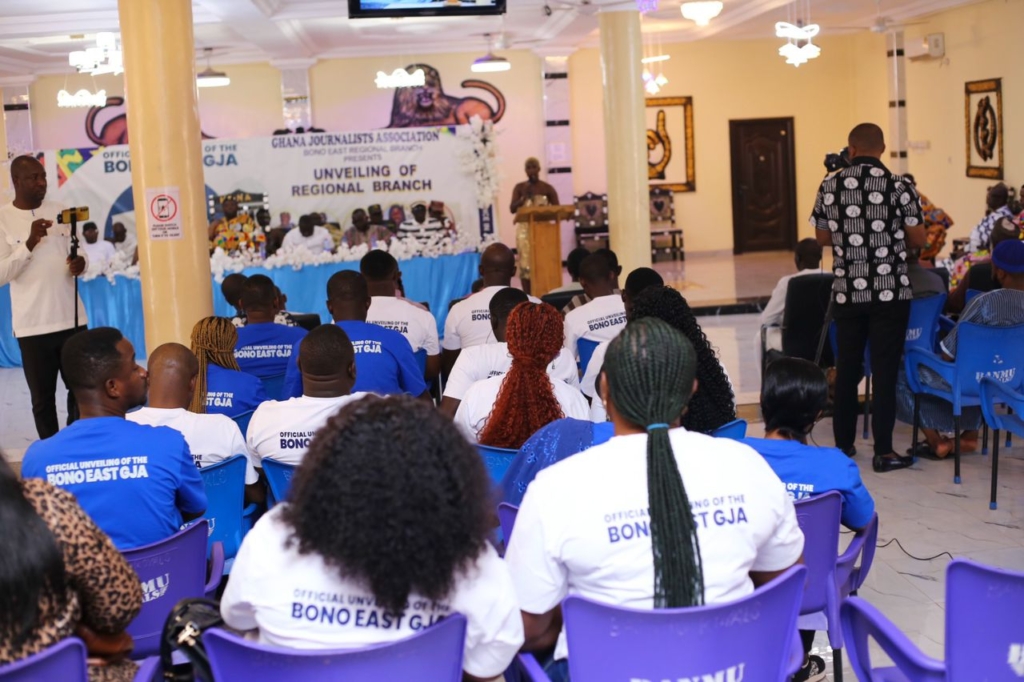
In a ceremony that blended traditional reverence with modern democratic ideals, the vibrant capital of Techiman played host to a significant moment for media and governance: the official unveiling of the Bono East Regional Chapter of the Ghana Journalists Association (GJA).
Far more than a mere organisational launch, the event evolved into a profound regional dialogue on power, responsibility, and narrative sovereignty, drawing a powerful cross-section of society to forge a new pact for journalism in the region.
A Historic Convergence of Power and Press
The colourful gathering was a testament to the stake all sectors hold in truthful storytelling. The hall was filled with traditional leaders in full regalia (‘Nananom’), government officials, security chiefs, members of parliament, religious leaders, and journalists—a visual representation of a whole society agreeing that how the Bono East story is told is of paramount importance.
This convergence signaled one thing: recognition that how this region's story is told matters to everyone.
The Royal Charge: Credit and Constructive Critique
Chairing the historic occasion, the Chief of Anyima in the Nkoranza Traditional Area, Obrempong Ameyaw Amponsem II, set a compelling philosophical framework. Blending his authority as a traditional ruler with the acumen of an established businessman, he charged journalists with a dual mandate.

His message formed the cornerstone of the day’s discourse: a call for journalism that both celebrates progress and offers constructive oversight. It was framed as nothing less than a civic duty in nation-building, emphasising that the media holds the power to “make or unmake a nation” and must wield it with ethical responsibility.
A Fortress for Freedom: GJA’s Unwavering Stance
Echoing this charge with a focus on the enabling environment, the National President of the GJA, Albert Kwabena Dwumfour, delivered a robust message on press freedom. He reaffirmed the Association’s unwavering stance against threats to journalists, declaring the new chapter must be “a beacon for fearless, ethical reporting.”

“The GJA will fight against any individual or group that threatens the freedom and safety of journalists,” Dwumfour asserted, setting a clear boundary for the protection of press rights in the newly established chapter.
Government and Security: Promises of Partnership and Protection
This strong message on protection found immediate and resonant assurance from the political and security apparatus. The Bono East Regional Minister, Oheneba Francis Owusu-Antwi, articulated the government’s commitment, aligning it with the development goals of the region.
“The government of President Mahama is committed to the safety of Journalists and sees the media as essential partners in our development journey,” he stated.

The commitment was universal. Parliamentarians promised partnership, and the police guaranteed protection, creating what was described as a “rare consensus” that a free, responsible press serves the entire community.
A Call to Action for the New Chapter
The Regional Chairman of the newly inaugurated chapter, Frederick Antwi, turned the focus inward, admonishing his colleagues to actively spotlight the region’s positive developmental strides while fostering open partnerships with all stakeholders.
His admonishment outlined the practical pathway forward for the chapter: to endeavour towards “highlighting positive developmental progress for the region and extend an open partnership between the media and the key stakeholders.”
Celebrating a Living Example of Excellence
Amidst the solemn promises and strategic discussions, the event also celebrated exemplary journalism. Anass Sabit of JoyNews, the national winner of the 2025 GJA Award for Best Journalist in Domestic Tourism, was honoured.

His work was highlighted as a “living example of the impactful storytelling championed here today,” providing a tangible model for the chapter’s members.
The “Techiman Consensus”: A New Unwritten Contract
As the ceremony concluded, the outlines of a new, unwritten contract for the Bono East Region became clear. The televised feature captured it succinctly: “So today in Techiman, a new contract was written—not on paper, but in the collective commitment of a region.”

In this pact, the media accepts the charge to tell balanced stories—navigating the delicate space between credit and critique. Concurrently, the traditional, political, and security powers pledge to protect and partner in that mandate.

This historic launch in Techiman has set a formidable precedent, suggesting that in the Bono East Region, a free and responsible press is not perceived as an adversarial force, but as an indispensable partner in scripting a prosperous and truthful future for its people.
Latest Stories
-
Fiabci-Ghana inaugurated to promote professionalism and global collaboration in real estate sector
10 minutes -
‘No flying in just for matches’ – Kofi Adams sets conditions for next Black Stars coach
14 minutes -
Ghana and BRICS: Strategic opportunity, economic imperative or geopolitical gamble?
19 minutes -
SML vs GRA: Court grants preservation order in dispute over US$500 million investment
20 minutes -
Spotify brings audiobooks to Ghana
23 minutes -
GPL 2026/27: ‘We are the team to beat’ – Medeama boss Tanko ahead of Samartex clash
24 minutes -
Parliamentary Select Committee on Health assesses progress of work on KATH maternity block
30 minutes -
Ghana’s fertility rate too high for development – Reproductive health specialist warns
45 minutes -
NLA/KGL Licence Contract: Why Ghana must reform the law to maximise the state’s benefit
50 minutes -
Association of Small-Scale Industries empowers trade executives in Bono East with a mentorship programme
57 minutes -
AMA evacuates refuse along Graphic Road, warns against indiscriminate dumping
1 hour -
STC interdicts driver over Pokuase overtaking incident
1 hour -
Ekumfi: How $6m EXIM participation built a $53m industrial asset — now poised for a 24-Hour Economy breakthrough
1 hour -
4 arrested, 142 parcels of suspected Indian hemp seized as officers reject GH¢50k bribe
1 hour -
No MMDCE can say they don’t see galamsey – Local Government Ministry
1 hour