

Audio By Carbonatix
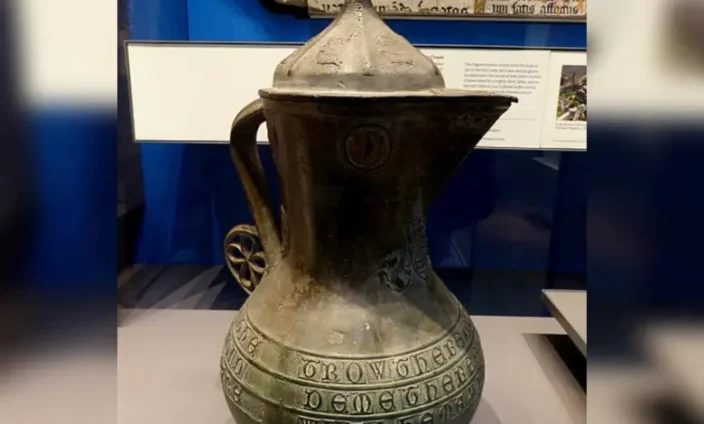
The British Museum's Object in Focus series has published The Asante Ewer that unpacks the history of a fascinating vessel and its journey from medieval England of the fourteenth century to West Africa and back to England.
Published in collaborative distribution with the leading US Barnes and Noble, it throws light on a single object of curiosity and is authored by two English curators and a Ghanaian historian.
In elegant prose, it draws on archival and new research of the jug popularly known today as The Asante Ewer with its remarkable details of the royal arms of England.
Transported to West Africa, possibly at some point between the fifteenth and seventeenth centuries, it had by the nineteenth century, been located in a courtyard associated with the royal palace of the Asantehene in Kumasi.
During widespread looting by British forces in the aftermath of the so-called Fourth Anglo-Asante War of 1896, the ewer was removed from the royal building before the British forces set it on fire. It was subsequently purchased by the British Museum in 1896.
This however was not the first interest in the ewer. Major essays and inquiries into it have included those of the well-known English art historian Martin Bailey in The Art Newspaper of, “Two Kings, their Armies and Some Jugs- The Asante Ewer (1993) and “The Long Curious Journey of British Museum’s Asante Ewer” (2023).
There is a trade or commodity exchange dimension of an inquiry that possibly brought the jug to Kumasi through the Caravan Trade from the Sahel or Moors in North Africa and even close-by Cape Coast in the central region to Kumasi. This is speculated in Jack Goody’s Metals, Culture and Capitalism.
This book captures in a more detailed way (including assessing the previous arguments of provenance) one of the finest examples of late medieval English bronze casting. It also explores the significance of the vessel in both European and African contexts – from the intricate medieval symbolism, linked to English royalty, that forms its decoration, to its potential connections with the trade in ivory and gold across the Sahara and the West African coast.
This publication also addresses collecting practices of the nineteenth century and their inextricable links with colonialism, as well as discussing how the ewer has historically been presented in a European context and is now being re-evaluated to include its African history.
The 72-page book with over 40 illustrations, had a research grant from the British Academy and the Wolfson Foundation. It’s chapters has a preliminary Historical Notes and the following: What is the Asante Ewer? Material Values from England to West Africa, A Military Expedition and the Looting in Kumasi, Acquisition and an Epilogue.
The interesting backgrounds of the three authors – two English staff of The British Museum and a Ghanaian historian give the book an agreeable condor.
The lead, Lloyd de Beer, a PhD in English from the University of East Angelia, is a curator with responsibility for the late medieval collection. A researcher in art and architecture of the Middle Ages, he has worked on the alabaster sculptures of medieval England after the English Reformation. De Beer curated the 850th martyrdom anniversary exhibition and lecture on, Thomas Becket: Murder and the Making of a Saint (2021).
Julie Hudson is a well-known English curator in many African museums where she has curated major exhibitions. She works in the Department of Africa, Oceania and the Americas, and among her particular areas of interest are the textiles of Tunisia. She co-authored with Chris Spring, Silk of Africa (2002). An Egyptologist, she studied at the University of Liverpool and Cambridge University.
The third is Director of the Manhyia Palace Museum, Ivor Agyeman-Duah, co-editor with the late Peggy Appiah and world leading philosopher, Kwame Anthony Appiah of, Bu Me Be: Proverbs of the Akans; of essays on art and the evolution of currency notes in Ghana as well as architectural history. He is the winner of several international awards including ‘The Distinguished Friend of Oxford 2012’ at Oxford University.
Latest Stories
-
Fire destroys belongings in Akweteyman apartment
8 minutes -
Baffour Awuah to turn himself in to EOCO today – JoyNews sources
14 minutes -
Government identifies payment discrepancy holding up teachers’ strike resolution
32 minutes -
BoG signals no FX intermediation for October as GoldBod plans $1bn support for banks
35 minutes -
When share ownership becomes personal: The African mindset of the Dangote IPO
45 minutes -
Why MFWA Legal Fund matters to Ghana’s democracy
45 minutes -
Fuel prices to rise from October 1; diesel could hit GH¢19.60 – COMAC
46 minutes -
Parliament must investigate how 3.9 tonnes of cocaine left Ghana undetected – Samuel Jinapor
47 minutes -
Government pledges to pay striking teachers as payment dispute is resolved
1 hour -
Government cannot investigate drug exports under its own watch – Abu Jinapor
1 hour -
Government extends GH¢2 diesel subsidy for two more months
1 hour -
GTEC flags over 100 tertiary institutions as unrecognised
1 hour -
Agric Committee chair commends NAFCO for turnaround from GH¢20m debt to GH¢96m profit
1 hour -
NPP: Judicial office requires judges to surrender some personal freedoms
1 hour -
Senyo Hosi: Ghana missed its chance to end galamsey under Akufo-Addo
1 hour