

Audio By Carbonatix
The biggest movie in the world right now is not the latest Bond film No Time To Die or even Marvel's Shang-Chi and the Legend of the Ten Rings.
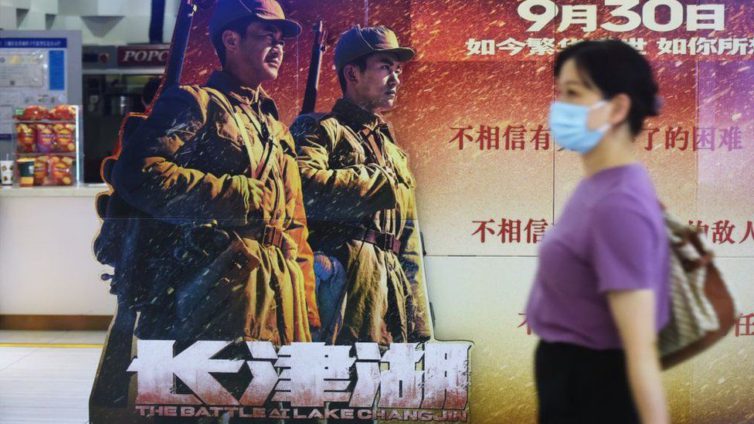
It's a Chinese propaganda film about the 1950s Korean War, centred on a story of Chinese soldiers defeating American troops despite great odds.
In just two weeks since its release, The Battle at Lake Changjin has made over $633m (£463m) at the box office. This puts it far ahead of Shang-Chi's global earnings of $402m, and in just half the time.
It is set to become China's highest-grossing film ever.
Its success is good news for China's pandemic-affected film sector as Covid forced cinemas to shut and reopen multiple times.
It is even better news for the state, which experts say appears to have nailed a formula of making propaganda appeal to the masses.
But for Hollywood looking in from the outside, the immense popularity of a local film like this could mean even more challenges ahead as it struggles to gain ground in China - the biggest film market in the world.
'Patriotic duty to watch the film'
Commissioned by the Chinese government, The Battle At Lake Changjin is just one of several nationalist films which have become big commercial hits in China in recent years.
In 2017, Wolf Warrior 2, about a Chinese soldier saving hundreds of people from baddies in an African warzone, raked in a record 1.6bn yuan ($238m; £181m) in just one week.
Lake Changjin depicts a brutal battle in freezing weather which the Chinese claim was a turning point in the Korean War - formally known in China as the "War to Resist US Aggression and Aid Korea".
Thousands of young Chinese soldiers died at the titular lake to secure a crucial win against American forces.
"I'm so moved by the soldiers' sacrifice. The weather was so extreme, but they managed to win. I feel so proud," an audience member wrote on reviews site Douban.
It is no coincidence that the film's popularity comes amid rising tensions between Washington and Beijing.
"It is definitely related to the ongoing tensions with the US, and has been promoted that way - sometimes indirectly, but still very clearly," said Dr Stanley Rosen, a political science professor from the University of Southern California.
Another reason behind its success is the co-ordinated push between film studios and the authorities, which tightly control the number and types of films that can be distributed at any one time.
At the moment, Battle At Lake Changjin has little competition in theatres. Major Hollywood blockbusters No Time To Die and Dune will only open in China at the end of October, despite already showing elsewhere.
This film was also particularly well-timed - not only did it open during China's National Day holidays starting 1 October, it comes as the ruling Chinese Communist Party (CCP) celebrates its 100th anniversary this year.
"It's almost a patriotic duty to go see this film," said Dr Rosen.
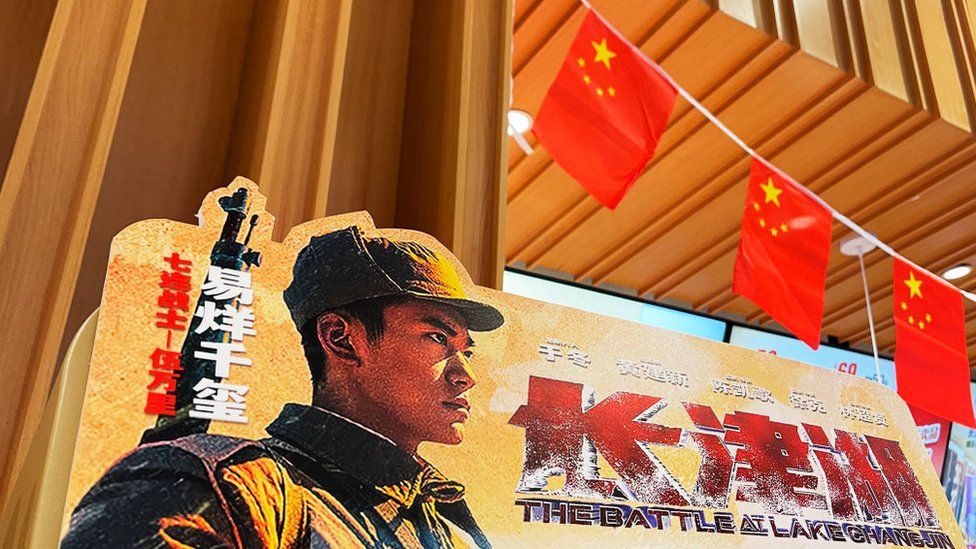
Such propaganda films are often mandatory viewing for CCP cadres, said Dr Florian Schneider, director of the Netherlands' Leiden Asia Centre.
"Work units frequently organise collective viewings, and with over 95 million card-holding members, that promises a significant box office boost," he told the BBC.
So far, online reviews of the film are overwhelmingly positive, though some observers pointed out that they may not be entirely true.
After all, criticism could land one in jail.
Last week, former journalist Luo Changping was detained for making "insulting comments" on social media about the Chinese soldiers portrayed in the movie.
Police in Sanya said that he was being held on the charge of "infringing the reputation and honour of national martyrs", and that the case was being investigated.
"Youngsters [in China] with strong nationalist feelings have a disproportionate voice online," Dr Jonathan Hassid, a political science expert at Iowa State University, told the BBC in an earlier interview.
"In part, this voice is amplified because legitimate criticism of the state is increasingly unacceptable."
Blockbuster propaganda
Still, fans of the film say that they enjoy its blockbuster elements that put it on par with other major mainstream flicks.
"With a reported $200 million budget, the production values and special effects are very good. The three directors are all good storytellers and well known in China," said Dr Rosen.
The film's directors Chen Kaige, Tsui Hark, and Dante Lam are all celebrated film-makers.
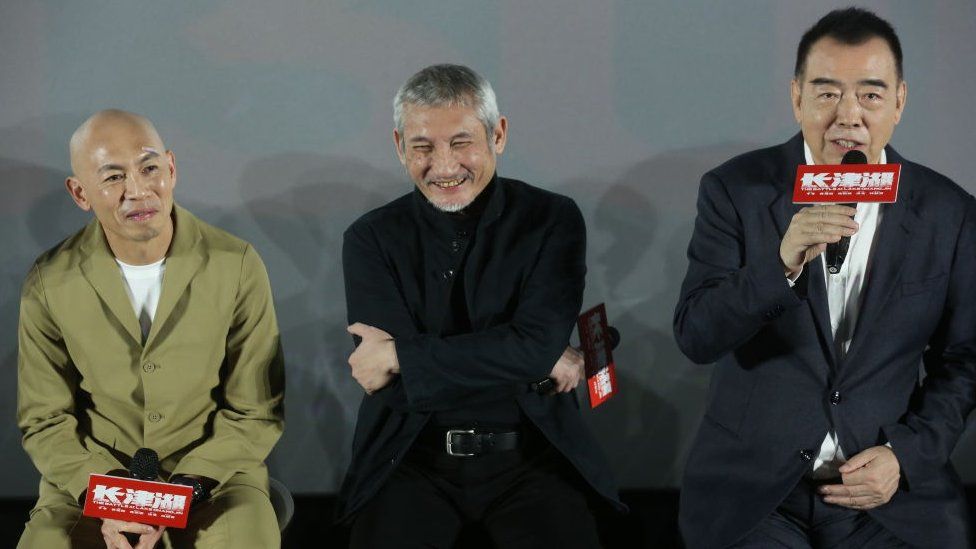
Tsui is known for special effects and martial arts films, while Lam is famous for his action spectacles involving giant explosives. Chen is celebrated for sensitive portrayals of Chinese life.
"We all know this is meant to be a patriotic film but I really cried when I watched it. It felt very authentic," one person wrote on microblogging platform Weibo.
Big headache for Hollywood
But China's domestic film success is potentially adding to a list of problems that foreign players like Hollywood already face, in their attempt to win over the lucrative Chinese market.
China has a quota for foreign films, officially allowing only 34 to be shown each year.
There are some workarounds - if Hollywood co-produces a film with Chinese companies, it will not count towards the quota.
According to a report last year, Hollywood bosses have also been censoring films to placate the Chinese market, with casting, content, dialogue and plotlines increasingly being tailored to appease censors in Beijing.

But even then, this is no guarantee of box office success, with even some co-productions bombing badly.
Fantasy-action movie The Great Wall (2016), directed by celebrated Chinese director Zhang Yimou and starring Matt Damon, was criticised both in the US and China for its "white saviour narrative".
Despite these challenges, experts told the BBC that foreign film-makers will not be giving up anytime soon.
Ultimately, China and Hollywood need each other, they say.
"China wants to remain the No. 1 film market after Covid, and it still needs Hollywood blockbusters - especially those that play on Imax screens or are in 3D since ticket prices are higher - to help it maintain that edge over the North American market," Dr Rosen said.
"As the production values of Chinese films continue to improve, Hollywood may become less relevant, but Hollywood tells universal stories that China can't or won't tell."
Latest Stories
-
Ghana to honour Christina Hammock Koch for historic Artemis II mission
26 minutes -
Supreme Court appointments require more than 15 years’ experience – Justice Adjei-Frimpong
43 minutes -
Fire destroys 3-bedroom house at Bogyawe
1 hour -
Why the Supreme Court is a “policy court” – Justice Richard Adjei-Frimpong breaks it down
1 hour -
Playback: The Law discussed Supreme Court @150
2 hours -
MTN Momo staff walk to promote wellness and fitness
3 hours -
Assafuah: Sedina Attionu’s return from Nevada will test government’s commitment to accountability
3 hours -
How GRA’s Modified Taxation Scheme is boosting revenue compliance & SMEs competitiveness
3 hours -
Stonebwoy Can Do It: A call to unite behind 2026 BHIM Fest
3 hours -
World Shea Expo returns to Tamale for 2026 edition
3 hours -
Prioritise cocoa sector with better prices, timely payments-Annoh-Dompreh urges NDC
4 hours -
Lands and Mines Watch Ghana endorses Heath Goldfields’ mining capacity
4 hours -
Gbintiri residents protest alleged diversion of 24-hour market project
5 hours -
Justin Bieber headlines Coachella with nostalgia-fuelled set
5 hours -
Ukraine and Russia accuse each other of hundreds of ceasefire violations
5 hours