


Audio By Carbonatix
"Dumping babies is forbidden," the sign created by Eric Mejicano reads. The Venezuelan artist posted the signs on walls across Venezuela after a newborn was found in the rubbish near his apartment block in the capital, Caracas.
Mejicano says that he launched the campaign to alert people to the fact that in Venezuela "something is becoming common which should never be considered normal".
The country's economy is in freefall and one in three Venezuelans is struggling to put enough food on the table to meet minimum nutrition requirements, according to a study by the UN World Food Programme.
With contraceptives hard to come by and beyond the financial means of many, unwanted pregnancies are common. Strict abortion laws which only allow for terminations in cases when the mother's life is in danger further limit women's choices.
Amid the economic crisis, one charity said in 2018 that it had seen the number of babies abandoned in the streets or left at the entrances of public buildings increase by 70%.
The Venezuelan government has not released any official figures in recent years and neither the communications ministry nor the government body dealing with the rights of children answered requests for comment.
But social services and health workers consulted by the BBC confirmed there had been an increase in the number of abandoned babies as well as a spike in those handed over for informal adoption.
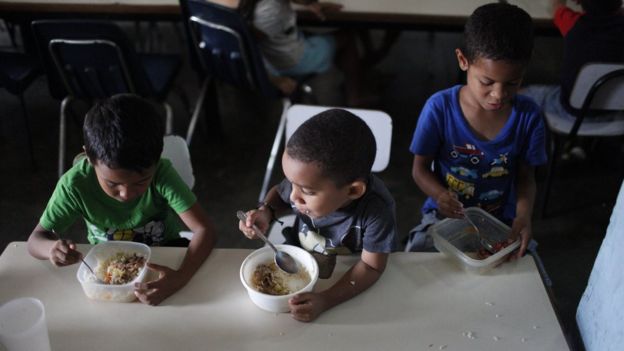 Community kitchens have been set up to help feed those in need but even so malnutrition is a major problem
The story of Baby Tomás (not his real name) is one such case. He was born to a mother living in poverty in Caracas who felt she was in no position to raise him.
The gynaecologist who was present at Tomás' birth agreed to help.
He says it was not the first time he came across a mother who felt she could not bring up her baby. "They almost always change their minds the first time they breastfeed the baby," he explains. "But sometimes that is not the case, and then you have to find a solution."
He contacted one of his patients. In her forties and dreaming of having a baby, Tania (not her real name) had not been able to get pregnant.
She wanted to help Tomás and his mother, but after some thought decided against taking him in. Instead, she contacted a couple with whom she is friends who agreed to raise Tomás as their own child in their home in rural Venezuela.
They had to get the baby registered quickly in order not to arouse suspicion, so Tania paid a $250 (£195) bribe for an official to turn a blind eye and put down her friend's name as Tomás' birth mother.
Tomás is now being raised by her friends in the countryside and his new family has just celebrated Tomás taking his first steps.
Tania says she does not regret what she did and insists that she bypassed the official adoption channels for Tomás' benefit. "I never thought of doing anything like this but legal adoption doesn't work in Venezuela and that baby would have suffered a lot of hardships in a public orphanage," she explains.
Community kitchens have been set up to help feed those in need but even so malnutrition is a major problem
The story of Baby Tomás (not his real name) is one such case. He was born to a mother living in poverty in Caracas who felt she was in no position to raise him.
The gynaecologist who was present at Tomás' birth agreed to help.
He says it was not the first time he came across a mother who felt she could not bring up her baby. "They almost always change their minds the first time they breastfeed the baby," he explains. "But sometimes that is not the case, and then you have to find a solution."
He contacted one of his patients. In her forties and dreaming of having a baby, Tania (not her real name) had not been able to get pregnant.
She wanted to help Tomás and his mother, but after some thought decided against taking him in. Instead, she contacted a couple with whom she is friends who agreed to raise Tomás as their own child in their home in rural Venezuela.
They had to get the baby registered quickly in order not to arouse suspicion, so Tania paid a $250 (£195) bribe for an official to turn a blind eye and put down her friend's name as Tomás' birth mother.
Tomás is now being raised by her friends in the countryside and his new family has just celebrated Tomás taking his first steps.
Tania says she does not regret what she did and insists that she bypassed the official adoption channels for Tomás' benefit. "I never thought of doing anything like this but legal adoption doesn't work in Venezuela and that baby would have suffered a lot of hardships in a public orphanage," she explains.
'Shortcuts'
Nelson Villasmill is a member of a child protection council in one of Caracas' poorest areas. He explains that, faced with a poorly funded adoption system that is in total disarray, desperate parents sometimes resort to shortcuts.
Community kitchens have been set up to help feed those in need but even so malnutrition is a major problem
The story of Baby Tomás (not his real name) is one such case. He was born to a mother living in poverty in Caracas who felt she was in no position to raise him.
The gynaecologist who was present at Tomás' birth agreed to help.
He says it was not the first time he came across a mother who felt she could not bring up her baby. "They almost always change their minds the first time they breastfeed the baby," he explains. "But sometimes that is not the case, and then you have to find a solution."
He contacted one of his patients. In her forties and dreaming of having a baby, Tania (not her real name) had not been able to get pregnant.
She wanted to help Tomás and his mother, but after some thought decided against taking him in. Instead, she contacted a couple with whom she is friends who agreed to raise Tomás as their own child in their home in rural Venezuela.
They had to get the baby registered quickly in order not to arouse suspicion, so Tania paid a $250 (£195) bribe for an official to turn a blind eye and put down her friend's name as Tomás' birth mother.
Tomás is now being raised by her friends in the countryside and his new family has just celebrated Tomás taking his first steps.
Tania says she does not regret what she did and insists that she bypassed the official adoption channels for Tomás' benefit. "I never thought of doing anything like this but legal adoption doesn't work in Venezuela and that baby would have suffered a lot of hardships in a public orphanage," she explains.
Trapped
Tomás was given away with his mother's consent but there is no shortage of people exploiting the desperation of Venezuelan women. While she was pregnant with her second child, Isabel's husband died, making Isabel (not her real name) consider giving up the child she was expecting. "I was alone and feared that I wouldn't be able to feed my baby," she says. Following the advice of an acquaintance, she flew to the island of Trinidad in the Caribbean to meet a couple she was told were interested in adopting her baby. She was told she would have the final say in any decision but soon came under pressure from the Colombian woman making the arrangements. "I was told it was going to be all legal and never committed to give my baby away," she recalls. But once in Trinidad, "I realised I had been trapped in a net of human traffickers". "I was always being watched," she recalls. Isabel says that she was not allowed to leave the house where she was staying and that the return ticket for the flight she had been promised would take her back to Venezuela never materialised.Separated
Weeks later she gave birth prematurely in a Trinidadian hospital. She decided to keep the baby but immediately was pressured by the Colombian woman and a man who claimed to be a lawyer. "They told me that the new parents were waiting in the parking lot and that I had to sign some documents in English that I didn't understand and to hand over my baby." Isabel refused at first but over the following weeks, her captors increased the pressure, taking away her food, medicine and nappies. "In the end, I had to hand over my son to save his life and for me to return to Venezuela to get help," she says crying. With the help of a non-governmental organisation, Isabel has now set off on a legal battle to recover her son who is under the guardianship of the authorities in Trinidad. At present, she is only allowed to see him once a week. She says she will not give up until she is reunited with him.DISCLAIMER: The Views, Comments, Opinions, Contributions and Statements made by Readers and Contributors on this platform do not necessarily represent the views or policy of Multimedia Group Limited.
DISCLAIMER: The Views, Comments, Opinions, Contributions and Statements made by Readers and Contributors on this platform do not necessarily represent the views or policy of Multimedia Group Limited.
Latest Stories
-
Mr President, Ghana was mentioned at the UN; why aren’t we talking about it?
2 hours -
Accra to convene Africa’s regulators and markets on tokenisation at AVAS 2026
2 hours -
The Paradox of Plenty — When every smartphone becomes a newsroom
2 hours -
GTA sensitises taxi drivers in ‘Know Ghana’ tourism campaign
4 hours -
Archbishop Agyinasare calls for responsible speech amid growing social media abuse
4 hours -
‘It will be inexcusable for gov’t not to honour payment of teachers’ arrears by 30th October’ – Haruna Iddrisu
4 hours -
Forbes’ World’s Best Employers 2026: No Ghanaian firm ranked among 900 companies
4 hours -
Electronic processing of teachers’ data: ‘The decision is the Controller’s’ – GES boss
4 hours -
Teachers’ Strike: Haruna Iddrisu questions paper-based processing of promoted teachers’ data
4 hours -
Savannah Region: Kunfusi bridge collapses again, leaving nearly 4,000 residents cut off
4 hours -
Teachers’ strike: GES targets Monday deadline to submit promotion data to Controller
4 hours -
Inflation to average 11.3% in 2027 – Fitch Solutions
5 hours -
‘I didn’t campaign for NDC to come and do this nonsense’ – Kpebu on EOCO’s conduct
5 hours -
Fitch Solutions maintains policy rate forecast of 14% by December 2026
5 hours -
Diaspora Nasara Caucus congratulates Mohammed Ali Suraj, new NPP executives
6 hours