

Audio By Carbonatix
Lead counsel for the Ashanti Regional Chairman of the New Patriotic Party (NPP), Bernard Antwi-Boasiako, popularly known as Chairman Wontumi, has criticized what he describes as an "indecent haste" in the prosecution of politically exposed persons, arguing that the judicial system appears to prioritise political criminal cases over other matters.
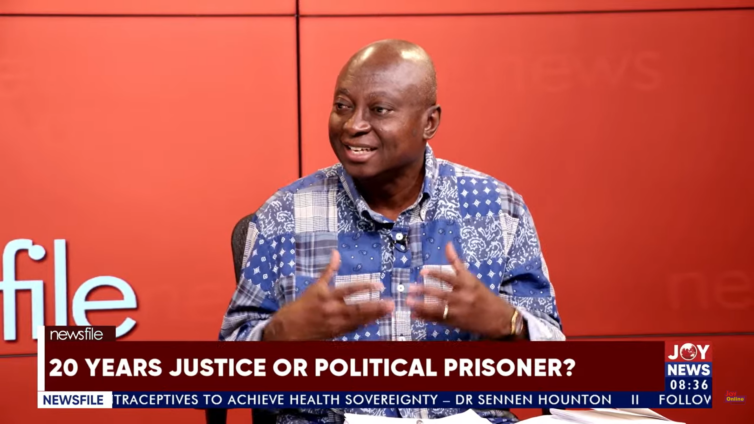
Speaking on JoyNews' Newsfile on Saturday, July 25, Samuel Atta Akyea questioned the pace at which his client's illegal mining case was prosecuted, contending that it differed significantly from the handling of ordinary criminal and civil cases.
"There seems to be an indecent haste to prosecute what I call political cases," Mr. Atta Akyea said.
According to him, the country's justice delivery system generally allows judges considerable discretion in scheduling cases, with adjournments often stretching over several weeks or even months. He argued that this was not the experience in Chairman Wontumi's trial.
"There is a justice delivery system in which judges are not by themselves in a hurry to prosecute people but to adjudicate matters," he said.
"You could do an audit of the adjournment mechanisms in the courts. If you conduct a proper audit, you will see that cases are treated in the normal course of events, and a judge could tell you, 'I will adjourn this case.' Some judges even adjourn cases for two months."
Mr. Atta Akyea, however, maintained that his client's case was handled under a markedly different regime.
"This is a special case. They take it to a special court, and the judge will tell you that you can't go to another court and do another case while I am waiting. You need to come to this court and then we proceed with the case. What is the meaning of that?" he asked.
The former Abuakwa South MP argued that such an approach creates the impression that politically significant criminal cases are deliberately fast-tracked.
"It is ministering to the generality of our people that let's do an ambulance trial relative to political cases," he said.
Mr. Atta Akyea also questioned whether judges devote the same level of commitment and urgency to civil litigation, particularly land disputes, as they do to high-profile criminal prosecutions involving politicians.
"Because when we come to civil cases about land matters, are the same energies these judges are using in trying to adjudicate criminal cases applied to civil cases?" he asked.
Drawing on his experience as a legal practitioner, he said judges handling civil matters often schedule hearings over extended periods and allow lengthy adjournments.
"If you have a very good land case, a judge will tell you, 'Come to court at 9:00 a.m. and let's adjudicate until lunchtime, then go and have lunch, and we'll close at 4:00 p.m.,'" he said.
He questioned why, in his view, the same urgency is not extended to other criminal matters before the courts.
"Are the judges giving their energies to political criminal cases? But the rest of the cases, whether civil or other criminal cases, don't receive the same attention," he argued.
Background
Mr. Atta Akyea's comments come less than a week after the Accra High Court sentenced Chairman Wontumi to 20 years' imprisonment for illegal mining activities on the Samreboi concession in the Western Region.
Justice Audrey Kocuvie-Tay, who presided over the Criminal Division of the High Court, delivered the judgment shortly after 11:40 a.m. on Monday, July 20, 2026, concluding one of Ghana's most closely watched prosecutions related to illegal mining.
The court also imposed a fine of 10,000 penalty units, equivalent to GH¢120,000, with a default sentence of three years' imprisonment should the fine remain unpaid.
Latest Stories
-
Drop-off charges at UK airports to be reviewed after sharp increase
1 hour -
Kenya confirms second Ebola case – a relative of the first victim
1 hour -
Hidden video recording device found in cabin of Australian navy ship
1 hour -
Saudi Arabia overturns death sentence for man over Facebook comment, Sri Lanka says
2 hours -
Burnham says he wants to ‘repair bridges’ between Ukraine and US
2 hours -
Pope walking and recovering ‘as expected’ after surgery, doctors say
2 hours -
Total expenditure as of July 2026 amounted to GH¢147.07bn, 16% below target – BoG
4 hours -
Total revenue & grants stood at GH¢144.5bn in July 2026, slightly below target – BoG
4 hours -
Ghana Sports Fund urges sports federations to submit credible proposals and measurable targets
4 hours -
Sally Rooney books withdrawn in UK over Palestine Action support
4 hours -
Musk says US government may be behind slowdown of Ukraine drone speeds
4 hours -
Picking Chief Justices nearing retirement could give Mahama immense power – Bentil
4 hours -
Netflix to shed 1,000 jobs in steepest cuts since 2022
5 hours -
Burnham had two hospitality dinners with Man City chairman, deleted records show
5 hours -
Semenyo ‘froze’ after alleged racist abuse, court told
5 hours