

Audio By Carbonatix
Dozens of people have been injured and at least three have been reported dead following a series of anti-government demonstrations in Togo, which were violently suppressed by law enforcement agencies over the weekend.
The protests, organised by online activists and youth-led civic movements, called for the release of political detainees and the resignation of President Faure Gnassingbé, now President of the Council of State Ministers.
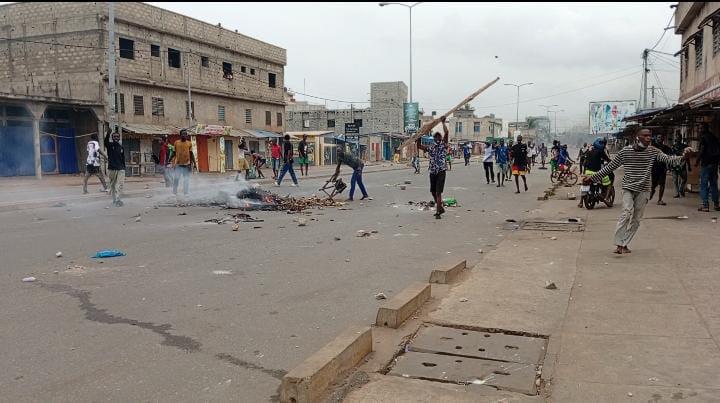
What began as peaceful demonstrations quickly descended into chaos as clashes erupted between protesters and security forces in the capital, Lomé.
Security personnel used tear gas to disperse crowds, while protesters retaliated by hurling stones and other projectiles. The confrontations, particularly fierce on Friday and Saturday, turned parts of Lomé, especially opposition strongholds such as Bè, into virtual war zones.
Eyewitnesses reported scenes of running battles, with security forces chasing demonstrators into homes and neighbourhoods.
Though Togolese authorities have not officially disclosed casualty figures, local media and human rights organisations report that at least seven people were killed, with dozens more sustaining injuries, some of them serious.
On Sunday, a coalition of 23 civil society organisations operating under the banner of the National Platform for Civic Space and Development Effectiveness issued a statement condemning what they described as the "disproportionate use of force against peaceful demonstrators."
The coalition has called for an immediate and independent investigation into the violent police crackdown.
“Peaceful protest is a fundamental right, recognised both by the Togolese Constitution and by international instruments ratified by our country,” the coalition emphasised.
In response, the Togolese government released a statement late on 29th June, accusing the protest organisers, particularly those based abroad, of orchestrating a "campaign of disinformation, hatred, violence, incivility, and civil disobedience."
The government vowed to take legal action against those behind the three-day demonstration.
Authorities also reiterated the national ban on public demonstrations, which has been in effect since 2022 due to what officials describe as "security concerns".
By Sunday, a tense calm had returned to the capital. Commercial activity resumed at key locations such as the Assigamé Central Market, with many shops reopening after days of disruption.
Some Togolese nationals living in Ghana have also condemned the recent developments in their home country, accusing the Faure family of maintaining autocratic rule in Togo for the past 50 years.
Jonas Bogavi, a Togolese resident of Ho in the Volta Region, expressed his frustration after receiving a call from his mother on Saturday, 28th June, informing him of the passing of his grandmother and the immediate plans for her burial.
However, he says the current unrest has made it impossible for him to travel.
“I had planned to ride my motorbike to attend my grandmother’s funeral over the weekend, but I’m afraid to enter Togo because of what I’m seeing on social media,” he lamented.
President Faure Gnassingbé, who has been in power since 2005 following the death of his father, the late President Eyadéma Gnassingbé, was sworn in as President of the Council of Ministers in May.
His current position carries no official term limits, a point that continues to fuel public frustration and allegations of authoritarian entrenchment.
Adding to the public discontent was the controversial arrest and psychiatric detention of Togolese rapper Narcisse Essowè Tchalla, also known as Aamron, in May.
The incident is widely seen as a catalyst for the recent surge in protests.
Over 50 people were arrested during demonstrations held on 6 June in response to his detention. While the majority have since been released, at least three individuals reportedly remain in custody.
The situation in Togo remains volatile, with growing calls for political reform, accountability, and respect for civil liberties.
Latest Stories
-
80–90% of gold purchased and exported is now refined in Ghana– Sammy Gyamfi
12 minutes -
Dichemso M/A teachers go house-to-house to get absent pupils back to class after strike suspension
15 minutes -
Meet Dr Hazel and Nhyira: Mother and daughter called to the Ghana Bar
18 minutes -
Black Star Fashion Week: Can Ghana turn the runway into a tourism attraction?
19 minutes -
Ghana sends 61 health workers to Grenada under Labour Export Programme
31 minutes -
Central banks should avoid reacting too strongly to headline inflation – IMF
37 minutes -
Kumasi: One injured, shops destroyed in Atasemanso fire in Kumasi
50 minutes -
Global economy proving resilient, growth projected at 3.1% in 2026 – IMF
54 minutes -
NDC targets all 6 parliamentary seats in Ahafo Region for 2028
58 minutes -
Ghana targets thousands of overseas nursing jobs under Labour Export Programme
60 minutes -
Pius Hadzide explains why Sports Ministry always attracts scandals
1 hour -
APL says GoldBod terminated US$1bn Goldstream deal over failure to meet obligations
1 hour -
Daily Insight for CEOs: Making better decisions under pressure
1 hour -
Weta rice farmers seek urgent support after floods destroy crops
1 hour -
Mahama commits GH¢200m in 2027 Budget to complete Police Hospital expansion
1 hour