

Audio By Carbonatix
The fate of US President Donald Trump's centrepiece budget plan remains mired in uncertainty despite a last-minute, in-person pitch to House Republicans on Tuesday.
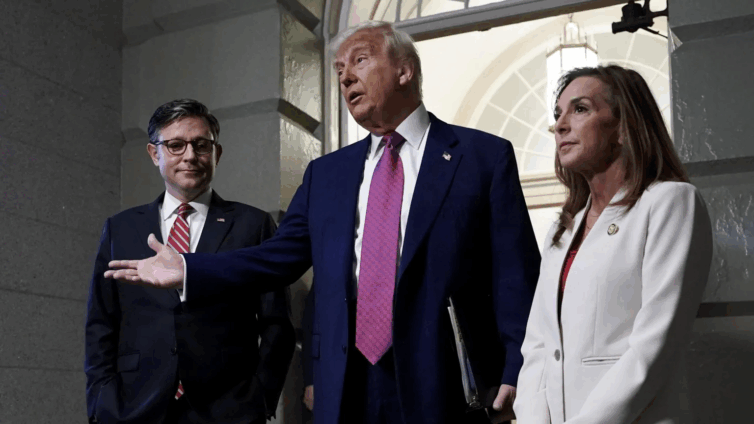
Trump departed the comfortable confines of the White House for a far more raucous setting - Capitol Hill - where he tried to rally squabbling factions within his party to back his "big, beautiful" bill.
Some members are at odds over changes to healthcare and tax deductions in the bill, which also includes about $4.9tr (€3.7tn) in tax breaks.
Trump, who wants it passed by 26 May, is amping up pressure on Republicans to support it. Some conservative hardliners pushing for deeper cuts are meeting fierce resistance from moderates.
It was obvious something big was happening on Capitol Hill from blocks away, as lines to get into different congressional buildings wrapped around blocks.
That, coupled with scurrying Secret Service agents lining the halls, were just some of the signs of a distinguished guest: Trump.
While Trump's pitch earned him the support of some House Republicans, not all left the meeting enthused and ready to support the bill.
The measure still needs to pass a full House vote before it heads to the Senate, where Republicans there have their own qualms with the legislation.
Trump downplayed dissent from some conservatives when he spoke to reporters after meeting House Republicans.
"This was a meeting of love; there was great unity in that room," Trump said. "We're going to have a great victory."
Others in his party weren't so emphatic. "As it stands right now, I do not support the bill," said Congressman Mike Lawler of New York.
The president has emphasised that the bill gets rid of the "waste, fraud and abuse" included in the budget, but not all Republican members agreed on what that means.

Much of the division in the party centres on changes to state and local tax deductions - known as Salt. The bill proposes to triple the allowable deduction from $10,000 to $30,000 for couples.
That's irked Republicans in states with higher taxes, such as New York, California and New Jersey, who are pushing for a higher cap. Lawmakers in those states argue a higher cap will give relief for middle-class Americans in high-taxed jurisdictions.
Mike Lawler appeared frustrated, saying he wouldn't back the measure in the upcoming full house vote.
"While I respect the president, I'm not budging on it," Lawler said.
About half a dozen members are similarly standing firm, threatening to hold out support.
Congresswoman Nicole Malliotakis, a New York Republican who previously expressed some scepticism about the Salt proposals, said she is satisfied with how the issue has been resolved but does not blame other representatives for pushing back.
"They're fighting for their districts, and they should be, but when it comes time to vote for the bill, it's get the best deal possible and vote for the bill" Malliotakis said.
Beyond the Salt dissenters, Republicans in both legislative chambers remain divided on perhaps the most contentious element of the bill - cuts to the healthcare program designed to assist lower-income Americans.
Some support tightening eligibility requirements for Medicaid, while others fear the proposal goes too far.
The bill currently would require that states deny Medicaid coverage, which is offered for free or a very low-cost, if able-bodied Americans using the programme are not working at least 80 hours a month or undertaking other community options - from 2029, after Trump has left office.
In private meetings with Republicans, Trump reportedly sought to ease concerns that his planned cuts were too deep.
Congressman Jodey Arrington, chair of the budget committee, said members found Trump's pitch convincing.
"His push to unify, keep the focus on reducing spending, on rooting out waste and reminding us what's at stake was exactly the right message, and the right tone," Arrington said.
However, that view wasn't universal.
"The president I don't think convinced enough people that the bill is adequate the way it is," said Republican Representative Andy Harris, who leads the hard-right House Freedom Caucus. He's among Republicans pushing for deeper cuts to Medicaid.
Last week, the legislation failed to pass a key a procedural committee vote, giving Trump his first legislative bruise of his second term.
On Sunday, days after the first vote failed, the bill cleared its first hurdle and passed the committee in a 17-16 vote.
Trump is now lobbying Republicans as the bill heads for a full House vote where his party has a narrow majority and cannot afford to lose support.
A full House vote is expected on Wednesday or Thursday.
Latest Stories
-
LA 2028: Black Queens hold final training session ahead of second leg against Mauritius
25 minutes -
Standards are not Seasonal: What the EC appointments teach both sides
39 minutes -
King Mohammed VI urges private sector to create youth jobs and spread benefits of growth
40 minutes -
KGL U17 Colts 2026: Greater Accra win title after penalties win over Western Region
40 minutes -
UK Investment Roadshow opens in London to advance UK-Ghana growth partnership
51 minutes -
Assemblies of God requires pastors to resign before entering partisan politics – Rev. Wengam
1 hour -
Ghana targets 20% annual reduction in maternal deaths – Health Minister
1 hour -
Cyber attacks in Africa grow faster than global rate, report finds
1 hour -
Ghana signs UAE deal to create 5,000 overseas jobs
1 hour -
One Million Coders Programme targets 100,000 digital jobs in two years – Sam George
1 hour -
John Jinapor, Italian Ambassador explore opportunities for energy sector investment
1 hour -
NHIA seeks legal reforms to support Free Primary Healthcare
1 hour -
Beatrice Annan defends Afi Agbenyo’s EC appointment, cites record of gender advocacy
1 hour -
Ghana seeks investment deals in Bangkok amid global economic crises
2 hours -
IMF raises Ghana’s 2026 growth forecast to 5.7%, sees inflation falling to 4.8%
2 hours