

Audio By Carbonatix
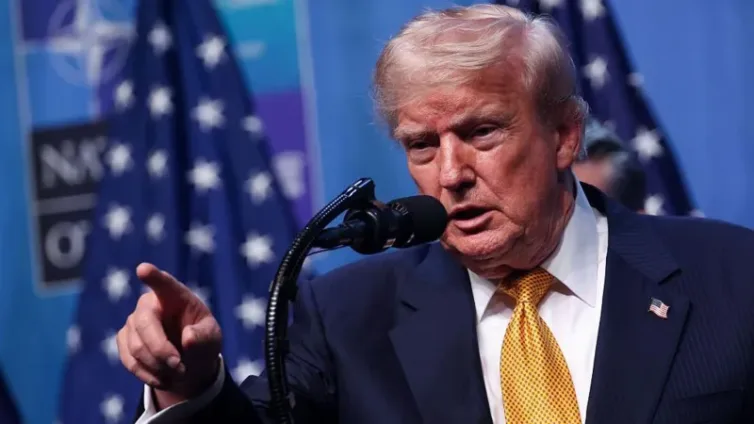
President Donald Trump has said the US is reinstating a naval blockade of Iranian ports and will impose a 20% charge on all cargo shipped through the Strait of Hormuz following days of escalating strikes between the two countries.
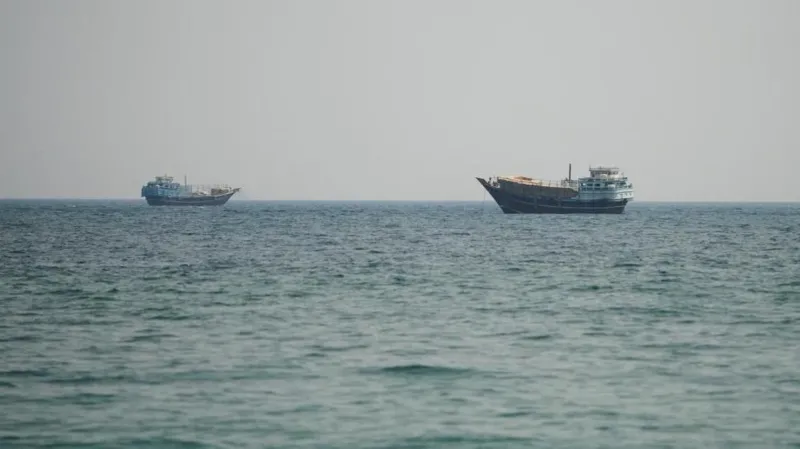
He said this would stop "Iran's ships or customers" from entering or leaving the key oil shipping route, but "all other countries will have fair and open use of the Strait". The blockade will be in effect from 16:00 Eastern Time (20:00 GMT) on Tuesday.
Iran's foreign minister later said whoever provides safe passage "should be compensated for this service", but Iran would remain the strait's "GUARDIAN" - using Trump's word.
Tehran and Washington clashed over the Strait's control after exchanging strikes in the region overnight and on Monday.
The US said it carried out strikes against military targets in Iran, targeting air defence systems, coastal radars, and missile and drone sites.
Iran said it responded by striking US military bases in Kuwait, Jordan, and Bahrain, and radars in Oman.
In Trump's Truth Social post on Monday, he insisted the Strait "will remain OPEN, with or without Iran".
"The U.S.A. will be, from this point forward, known as "THE GUARDIAN OF THE HORMUZ STRAIT," but as such, and as a matter of FAIRNESS, will be reimbursed, at the rate of 20% on all cargo shipped, for any and all costs necessary to do the job of providing safety and security to this very volatile section of the World," he wrote.
The US president added that "the process and formation will begin immediately".
His comments came shortly after he told Fox News the US would "probably run" the Strait of Hormuz, claiming that Iran "broke" a deal that was made with the US.
"We are taking over the strait," he said.
Later on Monday, US Central Command (Centcom) said its forces "will resume blockading maritime traffic entering and exiting Iranian ports" on 14 July.
"The US military continues to support traffic flow through regional waters for all vessels not violating the blockade," a Centcom statement said.
Last Friday, Trump notified Congress in a letter, seen by the BBC, that the US had resumed military action in Iran on 7 July.
Federal law requires congressional approval to continue military actions for more than 60 days. The White House can also extend the deadline for another 30 days, citing national security.
Responding to Trump'sStrait of Hormuz announcement, Iranian Foreign Minister Abbas Araghchi wrote in a post on X: "POTUS is absolutely right. Whoever provides secure and safe passage of commercial vessels through the Strait of Hormuz should be compensated for this service."
He continued: "Iran has always been the GUARDIAN of the Strait and will remain so FOREVER."
"20% is of course, too much. We will be fair," Araghchi added.
Meanwhile, a spokesperson for the International Maritime Organization - the UN agency regulating global shipping - was quoted by Reuters news agency as saying that "IMO stands firmly against charging fees for passage through straits used for international navigation".
"There is no legal basis through which to introduce mandatory tolls simply to transit through a strait," the spokesperson added.
Before Trump's announcement, Iran's top military headquarters said it would not allow the US to "interfere in the management" of the Strait of Hormuz.
In a statement shared by Iranian media, Ebrahim Zolfaghari, spokesperson of Khatam al-Anbiya, said "repeated adventurism and malicious actions" from the US in the strait have "seriously endangered regional security, international trade and the passage of oil tankers and commercial vessels".
Any co-operation with the US would be considered an act of "war" against Iran's sovereignty, he added, warning that if the conflict spreads, "the flames of war will engulf all the countries of the region".
What Trump's latest announcement means in practice remains unclear.
United Nations rules allow countries to exercise control of territorial seas up to 12 nautical miles (13.8 miles) from their coastline. At the narrowest point, the Strait of Hormuz and its shipping lanes lie entirely within Iran and Oman's territorial waters.
Iran effectively shut down the strait - through which some 25% of the world's oil and 20% of global liquefied natural gas previously passed - after the US and Israel launched strikes against Iran on 28 February.
Tehran retaliated by firing missiles and drones on Israel and US military bases in a number of Gulf countries.
Iran's Islamic Revolutionary Guards Corps (IRGC) also fired on commercial ships attempting to go through the strait without its permission, and seized two vessels. Maritime traffic through the strait dropped dramatically, triggering a rise in oil prices.
The US first imposed a naval blockade of all Iranian ports in April to put pressure on Tehran, and roughly five weeks later, the US military said it had redirected 100 commercial vessels and disabled four under the blockade.
The US lifted the blockade in June as part of a memorandum of understanding between the two countries that aimed to end the conflict. The initial agreement halted fighting, but disputes over the strait later resurfaced again.
Now, many US allies are likely to baulk at the prospect of reimbursing the US and paying 20% of all cargo shipped - and Trump detractors at home and abroad are likely to point out that the strait was open and unencumbered before the war began.
The announcement could also become politically complicated for the president domestically.
Some lawmakers - including fellow Republicans - had openly questioned what the US gained from the ceasefire, its extension and further negotiations.
Many Americans are also likely to wonder why - despite repeated promises to the contrary - oil prices are inching up again. Trump is not on the ballot for the upcoming midterm elections, but other Republicans are and will be hearing from constituents concerned about prices.
The announcement could also be a bid to restart negotiations and push other countries to be more involved, a tactic that Trump has used in the past.
Latest Stories
-
Mr President, Ghana was mentioned at the UN; why aren’t we talking about it?
46 minutes -
Accra to convene Africa’s regulators and markets on tokenisation at AVAS 2026
49 minutes -
The Paradox of Plenty — When every smartphone becomes a newsroom
1 hour -
GTA sensitises taxi drivers in ‘Know Ghana’ tourism campaign
3 hours -
Archbishop Agyinasare calls for responsible speech amid growing social media abuse
3 hours -
‘It will be inexcusable for gov’t not to honour payment of teachers’ arrears by 30th October’ – Haruna Iddrisu
3 hours -
Forbes’ World’s Best Employers 2026: No Ghanaian firm ranked among 900 companies
3 hours -
Electronic processing of teachers’ data: ‘The decision is the Controller’s’ – GES boss
3 hours -
Teachers’ Strike: Haruna Iddrisu questions paper-based processing of promoted teachers’ data
3 hours -
Savannah Region: Kunfusi bridge collapses again, leaving nearly 4,000 residents cut off
3 hours -
Teachers’ strike: GES targets Monday deadline to submit promotion data to Controller
3 hours -
Inflation to average 11.3% in 2027 – Fitch Solutions
4 hours -
‘I didn’t campaign for NDC to come and do this nonsense’ – Kpebu on EOCO’s conduct
4 hours -
Fitch Solutions maintains policy rate forecast of 14% by December 2026
4 hours -
Diaspora Nasara Caucus congratulates Mohammed Ali Suraj, new NPP executives
6 hours