

Audio By Carbonatix
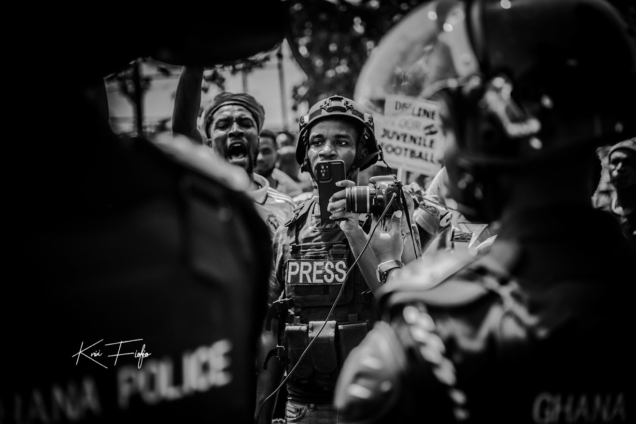
Yesterday, I heard one of the most outrageous things I have encountered in my short practice as a member of the Fourth Estate: that a journalist must seek permission before filming anything in public.
What made this claim even more bizarre was that it came from the Public Relations Officer of the Ghana National Fire Service (GNFS), a man who, by virtue of his role, I would assume has at least some elementary training in journalism and media relations.
He was responding to reports that a journalist had been beaten by fire service personnel at Kasoa. The journalist’s only “crime” was filming an altercation between GNFS officers and some residents. That singular act of documentation was apparently enough justification for him to be manhandled and assaulted, as though he had caused the very fire the officers had been deployed to extinguish.
But then again, why should I be surprised?
This is the same Ghana where police officers, whose constitutional mandate is to maintain law and order, once descended violently on a journalist simply for asking a question. When crowds gathered at the Police Headquarters following the arrest of NDC’s Koku Anyidoho, JoyNews’ Latif Iddrisu was assaulted for attempting to identify a police vehicle deployed for crowd control. He was beaten as though officers were extracting a confession from a hardened criminal. I doubt even a suspect would have been subjected to that level of brutality. His real offence, it seems, was being a journalist doing his job.
“How dare he?” one can only imagine they thought.
That case has been crawling through the courts for more than five years. Justice, if it ever arrives, is moving at a glacial pace. Even more shocking was the claim by a security installation as extensive as the Police Headquarters that there was no CCTV footage of the incident. Ghana, indeed.
Latif’s experience is not an isolated case. It is part of a disturbing and well-documented pattern of abuse against journalists in Ghana, one that has persisted and worsened over the last three years.
Data from the Ghana Journalists Association (GJA), the Committee to Protect Journalists (CPJ), and Reporters Without Borders (RSF) paint a troubling picture.
Between 2023 and 2025, Ghana recorded an estimated 31 to over 40 cases of physical assault against journalists.
• In 2023, the GJA documented between 9 and 12 incidents, many linked to political events and public demonstrations.
• In 2024, watchdog groups including CPJ recorded approximately 10 to 15 assaults, involving security officers, political party supporters, and private security.
• By October 2025, the GJA had already recorded 12 to 13 attacks, with several occurring during routine field reporting.
These figures are conservative. Many journalists, fearing reprisals or doubting the prospects of justice, never report their attacks.
Even more disturbing than the frequency of these attacks is what follows, or rather, what does not.
Across this three-year period, there is no publicly documented case of a journalist’s assault that has been fully prosecuted and concluded with a conviction. Arrests are occasionally announced. Investigations are promised. Committees are set up. But prosecutions? Convictions? Accountability? They remain elusive.
The GJA has repeatedly lamented this culture of impunity, noting that many of the perpetrators, particularly those in uniform, are shielded by the very institutions meant to uphold the law. CPJ and RSF echo this concern, consistently ranking Ghana lower on press freedom indicators due not only to attacks on journalists, but also the state’s failure to punish offenders.
Latif Iddrisu’s case, now more than half a decade old, stands as a symbol of this failure. If a high-profile case involving national media attention can stagnate for years, what hope is there for the countless less visible victims across the country?
The suggestion that journalists must seek permission before filming in public spaces is not just wrong. It is dangerous. It emboldens security agencies and state actors to act as gatekeepers of public truth. It reframes journalism as a privilege granted by authority rather than a constitutional right.
Public spaces, by definition, belong to the public. Journalists do not require permission to document events of public interest occurring within them. To argue otherwise is to fundamentally misunderstand both the law and the role of the press in a democracy.
When uniformed officers assault journalists and their superiors defend the act, either explicitly or through silence, it sends a chilling message: the camera is a threat, and those behind it are fair game.
A democracy cannot thrive where journalists are beaten into silence and justice is indefinitely deferred. Every assault left unpunished does more than harm an individual reporter. It weakens public trust, erodes accountability, and shrinks civic space.
Ghana has long enjoyed a reputation as a beacon of press freedom in West Africa. But reputations, like rights, must be protected. When attacks on journalists become routine and accountability becomes optional, that reputation rings hollow.
The question is no longer whether journalists are under attack in Ghana. The evidence is overwhelming. The real question is whether the state has the political will to end the impunity, and whether those in uniform understand that the camera is not their enemy, but democracy’s safeguard.
Until then, the Fourth Estate will continue to bleed, often in plain sight and far too often without justice.
Latest Stories
-
Mobile Money Fintech LTD, UMB train hairdressers and beauticians
2 hours -
Asylum votes show people want help, says Kemi Badenoch
3 hours -
Badenoch welcomes expanded grooming gangs inquiry
3 hours -
GACL MD sues Samuel Buabeng over alleged Facebook defamation
3 hours -
Christa Pike in critical condition after surviving two lethal injections, lawyer says
4 hours -
Kemi Badenoch backs face covering ban at protest
4 hours -
Man City not ‘above the rules’, says No 10 after backlash to Burnham remarks
4 hours -
Real Madrid submit ‘substantial’ dossier in Barca payments case
4 hours -
Messi completes purchase of second Spanish club
4 hours -
Government must engage horticulturists on tomato crisis – GhIH
4 hours -
King Promise’s ‘Can’t Tame Us’ becomes official Chelsea anthem
4 hours -
Afenyo-Markin demands Baffour Awuah’s release from EOCO’s custody, end to alleged political intimidation
4 hours -
Rapper Rick Ross arrested on domestic violence charges
5 hours -
Minority demands security review of Ghana-Colombia visa waiver and port deals
5 hours -
Pursue drug kingpins, not persecute political opponents – Afenyo-Markin tells EOCO
5 hours