

Audio By Carbonatix
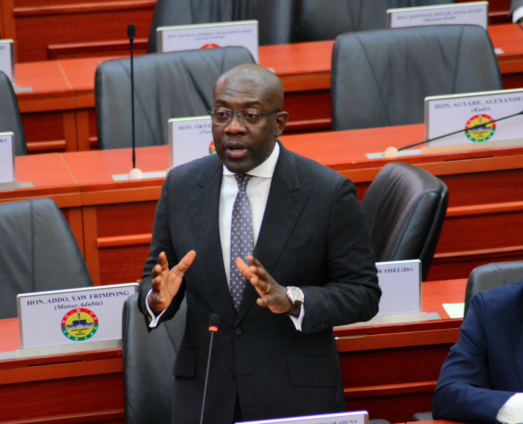
The Ranking Member on Parliament’s Economy and Development Committee, Kojo Oppong Nkrumah, has questioned the implementation of the government’s 24-Hour Economy programme.
He argues that nearly two years into the administration, there is still no clear evidence of its impact.
The Ofoase-Ayirebi MP said Parliament has approved about GH¢650 billion in public expenditure during the period, yet the government’s flagship economic policy has failed to produce the promised “one job, three people, three shifts” model.
Speaking on the floor of Parliament while supporting the adoption of a report by the Economy and Development Committee, the former Information Minister said the policy was presented to Ghanaians as a major industrialisation and job creation strategy.
He argued that the programme has not moved beyond policy discussions into practical implementation.
“For all the stories that were told and all the promises that accompanied the 24-Hour Economy, almost two years after assuming office, there is not one government agency implementing the one-three-three model,” he told Parliament.
Mr. Oppong Nkrumah said the Minority had consistently pushed government to submit key policy documents to Parliament for scrutiny, but the 24-Hour Economy framework remains one of the few major policies presented to the House.
He said discussions at the committee level suggest the government is now focusing on two areas — the construction of 24-hour markets and incentives for private-sector participation.
However, he questioned whether building markets alone would create round-the-clock economic activity.
According to him, many existing markets across the country already struggle with low activity despite having the necessary infrastructure.
Mr Oppong Nkrumah said simply constructing new markets without expanding production and demand would not automatically deliver the intended results.
He also criticised the delay in introducing incentives to encourage private businesses to operate additional shifts.
The former Information Minister said investors require clear policy direction and incentives before committing resources to expanded production and employment.
He argued that the delay raises questions about the government’s readiness to implement the programme.
Mr Oppong Nkrumah further questioned the decision to move away from the One District, One Factory (1D1F) programme, which he said had recorded measurable progress.
He cited the National Development Planning Commission’s 2024 Annual Progress Report, which he said confirmed that at least 150 1D1F projects were operational by the end of 2024.
According to him, the government should have improved the policy rather than replacing it with a programme whose key components are still being developed.
He warned that delays in implementing a strong industrialisation strategy could worsen the country’s unemployment challenge, particularly among young people.
Citing Ghana Statistical Service figures, Mr Oppong Nkrumah said youth unemployment has risen to about 32.4%, making urgent job creation measures necessary.
He urged the government to move beyond campaign promises and implement policies that expand production, create jobs and support sustainable economic growth.
Latest Stories
-
KMA empowers 64 persons with disabilities; Mayor unveils plan for sustainable skills centre
11 seconds -
DJs Union urges musicians to prioritise respect, communication amid industry tensions
8 minutes -
“Ghanaian DJs deserve their flowers” – Lasmid
8 minutes -
Zenith Bank supports childhood cancer unit at Greater Accra Regional Hospital
10 minutes -
‘Who’s in charge doesn’t really matter; we’re all servants’ – John Boadu on leader of NPP
13 minutes -
Christa Pike’s prognosis still unclear after failed execution, lawyer says
29 minutes -
SLTF to advance fees for first-year students facing admission payment deadlines
32 minutes -
Ghana Institute of Architects calls for action to make adequate housing a human right
32 minutes -
BoG, Police arrest seven over alleged misuse of Ghana Cedis as bouquets
32 minutes -
NCPTAs appeal to striking teachers to return to classroom
33 minutes -
Government plans engineered landfills and waste transfer stations nationwide – Ayariga
35 minutes -
Second edition of Prince Amoako Jr giveback project scheduled for December
37 minutes -
Muntaka commissions polyclinic at Ayigya Zongo to address healthcare challenges
45 minutes -
World Habitat Day: Adequate housing for all – a right we must build
46 minutes -
Ghana Institute of Architects urges government to adopt coordinated agenda for affordable housing
47 minutes