


Audio By Carbonatix
Two pieces of very disturbing news involving working women and menstruation have emerged in India in recent months.
Periods have long been a taboo in the country, menstruating women are believed to be impure and are still excluded from social and religious events. In recent years, these archaic ideas have been increasingly challenged, especially by urban educated women.
But two recent reports show that India's very problematic relationship with menstruation continues. A vast majority of women, especially those from poor families, with no agency and no education, are forced to make choices that have long-term and irreversible impacts on their health and their lives.
The first comes from the western state of Maharashtra where it has been revealed by Indian media that thousands of young women have undergone surgical procedures to remove their wombs in the past three years. In a substantial number of cases they have done this so they can get work as sugarcane harvesters.
Every year, tens of thousands of poor families from Beed, Osmanabad, Sangli and Solapur districts migrate to more affluent western districts of the state - known as "the sugar belt" - to work for six months as "cutters" in sugarcane fields.
Once there, they are at the mercy of greedy contractors who use every opportunity to exploit them.
To begin with, they are reluctant to hire women because cane-cutting is hard work and women may miss a day or two of work during their periods. If they do miss a day's work, they have to pay a penalty.
The living conditions at their work-place are far from ideal - the families have to live in huts or tents close to the fields, there are no toilets, and as harvesting is sometimes done even at night, there is no fixed time for sleeping or waking. And when women get their periods, it just becomes that much more tough for them.
Because of the poor hygienic conditions, many women catch infections and, activists working in the region say, unscrupulous doctors encourage them to undergo unnecessary surgery even if they visit for a minor gynaecological problem which can be treated with medicine.
As most women in these areas are married young, many have two to three children by the time they are in their mid-20s, and because doctors don't tell them about the problems they would face if they underwent a hysterectomy, many believe that it's OK to get rid of their wombs.
This has turned several villages in the region into "villages of womb-less women".
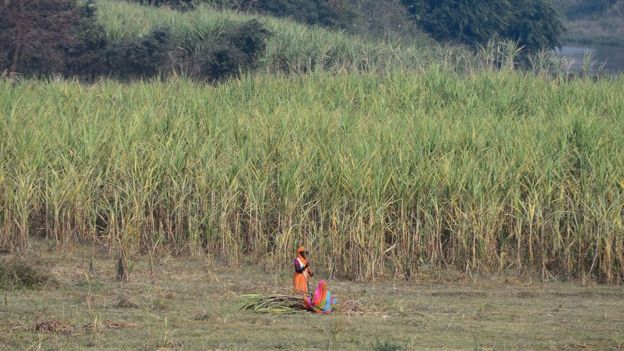 Tens of thousands of women work as sugarcane harvesters in India
After the issue was raised last month in the state assembly by legislator Neelam Gorhe, Maharashtra Health Minister Eknath Shinde admitted that there had been 4,605 hysterectomies just in Beed district in three years. But, he said, not all of them were carried out on women who worked as sugarcane harvesters. The minister said a committee had been set up to investigate several of the cases.
My colleague Prajakta Dhulap from the BBC's Marathi language service, who visited Vanjarwadi village in Beed district, says from October to March every year, 80% of villagers migrate to work in sugarcane fields. She reports that half of the women in the village have had hysterectomies - most are under the age of 40 and some are still in their 20s.
Many of the women she met said their health had deteriorated since they underwent surgery. One woman talked about the "persistent pain in her back, neck and knee" and how she wakes up in the morning with "swollen hands, face and feet". Another complained of "constant dizziness" and how she was unable to walk even short distances. As a result, they both said they were no longer able to work in the fields.
The second piece of news, from the southern state of Tamil Nadu, is equally dire. Women working in the multi-billion dollar garment industry there allege that they have been given unlabelled drugs at work - instead of a day off - when they have complained of period pain.
According to a Thomson Reuters Foundation expose, based on interviews with about 100 women, the drugs were rarely provided by medical professionals and the seamstresses, mostly from poor disadvantaged families, said they couldn't afford to lose a day's wages on account of period pains.
All of the 100 women who were interviewed said they had received drugs, and more than half said that as a result, their health had suffered.
Most said they were not told the name of the drugs or warned about any possible side-effects.
Many of the women blamed these medicines for their health problems, ranging from depression and anxiety, to urinary tract infections, fibroids and miscarriages.
The reports have forced the authorities into action. The National Commission for Women has described the condition of the women in Maharashtra as "pathetic and miserable" and asked the state government to prevent such "atrocities" in future. In Tamil Nadu, the government said they would monitor the health of the garment workers.
The reports come at a time when attempts are being made across the world to increase women's participation in the workforce by implementing gender-sensitive policies.
Worryingly, female workforce participation in India has fallen from 36% in 2005-06 to 25.8% in 2015-16 and it's not hard to understand why if we look at the conditions in which women have to work.
Tens of thousands of women work as sugarcane harvesters in India
After the issue was raised last month in the state assembly by legislator Neelam Gorhe, Maharashtra Health Minister Eknath Shinde admitted that there had been 4,605 hysterectomies just in Beed district in three years. But, he said, not all of them were carried out on women who worked as sugarcane harvesters. The minister said a committee had been set up to investigate several of the cases.
My colleague Prajakta Dhulap from the BBC's Marathi language service, who visited Vanjarwadi village in Beed district, says from October to March every year, 80% of villagers migrate to work in sugarcane fields. She reports that half of the women in the village have had hysterectomies - most are under the age of 40 and some are still in their 20s.
Many of the women she met said their health had deteriorated since they underwent surgery. One woman talked about the "persistent pain in her back, neck and knee" and how she wakes up in the morning with "swollen hands, face and feet". Another complained of "constant dizziness" and how she was unable to walk even short distances. As a result, they both said they were no longer able to work in the fields.
The second piece of news, from the southern state of Tamil Nadu, is equally dire. Women working in the multi-billion dollar garment industry there allege that they have been given unlabelled drugs at work - instead of a day off - when they have complained of period pain.
According to a Thomson Reuters Foundation expose, based on interviews with about 100 women, the drugs were rarely provided by medical professionals and the seamstresses, mostly from poor disadvantaged families, said they couldn't afford to lose a day's wages on account of period pains.
All of the 100 women who were interviewed said they had received drugs, and more than half said that as a result, their health had suffered.
Most said they were not told the name of the drugs or warned about any possible side-effects.
Many of the women blamed these medicines for their health problems, ranging from depression and anxiety, to urinary tract infections, fibroids and miscarriages.
The reports have forced the authorities into action. The National Commission for Women has described the condition of the women in Maharashtra as "pathetic and miserable" and asked the state government to prevent such "atrocities" in future. In Tamil Nadu, the government said they would monitor the health of the garment workers.
The reports come at a time when attempts are being made across the world to increase women's participation in the workforce by implementing gender-sensitive policies.
Worryingly, female workforce participation in India has fallen from 36% in 2005-06 to 25.8% in 2015-16 and it's not hard to understand why if we look at the conditions in which women have to work.
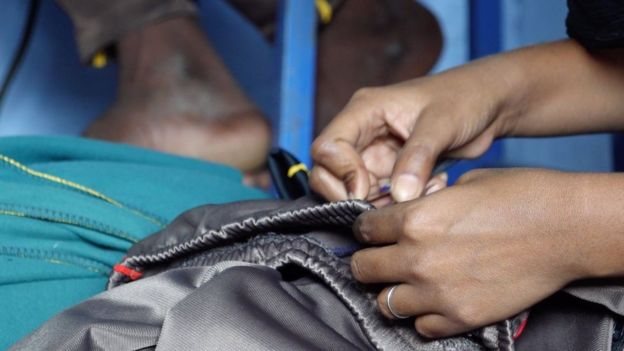 Tamil Nadu's multi-billion dollar garment industry employs 300,000 women
In Indonesia, Japan, South Korea and a few other countries, women are allowed a day off work during their periods. Many private companies also offer similar relief.
"In India too, the Bihar state government has been allowing women employees to take two extra days off every month since as far back as 1992 and it seems to be working very well," says Urvashi Prasad, a public policy specialist at the Indian government think tank, Niti Aayog.
And last year, a female MP tabled a Menstrual Benefits Bill in the parliament, seeking two days off every month for every working woman in the country.
Ms Prasad says there are challenges to implementing any policy in a vast country like India, especially in the informal sector where it needs much more monitoring. But, she says, if a start is made in the formal sector, it can signal a change in mindsets and help remove the stigma that surrounds menstruation in India.
"So what we need is for the powerful organised private sector and the government to take a stand, we need people at the top to send the right signals," she says. "We have to start somewhere and eventually we can expect to see some change in the unorganised sector too."
The Menstrual Benefits Bill is a private member's bill so it's unlikely that it will come to much, but if it does become law, it would likely benefit the women who work in Tamil Nadu's garment factories which will have to implement it.
But such welfare measures rarely benefit those employed in India's vast unorganised sector, which means that women like those working in Maharashtra's sugarcane fields will remain at the mercy of their contractors.
Tamil Nadu's multi-billion dollar garment industry employs 300,000 women
In Indonesia, Japan, South Korea and a few other countries, women are allowed a day off work during their periods. Many private companies also offer similar relief.
"In India too, the Bihar state government has been allowing women employees to take two extra days off every month since as far back as 1992 and it seems to be working very well," says Urvashi Prasad, a public policy specialist at the Indian government think tank, Niti Aayog.
And last year, a female MP tabled a Menstrual Benefits Bill in the parliament, seeking two days off every month for every working woman in the country.
Ms Prasad says there are challenges to implementing any policy in a vast country like India, especially in the informal sector where it needs much more monitoring. But, she says, if a start is made in the formal sector, it can signal a change in mindsets and help remove the stigma that surrounds menstruation in India.
"So what we need is for the powerful organised private sector and the government to take a stand, we need people at the top to send the right signals," she says. "We have to start somewhere and eventually we can expect to see some change in the unorganised sector too."
The Menstrual Benefits Bill is a private member's bill so it's unlikely that it will come to much, but if it does become law, it would likely benefit the women who work in Tamil Nadu's garment factories which will have to implement it.
But such welfare measures rarely benefit those employed in India's vast unorganised sector, which means that women like those working in Maharashtra's sugarcane fields will remain at the mercy of their contractors.
Tens of thousands of women work as sugarcane harvesters in India
After the issue was raised last month in the state assembly by legislator Neelam Gorhe, Maharashtra Health Minister Eknath Shinde admitted that there had been 4,605 hysterectomies just in Beed district in three years. But, he said, not all of them were carried out on women who worked as sugarcane harvesters. The minister said a committee had been set up to investigate several of the cases.
My colleague Prajakta Dhulap from the BBC's Marathi language service, who visited Vanjarwadi village in Beed district, says from October to March every year, 80% of villagers migrate to work in sugarcane fields. She reports that half of the women in the village have had hysterectomies - most are under the age of 40 and some are still in their 20s.
Many of the women she met said their health had deteriorated since they underwent surgery. One woman talked about the "persistent pain in her back, neck and knee" and how she wakes up in the morning with "swollen hands, face and feet". Another complained of "constant dizziness" and how she was unable to walk even short distances. As a result, they both said they were no longer able to work in the fields.
The second piece of news, from the southern state of Tamil Nadu, is equally dire. Women working in the multi-billion dollar garment industry there allege that they have been given unlabelled drugs at work - instead of a day off - when they have complained of period pain.
According to a Thomson Reuters Foundation expose, based on interviews with about 100 women, the drugs were rarely provided by medical professionals and the seamstresses, mostly from poor disadvantaged families, said they couldn't afford to lose a day's wages on account of period pains.
All of the 100 women who were interviewed said they had received drugs, and more than half said that as a result, their health had suffered.
Most said they were not told the name of the drugs or warned about any possible side-effects.
Many of the women blamed these medicines for their health problems, ranging from depression and anxiety, to urinary tract infections, fibroids and miscarriages.
The reports have forced the authorities into action. The National Commission for Women has described the condition of the women in Maharashtra as "pathetic and miserable" and asked the state government to prevent such "atrocities" in future. In Tamil Nadu, the government said they would monitor the health of the garment workers.
The reports come at a time when attempts are being made across the world to increase women's participation in the workforce by implementing gender-sensitive policies.
Worryingly, female workforce participation in India has fallen from 36% in 2005-06 to 25.8% in 2015-16 and it's not hard to understand why if we look at the conditions in which women have to work.
Tamil Nadu's multi-billion dollar garment industry employs 300,000 women
In Indonesia, Japan, South Korea and a few other countries, women are allowed a day off work during their periods. Many private companies also offer similar relief.
"In India too, the Bihar state government has been allowing women employees to take two extra days off every month since as far back as 1992 and it seems to be working very well," says Urvashi Prasad, a public policy specialist at the Indian government think tank, Niti Aayog.
And last year, a female MP tabled a Menstrual Benefits Bill in the parliament, seeking two days off every month for every working woman in the country.
Ms Prasad says there are challenges to implementing any policy in a vast country like India, especially in the informal sector where it needs much more monitoring. But, she says, if a start is made in the formal sector, it can signal a change in mindsets and help remove the stigma that surrounds menstruation in India.
"So what we need is for the powerful organised private sector and the government to take a stand, we need people at the top to send the right signals," she says. "We have to start somewhere and eventually we can expect to see some change in the unorganised sector too."
The Menstrual Benefits Bill is a private member's bill so it's unlikely that it will come to much, but if it does become law, it would likely benefit the women who work in Tamil Nadu's garment factories which will have to implement it.
But such welfare measures rarely benefit those employed in India's vast unorganised sector, which means that women like those working in Maharashtra's sugarcane fields will remain at the mercy of their contractors.DISCLAIMER: The Views, Comments, Opinions, Contributions and Statements made by Readers and Contributors on this platform do not necessarily represent the views or policy of Multimedia Group Limited.
DISCLAIMER: The Views, Comments, Opinions, Contributions and Statements made by Readers and Contributors on this platform do not necessarily represent the views or policy of Multimedia Group Limited.
Latest Stories
-
I do not see myself as better than anyone – NPP’s 1st Vice Chair Kojo Bamba
26 minutes -
Police blur the line between invitations and arrests – Reindorf Twumasi Ankrah
1 hour -
Turning invitations into arrests is making citizens reluctant to assist police – Twumasi Ankrah
2 hours -
The Traffitech-GH SMS spot-fine system: The good, the sad, and the funny – Bright Simons writes
2 hours -
Hawa Koomson pledges experienced and mature leadership of NPP women’s wing
3 hours -
Young woman found dead at Kasoa Peace Town
3 hours -
Playback: The Law examined lawful arrest in Ghana
4 hours -
Mahama urges African governments to treat healthcare as an investment, not budget cost
4 hours -
Bawumia congratulates John Boadu and new NPP executives, pledges support ahead of 2028
4 hours -
Aksa Energy delegation pays courtesy call on GRA Commissioner-General
4 hours -
‘No talent should be left out’ – Bawumia pledges inclusive NPP campaign for 2028
5 hours -
Prof. Mike Oquaye recounts how he blocked the Special Prosecutor’s attempt to arrest Bawku Central MP
5 hours -
Make health sovereignty a priority for Africa – Mahama
5 hours -
Dorimon Naa, Wa West DCE lead massive clean-up exercise; threaten sanctions against recalcitrant residents
5 hours -
Photos from Adom FM Y2K Jam
5 hours