

Audio By Carbonatix
Burgundy is one of the most prestigious wine regions in France, and the US is its biggest export market. But now, Donald Trump's tariffs are threatening to price European wine out of the American marketplace.
Crouched in cold mud under a thin Spring rain, vineyard employee Élodie Bonet snaps off unwanted vine shoots with her fingers and pruning clippers.
"We want the vine to put all its energy into the shoots that have the flowers where the grapes are going to grow," she explains.
I leave Élodie working her way down the rows of vines, and walk up to the house and winery in the Burgundy village of Morey-Saint-Denis, where I meet owner and winemaker Cécile Tremblay.
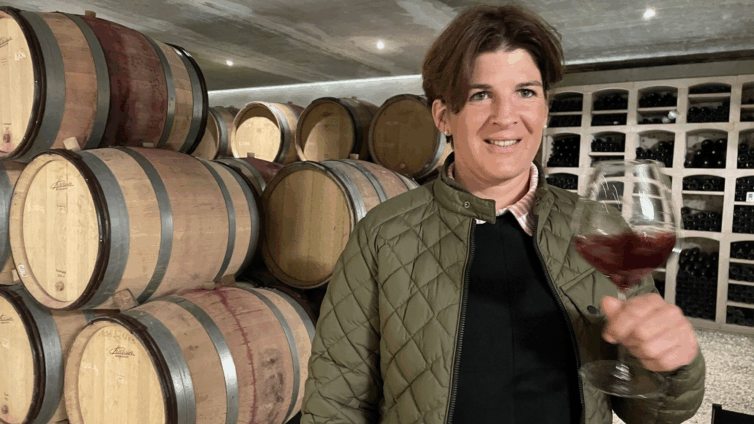
She takes me down to her cellar to taste some of her prized red wines, standing among the oak barrels and old bottles with labels weathered by mould and age.
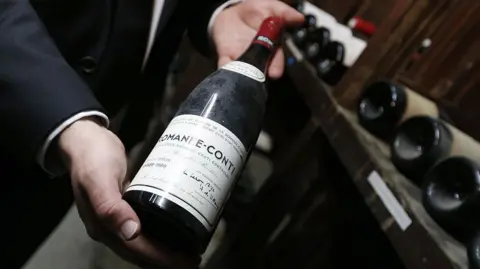
They have names on them that make wine lovers go weak at the knees - Nuits-Saint-Georges, Echezeaux, Vosne-Romanée, Clos-Vougeot, and Chapelle-Chambertin.
Ms Tremblay sells over half of her wine abroad, under the name Domaine Cecile Tremblay.
"For the United States, it's around 10% of the production; it's a big production for me!" she says.
After threatening a 200% mark-up on alcohol from Europe, Donald Trump imposed a 20% tariff on practically all European Union products on 5 April.
Four days later, he lowered this to 10%, with the threat that he'd hike it back up again to 20% in July, depending on how trade negotiations pan out. And now Trump is threatening a future tariff of 50% on all goods from the EU.
I ask Ms Tremblay if she's worried. "Yes, sure," she says, "As everybody is."
But that is all she will say on the matter. French winemakers are walking on eggshells at the moment, fearful of saying anything that might aggravate the situation.
Perhaps their representatives will be more forthcoming? I get in my car and drive over to one of her neighbours - François Labet. He is the president of the Burgundy Wine Board, which represents this region's 3,500 winemakers.
"The US is the largest export market for the whole region. Definitely," he tells me. "They are the biggest in volume and the biggest in value."
And, until Donald Trump's re-election, the US market was booming. While French wines and spirits' global exports fell 4% last year overall, sales of Burgundy wines to the US rose sharply.
In volume terms, there were up 16% from 2024, to 20.9 million bottles. This was worth €370m ($415m; £312m) in revenues, 26.2% higher than in 2023.
Mr Labet says the US accounted for about a quarter of Burgundy's wine exports last year.
Burgundy's reputation abroad is mainly for its red wines, which are made from the celebrated pinot noir grape. Indeed, in the English-speaking world, burgundy is not so much a wine as a colour.
The French word for the same colour is bordeaux; showing they know more about their wine, because while Bordeaux wines are mostly red, two-thirds of Burgundy is actually white.
These are predominantly made from the Chardonnay grape. Chablis, one of the best-known examples, is extremely popular in the US.
Burgundy also produces an increasingly successful sparkling wine, called Crémant de Bourgogne, and a small amount of rosé.
All of which is good for Burgundy because while general red wine consumption just keeps going down, white is holding firm, and sparkling is going up.
Also, the reds that come out of Burgundy are, according to Mr Labet, the kind consumers increasingly want, as they are typically lighter than New World reds.
"What is interesting to see is that there is a strong de-consumption of what we call the big reds, made in the US. Wines with a lot of alcohol, aged in new wood."
Less sun and lower temperatures in Burgundy, even with climate change, means less sugar in the grapes and lower alcohol content.
Mr Labet remembers when, for 18 months of his first presidency, Donald Trump hit European wine with a 25% import tariff during a dispute over airlines.
"We were hostages of that situation, and it really did affect our sales to the US. We had a drop of about 50% of our exports to the US."
Regarding the current 10% Trump tariff, he predicts that French wine producers and US merchants will split the cost of the new import duty between them in order to maintain sales.
But what will be the impact if, in July, Trump decides to increase the tariff on all European Union exports to 20%, as he has threatened to do? "We will go back to the 2019 situation where the market was almost stopped," says Mr Labet.
For French wines in general, things could be even worse.
"When President Trump raised import duties by 25% for one-and-a-half years of his first mandate, we lost about $600m [£450m] very quickly," says Jerome Bauer, president of the French National Wines and Spirits Confederation.
"But back then Champagne wasn't included, and neither were wines stronger than 14 degrees of alcohol. So you can see the scale of the threat today."
The solution Mr Bauer is backing is free trade. No tariffs. But you'd expect him to say that, given that France and Europe run a big trade surplus with the US when it comes to wines and spirits.
More surprising, perhaps, is the opinion of his American competitors in California and Oregon who, you might think, would be cracking open something a bit special to celebrate.
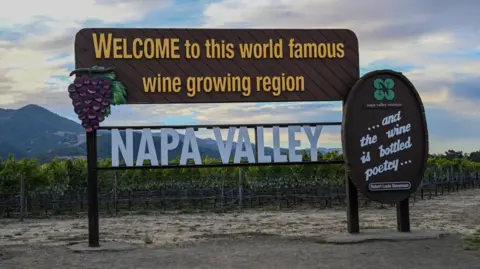
"This looks horrible from our perspective. We don't like it one bit," says Rex Stoltz, vice-president of industry relations at Napa Valley Vintners, which represents 540 wineries in the sunny slopes of California's most famous wine region.
"Wine is an international product. Even here in the Napa Valley, our wineries primarily get their corks from Portugal, and their oak barrels, a key component in winemaking, from France.
Mr Stoltz adds: "They're already expensive and the potential is that they will get more expensive."
Also, trade wars cut both ways. He says the tariffs announced against Canada are having a devastating impact on US wine exports.
"Canada is the most important export market for California wines, and one of the top export markets for Napa Valley wines. Right now, there are zero Napa Valley wines on the shelves of stores in Canada.
"They've removed all American alcohol beverage products from their store shelves!"
Mr Stoltz adds: "We just want to compete on an even playing field with our friends and neighbours all over the world. That's our ask and that's our hope."
Latest Stories
-
LA 2028: Black Queens hold final training session ahead of second leg against Mauritius
25 minutes -
Standards are not Seasonal: What the EC appointments teach both sides
38 minutes -
King Mohammed VI urges private sector to create youth jobs and spread benefits of growth
39 minutes -
KGL U17 Colts 2026: Greater Accra win title after penalties win over Western Region
39 minutes -
UK Investment Roadshow opens in London to advance UK-Ghana growth partnership
50 minutes -
Assemblies of God requires pastors to resign before entering partisan politics – Rev. Wengam
1 hour -
Ghana targets 20% annual reduction in maternal deaths – Health Minister
1 hour -
Cyber attacks in Africa grow faster than global rate, report finds
1 hour -
Ghana signs UAE deal to create 5,000 overseas jobs
1 hour -
One Million Coders Programme targets 100,000 digital jobs in two years – Sam George
1 hour -
John Jinapor, Italian Ambassador explore opportunities for energy sector investment
1 hour -
NHIA seeks legal reforms to support Free Primary Healthcare
1 hour -
Beatrice Annan defends Afi Agbenyo’s EC appointment, cites record of gender advocacy
1 hour -
Ghana seeks investment deals in Bangkok amid global economic crises
2 hours -
IMF raises Ghana’s 2026 growth forecast to 5.7%, sees inflation falling to 4.8%
2 hours