

Audio By Carbonatix
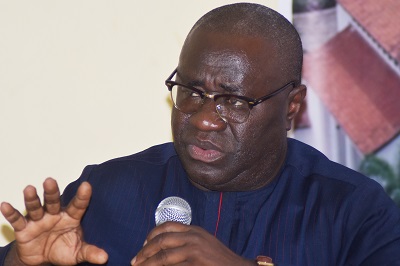
The Director of Academic Affairs and Research at the Kofi Annan International Peacekeeping Training Centre, (KAIPTC) has expressed displeasure with the recent military operation in Ashaiman.
Professor Kwesi Aning said the military swoop in Ashaiman to arrest persons who stabbed a soldier to death is not an intelligence-led operation.
According to him, if people are always brutalised by the military for a crime committed without taking the appropriate steps, their actions will be seen as acceptable in society.
He said that the military creates a society of fear when they deprive citizens of their rights to freedom.
“When we say something is intelligence-led, then it is sharp, pinpointed, specific and deliberate. So an intelligence-led operation that seizes 184 people, brutalises and if you see the picture of those guys lying in mud how is that intelligence?……you treat people in a way that dehumanises and takes away their sense of self-respect and humanity in the name of gathering intelligence?
“So when you let them wade in mud, what you will do is that you seek to dehumanise them, by brutalising and teaching sense to those people, you create societies of fear and societies of abuse”, Prof Aning said.
Speaking on Newsfile on Saturday, the professor said the Defence and Interior Committee in Parliament has failed its oversight duty in the case of the Ashaiman military brutality.
He explained that the Committee’s failure to sympathise with the family of the affected person and hold the Ghana Armed Forces (GAF) to account for their brutality toward the civilians is uncalled for.
Prof Aning said that Parliament had missed an opportunity to ensure public faith in security institutions.
“Part of my pain and this abiding sense of failure also relates to the discursive language used by our political class.
“So the Parliamentary Committee on Defence and Interior sympathises not with the family but with the Ghana Armed Forces (GAF) as an institution for losing one of their personnel. That is okay.
“But then the Parliamentary Committee then said we need to be careful about how we handle this case so we don’t worsen it. That is not the way oversight must be done.
"Oversight and particularly parliamentary oversight in dealing with interior, defence and intelligence is about ensuring that the public faith in these institutions is kept,” he stressed.
He cautioned that without Parliament’s oversight role especially in relation to the activities of the military, Ghana could be heading towards a precarious future.
Latest Stories
-
Be careful with cross-border lending, foreign currency exposures – BoG to financial institutions
2 hours -
GPL 2026/27: Medeama go three clear as Hearts of Oak recover and Bechem stage stunning comeback
2 hours -
Ntiamoah Foundation launches “BEYOND 20” anniversary campaign
2 hours -
Credit Risk Management Directive: BoG to begin implementation for banks, others from July 1, 2027
2 hours -
Ghana Brands Awards 2026: Leading brands, business trailblazers to shine on November 20
3 hours -
T-bills auction: Demand improves as government exceeds target by about 76%; interest rates soften
3 hours -
Ziope undertakes initiative to build a technologically inclined community, commissions self-help ICT lab
3 hours -
ECG announces power outage in parts of Tema, Central Region due to network fault, maintenance
4 hours -
When the Gospel Becomes a Weapon: The church, blackmail and the abuse of faith
4 hours -
JoyNews’ Jacqueline Ansomah Yeboah selected for UK Media Excellence for Emerging Technologies Fellowship
4 hours -
Mental Health Alliance urges government to operationalise Mental Health Fund
5 hours -
Ghana–Holy See agreement heads to Parliament after Cabinet approval
5 hours -
Luv FM Corporate Games 2026: Kumasi Central Prisons, Amanfiman Bank win big amid fun
5 hours -
WAFU B U17: Ghana top Group A after win over Togo
5 hours -
Ho Central Mosque reopens amid unresolved leadership dispute that led to closure
7 hours