

Audio By Carbonatix
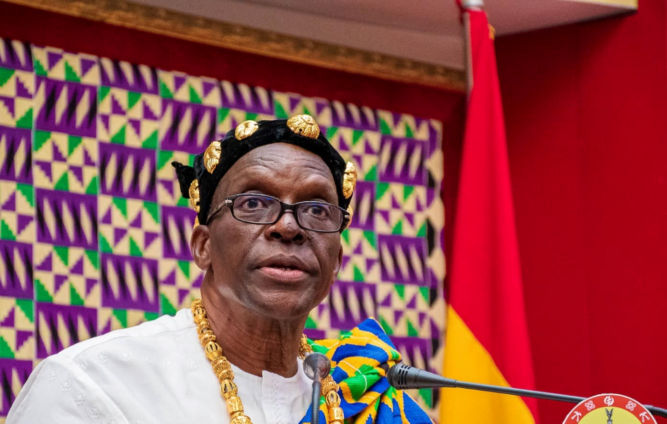
The Speaker of Parliament, Alban Bagbin, has delivered a powerful and critical assessment of the proposed 2026 Budget Statement, cautioning that the fiscal plan must serve as the primary catalyst for fundamentally transforming Ghana's economy and dismantling the nation's reliance on perpetual external financial support.
Speaking at a crucial Post-Budget Workshop in Accra on Saturday, November 15, attended by legislators and key financial stakeholders, the Speaker framed the budget not merely as an accounting document but as a decisive "roadmap for self-reliance and long-term growth."
His remarks come as Ghana faces continued pressure to stabilize its economy and enhance domestic resource mobilization.
In a pointed commentary directed at the core issue of fiscal policy implementation across the continent, Speaker Bagbin invoked a widely accepted critique of African governance, urging Ghanaian lawmakers to ensure the 2026 budget reflects sound management principles.
“A common refrain echoes across Africa: ‘Africa is not poor, it is poorly managed, and the budget is the clearest expression of that management.’ At this pivotal moment, our budget must serve as a primary instrument for transforming Ghana’s economic paradigm,” he said.
The statement implies that the 2026 Budget, which was presented by Finance Minister Dr. Cassiel Ato Forson on November 13, 2025 (as indicated in the budget document metadata), must be free of the structural weaknesses and political influences that have hampered previous fiscal policies.
Mr Bagbin stressed that the policy direction laid out in the 2026 fiscal plan must prioritize domestic resilience over dependency. Ghana's economy has historically struggled with external shocks, fluctuating commodity prices (like cocoa and gold), and high debt-to-GDP ratios, often necessitating bailouts and concessional lending from international bodies.
He urged the legislative body to scrutinize the budget’s provisions to ensure they actively foster internal economic drivers.
“The policies contained in this budget must steer us away from dependency towards a resilient, domestically driven economy. Honorable members, data tells a clear and urgent story. Reform cannot wait,” Mr Bagbin concluded.
The Speaker's warning serves as a call to action for Parliamentarians to rigorously analyze key budget components—including domestic revenue targets, local industrialization incentives, and expenditure management frameworks—to ensure the 2026 budget is truly the instrument of economic transformation that Ghana needs.
Latest Stories
-
WAEC Awards: PRESEC-Legon student grabs best business student prize
3 hours -
Bills Micro-Credit suspends officers over altercation with customer, hands them over to police
5 hours -
Court jails foreign national 5 years after GH¢1.9m & US$191k fake currency conviction
5 hours -
E.P. College of Education raises alarm over infrastructure deficit
5 hours -
Hamas urges key ally Iran to halt attacks on Gulf states
6 hours -
Trump urges UK and other nations to send ships to help secure Strait of Hormuz after Iranian attacks
6 hours -
Ken Ofori-Atta eyes US residency as Ghana seeks his extradition over corruption allegations
6 hours -
JoyNews’ Kwetey Nartey selected for 2026 Stigler Center Journalism Fellowship
7 hours -
Bills Micro-Credit probes viral altercation involving field officers and woman carrying baby
7 hours -
Ghana, Russia review bilateral ties, explore new areas of cooperation
8 hours -
Spintex Burglary: Police arrest suspect, recover stolen cash and valuables
8 hours -
Drug suspect arrested after attempting GH¢20,000 bribe to police in Tamale
8 hours -
Police arrest 10 suspects in anti-drug operation in Tamale
8 hours -
IRC Ghana, Ahafo RCC hold RLAP meeting on sustainable rural water infrastructure and management
8 hours -
Gov’t to ban gas cylinder importation – Energy Minister
9 hours