

Audio By Carbonatix
Parliamentary sittings are to be decentralised to offer ordinary Ghanaians an opportunity to deliberate and forge the nation’s future.
Subsequently, debates will no longer be between the Majority and Minority, but will involve district assemblies, local markets, chiefs’ palaces, schools and popular rendezvous in small communities, where “ordinary honorables” can own the national debate.
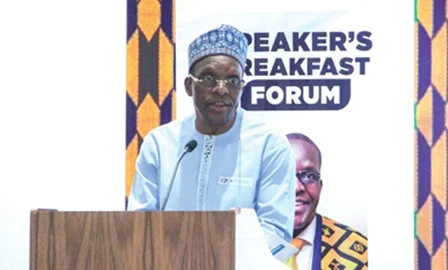
The Speaker of Parliament, Alban Sumana Kingsford Bagbin, announced this during this year's Speaker’s Breakfast Forum on "Parliamentary decentralisation: Taking Parliament closer to the people."
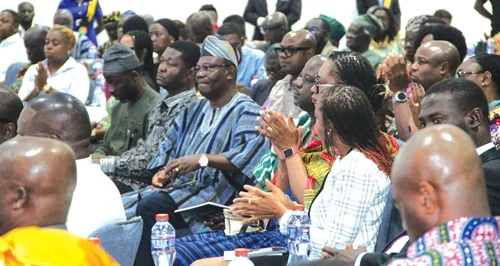
The meeting attracted people from all walks of life, including Members of Parliament (MPs), academia, security services, politicians, students and ordinary citizens.
Discussants at the forum believed that structures for engaging the locals already existed, but excessive partisanship had created a disconnect.
The common thread in their presentations was that an institution such as the National Commission for Civic Education (NCCE), if well resourced, could carry the information to the districts.
The discussants, a local government expert and Ghana's longest-serving Local Government Minister, Prof. Kwamena Ahwoi; President, Chamber of Local Governance, Dr Richard Fiadomor; Research Fellow, Institute of Local Government Studies, Dr Charity Dzradosi, and Executive Director, Parliamentary Network Africa, Sammy Obeng, suggested that first of all, citizens’ education and sensitisation should precede the replication of parliamentary work at the district level while MPs should not have overbearing powers over the assembly.
Dr Fiadomor, for instance, said structures at the local level already existed and that what needed to be done was to strengthen them to work seamlessly with their respective MPs.
Dr Dzradosi called for more enlightenment of citizens on what MPs’ clear mandates were.
For his part, Mr Obeng said the challenge MPs faced emanated from dabbling in service delivery rather than legislative work, and therefore, they tended to run away from their constituents when pressure was mounted.
Prof. Ahwoi, who crafted Ghana's decentralisation policy framework, brought a lot more clarity on the concept, especially the issue of electing assembly members on party lines.
To him, theoretically, it was feasible, but in practice, it could pose a lot of challenges.
The discussants said the legislative powers at the district level emanated from Parliament.
Unfortunately, MPs who were supposed to be ex officio members of the assembly hardly participated in any discussion because they did not have voting rights.
They, therefore, called for a realignment of the various segments to ensure that MPs played their dutiful roles in bringing the people closer.
Inclusivity
The Speaker said he would continue to champion inclusive participation by women, youth, the aged, the uneducated and marginalised groups.
"Their voices matter more than any other demographic segment.
A truly decentralised system is one where everyone has a seat at the breakfast table," he said.
Mr Bagbin said parliamentary decentralisation ensured that legislative and representative authority, administrative and oversight responsibilities, and our collective resources were equitably shared among national, regional, district and local bodies.
"It allows for sub-national law-making, deeper citizen participation, and more context-responsive governance, all within the bounds of our constitutional and legal framework.
"But decentralisation is not merely about proximity. It entails empowering local voices, enabling community initiatives and tailored solutions, and reinforcing the legitimacy of our democratic institutions," he added.
The Speaker said the physical absence of MPs from their constituencies, largely due to the demands of parliamentary duties in Accra, limited their ability to maintain continuous and meaningful engagements with the people.
"This disconnect can weaken trust and reduce the perceived legitimacy of democratic representation at the local level.
"Besides, in the absence of robust local governance structures, MPs are frequently expected to finance projects such as roads, schools, and health facilities,” he explained.
Mr Bagbin said that when legislative power was decentralised, oversight became more immediate, visible and tangible.
"Citizens can hold their local leaders directly accountable, promoting a culture of transparency and ethical governance," he added.
Initiatives
The Speaker said Parliament had created new departments such as Broadcasting, Public Engagements, Media Relations and Citizens Bureau, which were tasked to open doors of the house wider for ordinary citizens to enter.
Under the initiatives, Parliament now had a television network for the live broadcast of sittings and committee work.
Aside from the live broadcast, it also has live-streaming of sittings, the use of sign language to enhance participation by the hearing and speech impaired, the institution of Democracy Cup, Editors’ Forum and Time with Leaders.
It also has Parliament Connect, a virtual educational series that promotes public understanding of Parliament.
Among the initiatives is Citizens in Focus, a platform designed to amplify citizens’ voices within Parliament.
There is also Parliament Aayalolo, a structured outreach programme aimed at engaging citizens, groups, and associations on strategic national matters, and incorporating their perspectives into legislation.
Local languages
The Speaker also announced that nine local languages had been approved, together with MPs, to be rolled out on the floor for those who prefer to use them.
The languages are expected to be expanded to embrace more local dialects.
Latest Stories
-
FTBLRLIFE targets Ghana in expansion of global grassroots football network
26 minutes -
Former ‘American Idol’ contestant sentenced to life without parole for wife’s murder
2 hours -
Education Ministry commends Ghanaian teachers on World Teachers’ Day 2026
2 hours -
NPP can reconcile with aggrieved members who want to return – Nana Akomea
2 hours -
Tamale Child Deaths: Vehicle owner arrested as IGP deploys homicide team
3 hours -
From ShattaFest to MoMo Fest: Entertainment takes centre stage in youth engagement
3 hours -
Nigerian military aircraft crashes, killing 32
3 hours -
MTN encourages Ghanaians to use MoMo for saving, investing and financial planning
3 hours -
Absa Bank Ghana names Stephen Ato Frimpong as Board Chair
3 hours -
Pickford ‘almost caused crash’ with careless driving
3 hours -
Author and former politician Jeffrey Archer dies aged 86
3 hours -
No education reform can succeed without teachers – Education Ministry
3 hours -
Gauff condemns racist abuse after China Open win
4 hours -
Medvedev disqualified for hitting spectator with ball
4 hours -
Oliseh scores twice in late comeback win for France
4 hours