

Audio By Carbonatix
Limited resources for the health sector in Low and Middle Income Countries (LMICs) require the use of appropriate technologies and innovations to influence priority setting and guide coverage decisions in a bid to attain Universal Health Coverage by 2030.
Health Technology Assessment (HTA) allows a critical assessment of health technologies as a basis for making evidence-based decisions in the health sector.
The use of HTA in Ghana and Africa at large is low and therefore, the need for capacity building for efficient utilization of limited resources in the sector.
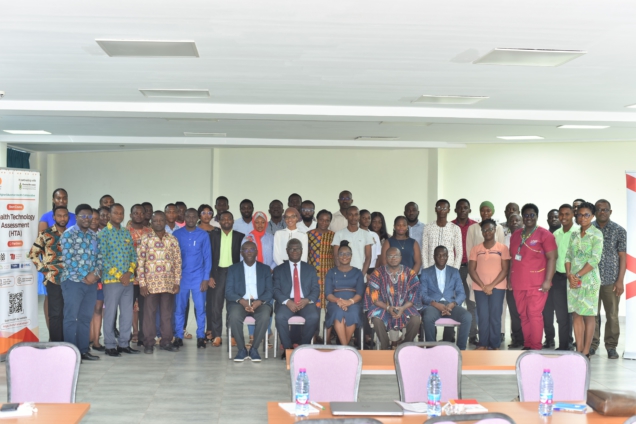
Thirty (30) healthcare professionals are therefore benefiting from a Health Technology Assessment short course by the KNUST Africa Higher Education Health Collaborative in partnership with the Mastercard Foundation.
The participants are health professionals, health managers, policy makers, civil servants and researchers working at the primary Health Care level in Ghana.
Prof. Anthony Edusei of KNUST School of Public Health who read the speech of the Principal Investigator of KNUST Africa Higher Education Health Collaborative, Prof. Ellis Owusu-Dabo, is optimistic the 5-day workshop will maximize the gains in the health sector.
“Through this critical assessment we can make evidence-based decisions, potentially contributing to appropriate and efficient use of resources, thus achieving value for money in respect of investments in health care provision.
“This modular short course is therefore being organized for healthcare professionals so that their capacity in the use and application of HTA at the Primary Health Care level can be enhanced,” he said.
The course is under the aegis of the Health Employment pillar of the Africa Higher Education Health Collaborative.
The pillar lead, Dr. Kofi Akohene Mensah, said the course has been accredited by various health professional bodies for Continuous Professional Development (CPD) points.

The partners in the workshop include: KNUST School of Public Health, The DAAD-PAGEL (German Academic Exchange Service Partnership for the Health Sector in Developing Countries) Accelerating Capacity-Building in Health Systems Research and Management in Africa Project, and the German-West African Centre for Global Health and Pandemic Prevention (G-WAC)
The rest are: The Department of Health Care Management at the Technische Universitat Berlin (TUB), Germany, the Norwegian Institute of Public Health, Norway, and the HTA Secretariat of the Ministry of Health, Ghana.
Latest Stories
-
Stonebwoy Can Do It: A call to unite behind 2026 BHIM Fest
3 minutes -
World Shea Expo returns to Tamale for 2026 edition
6 minutes -
Prioritise cocoa sector with better prices, timely payments-Annoh-Dompreh urges NDC
34 minutes -
Lands and Mines Watch Ghana endorses Heath Goldfields’ mining capacity
49 minutes -
Gbintiri residents protest alleged diversion of 24-hour market project
1 hour -
Justin Bieber headlines Coachella with nostalgia-fuelled set
1 hour -
Ukraine and Russia accuse each other of hundreds of ceasefire violations
1 hour -
Asha Bhosle: The sound of Bollywood dies aged 92
2 hours -
Fire destroys section of 4-bedroom apartment at Tantra Hill
2 hours -
Safe city: Unnoticeable protection
2 hours -
North East Regional Police Commander raises alarm over burning of checkpoints
2 hours -
Free Primary Healthcare Programme set for take-off — Health Ministry confirms readiness
2 hours -
3 co-wives, 5 children perish in canoe disaster – Maritime Authority insists life jackets use mandatory for all water transport
3 hours -
Iran war lands ‘triple blow’ to flood-ravaged Sri Lankans
4 hours -
Gunmen kill at least 11 people at Afghanistan picnic spot
4 hours